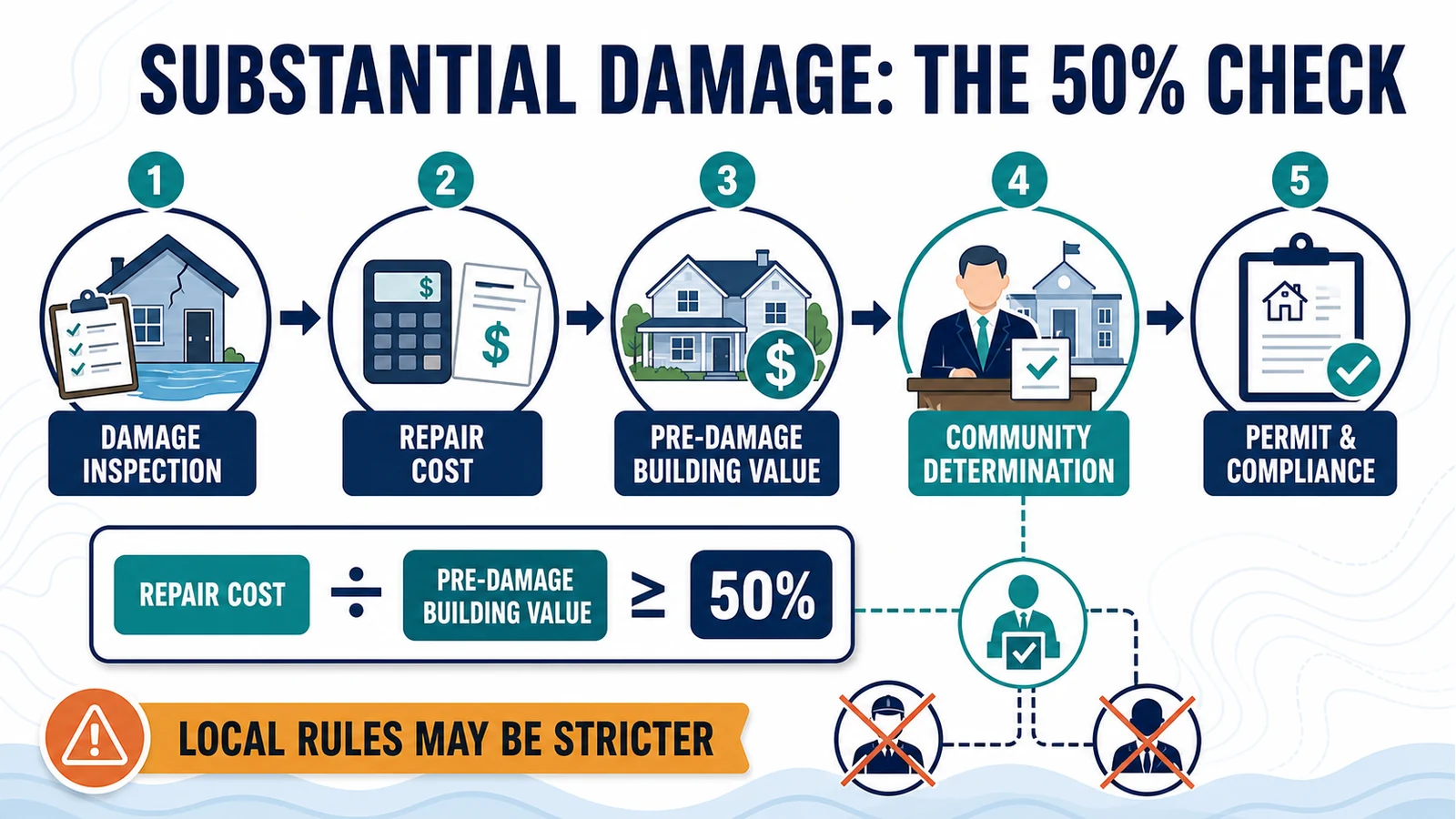
A substantial-damage determination is a local floodplain-management decision, not an insurance settlement. Under the National Flood Insurance Program minimum definition, a structure is substantially damaged when the cost to restore it to its condition before the damage equals or exceeds 50% of the structure’s market value immediately before the damage. The community’s authorized official makes the determination and may enforce a lower threshold, count damage or improvements cumulatively, or apply other higher standards. Before signing a repair contract or replacing walls, electrical systems, or finishes, ask the local floodplain administrator or building official for the ordinance, the calculation method, the required cost and value evidence, and written permission for any work that may begin.
This guide addresses owner-occupied buildings in the United States after a flood, with emphasis on properties regulated under an NFIP-participating community’s floodplain ordinance. It does not calculate an insurance claim, decide permit eligibility, interpret one jurisdiction’s law, or guarantee access to mitigation funding.
What the 50% comparison actually measures
The federal definition is in 44 CFR 59.1. It compares the cost of restoring the structure to its before-damaged condition with the market value of that structure before the damage occurred. The definition says damage may be of any origin. A flood is therefore one possible cause, but the same local provision can be triggered by fire, wind, impact, or another cause when the regulated building and ordinance conditions are met.
| Part of the comparison | What it generally means | What not to substitute automatically |
|---|---|---|
| Cost to restore | The reasonable cost to return the structure to its pre-damage condition, using the community’s required scope and costing method | The check already received, the owner’s available cash, or a plan to repair only part of the damage |
| Pre-damage market value | The value of the structure immediately before the damage, under the community’s accepted valuation method | The value of the land plus building, the mortgage balance, an online sale estimate, or the cost to build a brand-new home |
| Threshold | 50% under the NFIP minimum definition; equality counts | An assumption that 50.0% is still below the threshold or that every community uses exactly 50% |
| Decision maker | The community official authorized to administer the local floodplain rules | The insurer, adjuster, contractor, real-estate agent, FEMA map website, or this guide |
A simple illustration helps, but it is not a property determination. If the community accepts $120,000 as the complete cost to restore a building and $240,000 as its pre-damage structure value, the ratio is 50%. Under the federal minimum definition, that reaches the threshold. If either input changes after review, the result changes. Never use the example to replace the local worksheet or ordinance.
The community decision and the insurance claim are separate
FEMA’s Substantial Damage Quick Guide states that community officials are responsible for making substantial-improvement and substantial-damage determinations before structures are repaired or improved. An insurance adjuster may supply a damage estimate, and an insurer may use its own policy terms to settle a covered loss. Those records can be relevant evidence, but neither one automatically decides the local permit question.
- The local official decides: which ordinance applies, what must be included in the repair estimate, the accepted market-value method, whether the threshold is reached, and which permit conditions follow.
- The insurer decides: coverage, deductibles, depreciation, proof of loss, payment timing, and other questions under the policy.
- The contractor estimates: the work described in a proposal. A bid may omit concealed damage, owner-performed work, code items, or components the community requires in its full restoration scope.
- The owner documents and responds: preserve evidence, request the local method, submit complete records, correct errors promptly, and obtain written authorization before regulated work.
Do not wait for the insurance claim to close before contacting the permitting office. Do not assume an insurance payment below 50% means the building is not substantially damaged. The scopes, valuation dates, excluded items, and purposes can differ.
Build a complete repair-cost file
The numerator is not simply what you plan to spend. The question is what it would cost to restore the structure to its before-damaged condition under the method the community applies. FEMA’s current Substantial Improvement/Substantial Damage Desk Reference explains that communities may use applicant-supplied costs, community estimates, or a combination. Its model worksheet treats volunteer labor and donated supplies as value rather than zero-cost work.
Ask the official for the jurisdiction’s inclusion and exclusion list before revising estimates. A useful package usually separates demolition needed to reach damaged materials, structural work, walls and finishes, electrical, plumbing, heating and cooling, fixtures, built-in equipment, labor, materials, contractor overhead, and other required components. Contents such as movable furniture are not the structure, but local worksheets and building definitions control the line items. Photographs and moisture or engineering reports help establish scope; they do not set the price by themselves.
- Request itemized estimates with quantities, unit prices, labor, material, tax, and contractor markups shown rather than one lump sum.
- Identify owner labor, volunteer labor, donated material, and work already performed; ask how the community values each item.
- Separate restoration to the pre-damage condition from optional additions or upgrades, but let the official decide which costs enter the determination.
- Update the scope when hidden damage is discovered. An early field estimate is not necessarily the final permit record.
Use the building’s pre-damage value, not the whole property value
The denominator is the market value of the structure before the damage. Land value is not part of that structure value. The Desk Reference discusses methods such as an independent appraisal and an adjusted assessed value. A tax assessment may need an official adjustment factor because assessment levels and appraisal cycles vary, and a tax record that combines land and improvements must be separated.
Ask which valuation date, appraisal standard, assessor ratio, depreciation treatment, and documentation the community accepts. If the official used an assessed value that appears old or included land, request the worksheet and ask about the jurisdiction’s reconsideration process. Do not commission an appraisal until you know the required effective date, scope, credentials, and wording; an otherwise sound appraisal may not answer the local floodplain question.
Local and cumulative rules can reach the threshold sooner
Fifty percent is the NFIP minimum definition, not a promise that every address gets a one-event 50% test. FEMA’s Quick Guide notes that a community may adopt a stricter percentage, such as 45%, or add repairs over a stated period. Some jurisdictions track cumulative substantial improvement, cumulative substantial damage, or both. State building or floodplain requirements may also be more protective than the federal minimum.
Ask for the adopted ordinance section and its effective date. Then ask whether prior permits, previous damage, phased projects, work by a former owner, or simultaneous remodeling are counted. A current project that looks like 30% in isolation may be treated differently if the ordinance requires earlier work to be added. Conversely, do not assume a cumulative rule exists merely because another city uses one.
Take these steps before permanent repairs begin
- Address immediate safety. Follow emergency officials, shut off unsafe utilities, use qualified professionals for hazards, and prevent further damage where it is safe and authorized. Ask which emergency stabilization or cleanup work may proceed before a permit.
- Document before removal. Photograph each room, exterior elevation, water line, damaged system, and material before disposal when safety permits. Preserve inspection reports, receipts, samples requested by the insurer, and a dated work log.
- Contact the community. Find the floodplain administrator or building official for the property’s jurisdiction, not merely the nearest FEMA or disaster-assistance office.
- Confirm the regulatory setting. Identify the effective flood zone, base flood elevation when available, local design elevation or freeboard, and any state or locally mapped hazard. The FEMA map-by-address workflow can help collect the map reference, while the official confirms which record controls.
- Request the exact method. Obtain the ordinance, substantial-damage worksheet, cost inclusion list, accepted value methods, cumulative rule, submission deadline, and review or appeal procedure.
- Submit both evidence files. Provide the full restoration estimate and the accepted pre-damage building-value evidence with matching property identifiers.
- Get the result in writing. Keep the determination letter, calculation, permit conditions, approved plans, inspection schedule, and the name of the official who issued them.
Cleanup and drying can be urgent, but urgency does not erase permit rules. Ask for written direction that distinguishes debris removal, mold prevention, temporary stabilization, and permanent reconstruction. Starting permanent work too early can destroy evidence, conflict with an approved scope, or create an enforcement problem.
What happens when the result is below the threshold
A below-threshold result does not mean “no permit required” or “safe from future flooding.” The repair still must comply with the parts of the local building and floodplain rules that apply to the work. A post-FIRM building may need damaged components restored without creating a new noncompliance. Electrical equipment, utilities, materials, openings, foundations, and other elements may have specific requirements.
Keep the written calculation and approved repair scope. If the project expands, concealed damage changes the estimate, or the owner adds improvements, ask whether the determination must be updated. Do not split a single project into smaller permits to avoid review; communities may evaluate the complete work and may have cumulative rules.
What happens when the result reaches the threshold
When a regulated building is substantially damaged, the community applies the current floodplain standards to the repair or reconstruction. The exact outcome depends on the effective map, flood zone, building type, local design elevation, foundation, and higher standards. Under the NFIP minimum framework in 44 CFR 60.3, residential structures in mapped areas with base flood elevations generally must have the lowest floor elevated to the required level. Nonresidential structures may have an elevation or qualifying floodproofing route in some zones. Coastal high-hazard areas, floodways, manufactured homes, basements, and local freeboard rules add constraints.
The next plan may involve elevation, compliant reconstruction, relocation, demolition, or another approved mitigation path. It is not always a direction to demolish, and it is not an automatic promise that elevation is feasible. Use the FIRM and FIS base-flood-elevation guide to understand the map data, then have the local official state the required design elevation and documentation. If site work, fill, grading, or a floodway encroachment is proposed, review the floodplain permit and no-rise guide before design begins.
Ask for the calculation before challenging the decision
There is no single nationwide homeowner appeal form for every substantial-damage determination. Review, reconsideration, hearing, or appeal rights come from the applicable state and local rules. Deadlines may be short, and filing may not authorize repair work. Request the local procedure and written direction about what may happen while review is pending.
- Which ordinance section and threshold were used?
- Was the property evaluated under the effective map and correct jurisdiction?
- What repair scope, unit costs, labor values, and assumptions form the numerator?
- What valuation method, date, structure value, land exclusion, and adjustment factor form the denominator?
- Were prior damage or improvements added under a cumulative provision?
- What evidence may the owner submit, to whom, by what deadline, and does the reviewer require a specific appraiser or estimator qualification?
Focus a challenge on documented inputs or procedure rather than on the hardship caused by the outcome. A lower contractor bid is not necessarily contrary evidence if it omits work in the community’s restoration scope. An appraisal of the land and building together does not necessarily answer a structure-only valuation.
Insurance and mitigation funding require separate follow-through
If the building had NFIP building coverage and the damage was caused by a covered flood, ask the insurer promptly about Increased Cost of Compliance coverage. FEMA’s ICC policyholder processing checklist treats the ICC claim as separate from the direct property-loss claim and calls for a written substantial- or repetitive-damage determination from the local building official. Eligibility, covered activities, limits, deadlines, and documentation depend on the policy and facts; a local determination alone does not guarantee payment.
Keep the determination letter and ask the insurer what it needs before choosing elevation, relocation, demolition, or eligible nonresidential floodproofing. Disaster grants, local recovery programs, loans, buyouts, and charitable help have separate applications and selection rules. Do not commit to a project on the assumption that a program will reimburse it. The map-versus-insurance guide explains why a mapped hazard, a permit decision, and an insurance result are related but not interchangeable.
Keep one recovery file from inspection through closeout
- Address, parcel identifier, owner contact, occupancy status, and the exact building evaluated.
- Dated photographs, high-water evidence, safety inspections, engineering reports, and damage inventories.
- Insurance policy, claim correspondence, adjuster estimate, proof of loss, and payments, kept separate from the permit calculation.
- Contractor estimates, community cost worksheet, valuation documents, assessor adjustment, appraisal, and all revisions.
- Effective FIRM panel, Flood Insurance Study data, local design elevation, ordinance, cumulative history, and official correspondence.
- Determination letter, appeal or reconsideration record, permit, approved plans, inspections, change orders, and closeout documents.
If elevation or floodproofing documentation is required at design or closeout, use the Elevation Certificate source guide to identify the correct form and recipient. An Elevation Certificate can document elevations; it does not replace the community’s repair-cost and market-value determination.
After an insured flood, organize the claim record with the NFIP proof-of-loss submission guide, including damage evidence, itemization, the signed form, delivery confirmation, and any later supplement.
Questions homeowners ask after receiving a notice
Does a 49% result let me repair without a floodplain permit?
No. A below-threshold result answers only the substantial-damage question under the method used. Ordinary building and floodplain permits, component standards, cumulative rules, and other approvals may still apply.
Does the insurance adjuster’s estimate control the 50% calculation?
Not automatically. The community makes the floodplain-management determination. It may consider the adjuster’s estimate but require a different restoration scope, costing format, or supporting evidence.
Is the land included in pre-damage market value?
The FEMA determination framework uses the structure’s value, not land value. Ask how the community separates land from improvements and whether it accepts an adjusted assessment or requires an appraisal.
Can damage count even when it was not caused by flooding?
Yes. The federal definition says damage of any origin. Whether the provision applies to a particular building and what standards follow depend on the mapped area, local ordinance, cause, and other facts. This is different from insurance coverage, which depends on the insured peril and policy.
May I continue repairs while I request reconsideration?
Do not assume so. Ask the local official in writing which stabilization, cleanup, or repair work is authorized and whether the permit or review process pauses other work. An appeal filing does not itself create permission.
Does a substantial-damage notice mean the house must be demolished?
Not by itself. It means the regulated repair or reconstruction must meet the applicable current standards. Elevation, compliant reconstruction, relocation, demolition, or another path may be considered depending on the building, site, ordinance, engineering, funding, and owner’s plan.
The federal definitions, current eCFR criteria, FEMA Quick Guide, FEMA Desk Reference, and ICC checklist were checked on July 29, 2026. Recheck the current state and local ordinance after any design or scope change. FloodMapCheck provides official-source routing and practical interpretation; it is not FEMA, the community’s permitting authority, an insurer, an engineer, an appraiser, or legal counsel.
Related insurance and compliance checks
- How to File an NFIP Increased Cost of Compliance Claim After Flood Damage — A written community substantial-damage or qualifying repetitive-loss determination may trigger an ICC Coverage D review within the same flood-event claim.