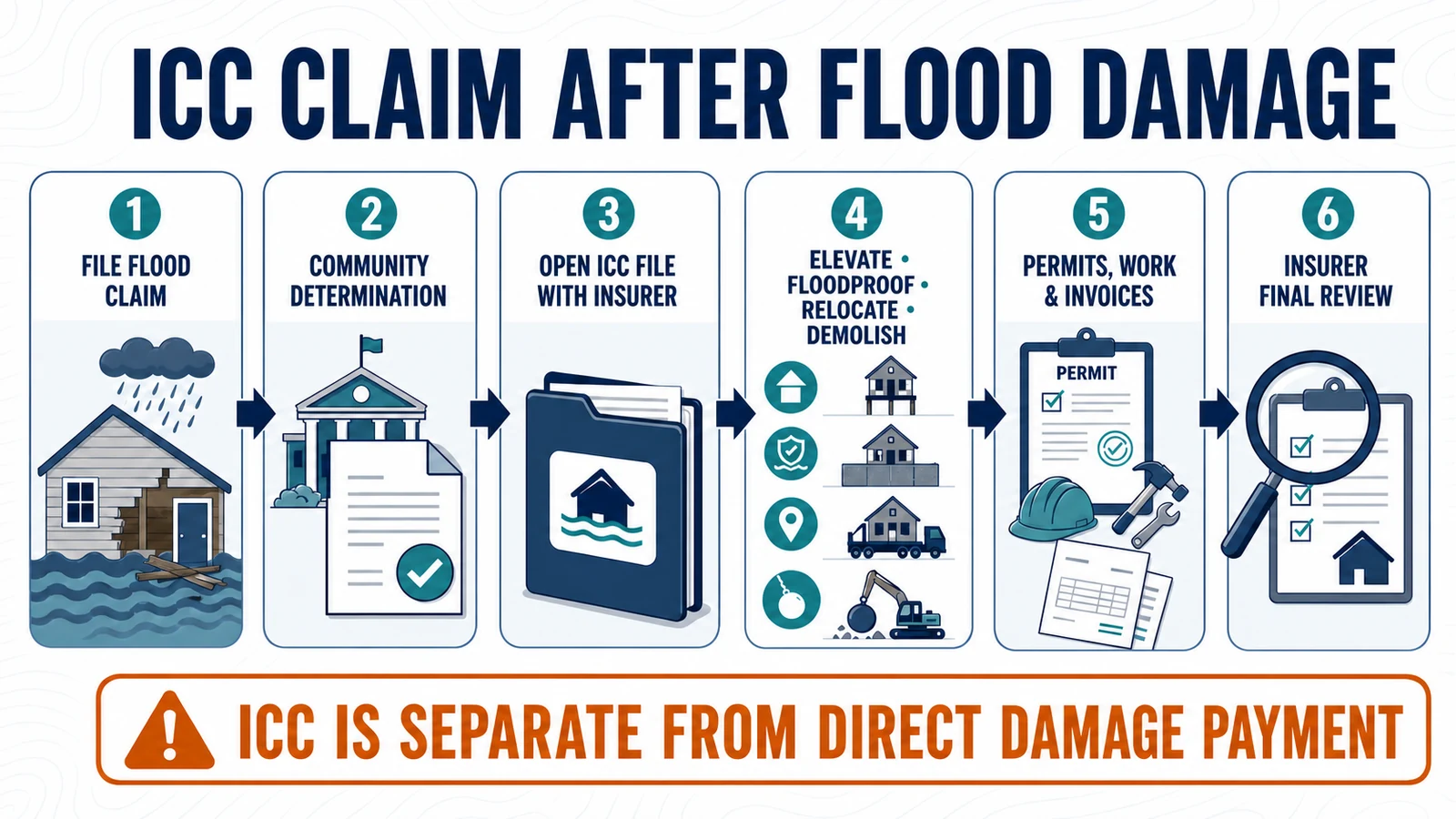
An NFIP Increased Cost of Compliance request can begin when a flood-damaged insured building is subject to a written community determination that requires it to meet current floodplain rules. Send that letter to your NFIP insurer immediately, ask the claims representative to open the Coverage D track, and get the required permit and insurer document list before mitigation work begins. ICC can help with eligible elevation, relocation, demolition, or floodproofing costs; it does not replace the payment for direct flood damage and it does not guarantee the advertised maximum.
Send the community letter before mitigation work starts
Start the underlying flood claim with the insurance provider as soon as possible. At the same time, contact the official who administers the local floodplain ordinance—often the floodplain administrator, building official, or permit office—and ask whether the building will receive a substantial-damage or repetitive-loss determination. The adjuster can identify possible ICC coverage, but the adjuster does not issue that local determination.
FEMA’s June 2025 NFIP Claims Manual says an insurer may open the ICC process after receiving the community’s written declaration. It also warns that beginning a mitigation project before the declaration may jeopardize payment. That warning concerns permanent compliance work. It is not a reason to ignore emergency safety orders, remove health hazards, or prevent further damage. Photograph conditions first when it is safe, tell the adjuster what must be done, and obtain written guidance from the local official before permanent rebuilding or mitigation begins.
- Report the flood loss and save the claim number, policy number, date of loss, adjuster contact, and insurer claims address.
- Request the community’s written damage determination and the ordinance section being enforced.
- Send the complete letter to the insurer and ask for written confirmation that the ICC review has started.
- Ask the insurer for its ICC proof-of-loss instructions, document checklist, available Coverage D amount, and all due dates that apply to this loss.
- Do not begin the permanent compliance project until the local permit and insurer requirements are clear.
Coverage D follows a different track from the building-damage payment
The direct building claim pays covered physical damage caused by flood under Coverage A. Coverage D addresses eligible additional costs imposed by a current state or local floodplain law after the qualifying flood loss. The Coverage D paperwork and adjustment follow a distinct track, but the policyholder has only one claim from the flood event. FEMA’s current manual explains that the ICC proof of loss requests Coverage D benefits under that same claim; it is not a separate claim. In practice, keep two labeled document folders and ask the insurer to identify which request each payment or denial addresses.
| Question | Coverage A building-loss track | Coverage D ICC track |
|---|---|---|
| What starts it? | Reported direct physical loss by or from flood during the policy term | Written community determination and a requirement to comply, plus the insurer’s coverage review |
| What can it pay? | Covered repair or replacement of insured building property, subject to the policy | Eligible costs of an approved elevation, relocation, demolition, floodproofing, or combination |
| Who makes the key decision? | The insurer decides coverage and payment; the adjuster investigates and recommends | The community decides local damage status and compliance; the insurer decides ICC eligibility and payment |
| What proves the amount? | Damage documentation, scope, estimate, and proof of loss | Community letter, ordinance or permit, itemized mitigation estimate, ICC proof of loss, and completion evidence |
| Can the same cost appear twice? | No. ICC cannot duplicate an allowance already paid or considered under the underlying flood claim. | |
A local requirement to elevate a building does not turn every elevation expense into an insured ICC cost. Likewise, a direct building claim can be payable even when ICC is not. Ask the examiner to separate covered flood repair, uncovered repair, and eligible compliance cost line by line.
The community decides damage status; the insurer decides Coverage D
The authorized community official has sole authority to make the local substantial-damage determination. FEMA’s claims guidance says neither FEMA nor the insurer substitutes for that land-use decision. The official applies the community’s adopted law, identifies the compliance requirement, issues permits, inspects the completed project, and supplies a compliance letter or occupancy document when appropriate.
The insurer then tests the request against the Standard Flood Insurance Policy and FEMA claims guidance. A community letter is therefore necessary in the usual ICC path, but it is not a payment approval. The insurer verifies that the building and policy are eligible, that the flood component satisfies the Coverage D trigger, that the proposed work is an eligible measure, that the cost is documented, and that money remains available under the applicable policy and statutory limits.
If the letter only says “substantially damaged” without stating the enforced requirement or usable supporting values, ask the official whether an amended or supplemental letter is available. Use the site’s substantial-damage determination guide to organize the repair-cost and pre-damage building-value records, but rely on the community’s actual written decision for the property.
Substantial damage and repetitive loss require different evidence
Most owners encounter ICC after a substantial-damage letter, but the SFIP also has a repetitive-loss route when the community has adopted and is enforcing the required cumulative or repetitive-loss provision. Do not assume that a history of several floods is enough by itself.
| Possible route | Community record | What the insurer still verifies |
|---|---|---|
| Substantial damage | Written determination requiring the building to comply with the applicable floodplain law or ordinance | For ICC, flood damage must reach the percentage threshold enforced by the community—normally 50%, or a lower adopted threshold—even if the community’s broader decision considered multiple perils |
| Repetitive loss | Written determination under an adopted and uniformly enforced cumulative substantial-damage or repetitive-loss provision | The SFIP loss-history test, including qualifying flood losses within the stated period, repair-cost percentages, and the required prior NFIP claim payment |
| FEMA-supported higher or advisory elevation | Written ordinance-based requirement using adopted FEMA advisory, preliminary, work-map, or best-available flood data | Whether the exception applies to the zone and property and whether the enforced standard is supported by FEMA data rather than a locally derived elevation alone |
The current Claims Manual describes the repetitive-loss test as two flood-damage occasions during a 10-year period ending with the second loss, with the repair cost meeting the policy percentage test for each event and the prior qualifying NFIP claim paid. Because local cumulative rules can be stricter or structured differently, give the insurer the full claim history and the exact ordinance language instead of calculating eligibility from memory.
Coverage D is tied to state or local floodplain requirements that meet the NFIP minimum standards in 44 CFR 60.3, with limited policy rules for certain higher standards. That federal section does not tell an owner which permit design the local official will approve. Obtain the adopted ordinance and property-specific requirement rather than treating the federal minimum as the complete local code.
ICC is ordinarily tied to an eligible building insured under Coverage A in a Regular Program community. Contents-only coverage, a condominium unit policy, a Group Flood Insurance Policy, an appurtenant structure, or an Emergency Program policy does not become eligible simply because a local official requires work. Verify the legal jurisdiction and program status with FEMA’s records using the NFIP community-status workflow, then let the insurer determine the policy-level result.
Choose only a mitigation measure the ordinance and policy recognize
Coverage D recognizes four compliance activities, individually or in combination. The community must accept the project and the insurer must accept the documented cost. A contractor’s preferred scope is not enough.
- Elevation: raising the insured building to the height required by the enforced floodplain standard, including adopted freeboard where applicable. ICC does not automatically pay to go higher than the minimum required height.
- Relocation: moving the insured building to a compliant location. Moving a shed, detached garage, fence, or another structure is not covered merely because it is on the same parcel.
- Demolition: demolishing the insured building and clearing eligible building debris and necessary utility connections as required by the ordinance.
- Floodproofing: principally a nonresidential option. FEMA recognizes a narrow residential exception for qualifying buildings with basements that meet 44 CFR 60.6(b) or (c). Ordinary residential dry floodproofing should not be assumed eligible.
For an elevation or floodproofing design, confirm the enforced Base Flood Elevation, freeboard, and zone before the contractor prices the work. The FIRM and Flood Insurance Study BFE workflow helps identify the official map evidence, while the local official decides which elevation applies to the permit.
Build the ICC file before construction begins
FEMA’s current ICC Policyholder’s Processing Checklist gives the practical sequence. Ask the insurer whether any additional form, bid format, photograph, certification, or signature applies to the chosen activity.
- The complete community substantial-damage or repetitive-loss determination on official letterhead.
- The applicable floodplain ordinance section or a determination letter that states the specific standard being enforced.
- A current floodplain development or building permit for the selected compliance measure. A permit should be valid, dated, and unexpired before construction starts.
- A detailed, signed contractor agreement and itemized estimate. A lump-sum total prevents the examiner from separating eligible mitigation cost from ordinary repair, upgrades, or additions.
- A contractor schedule with expected dates if an advance is requested.
- Before-work photographs and progress photographs that connect the insured building to the proposed measure.
- An Elevation Certificate for an elevation project or the applicable design and floodproofing certification for an eligible floodproofing project.
- The insurer-provided ICC proof of loss, signed and returned with the supporting amount documentation.
Do not assume that the permit issued for ordinary repairs authorizes the ICC mitigation measure. The community may require a distinct floodplain review. The site’s floodplain development permit guide explains why a permit and a no-rise certificate answer different questions; most ICC projects will not need a no-rise certificate unless work affects a regulated floodway.
Know who supplies each part of the record
| Party | Primary ICC responsibility | Record to request |
|---|---|---|
| Community official | Damage determination, ordinance requirement, permit review, and completion inspection | Determination letter, ordinance or standard, permit, compliance letter or occupancy document |
| NFIP insurer or claims examiner | Coverage decision, available amount, proof-of-loss handling, advance decision, and final payment | Written checklist, due dates, ICC proof of loss, payment or denial explanation |
| Flood adjuster or ICC representative | Investigation, estimate review, documentation guidance, and recommendation to the insurer | Contact details, missing-document list, claim-status notes |
| Contractor and design professionals | Itemized compliant scope, schedule, construction, certifications, and invoices | Signed estimate and contract, plans, schedule, invoices, receipts, professional certificates |
| Policyholder | Notice, document delivery, signatures, recordkeeping, permit coordination, and proof that funds were used as agreed | Submission log, copies of every signed form, dated photos, payment evidence |
The adjuster can help prepare and organize the request, but FEMA’s claims guidance says only the insurer may approve or deny coverage or promise a payment amount. Ask for decisions from the insurer, not a contractor’s or adjuster’s informal prediction.
An ICC advance is conditional, not automatic
Under the SFIP language, ICC is normally payable after eligible work is complete. FEMA’s June 2025 Claims Manual describes a conditional waiver that lets an insurer approve an advance of up to 50% of the available ICC amount when the supporting documents and a signed ICC proof of loss are provided. “Up to” is a ceiling, not a promise. If the full current $30,000 Coverage D limit is available, one-half is $15,000; if only $10,000 remains available, the maximum under that percentage would be $5,000. The insurer may approve a lower amount or decline the request based on the file.
The written advance request should identify the eligible work, requested amount, contractor, and schedule. The policyholder must agree to use the money only for eligible ICC work and to return funds not used within the permitted completion period. Keep the advance in a traceable account, save invoices and cleared-payment records, and notify the insurer before changing the approved scope.
The advertised $30,000 is also not automatically available in addition to every building payment. The October 2025 NFIP Flood Insurance Manual and current Claims Manual explain that Coverage A and Coverage D together cannot exceed the statutory maximum for the applicable policy form. Ask the examiner to show the amount remaining after the direct building payment.
Final payment follows completed and verified work
Completion alone is not enough. The community must inspect or otherwise verify that the project complies with the enforced floodplain standard. The insurer must then receive the final records required for the chosen measure before it sends or processes the final ICC proof of loss and remaining payment.
- Obtain the community’s mitigation-compliance letter, certificate of occupancy, or other accepted completion record.
- Collect the final itemized invoices, contractor proof of payment, and before-and-after photographs.
- For elevation or relocation, submit the required completed Elevation Certificate and building photographs. Use the Elevation Certificate source guide to identify the right document, but ask the insurer and community which version and certification they require.
- For eligible floodproofing, submit the required professional certification and photographs of the installed measures.
- Review the final ICC proof of loss against the approved eligible cost, sign it, and return it to the insurer at the address and by the date provided.
If the project cost exceeds the available ICC amount, the policyholder remains responsible for arranging other funding. A FEMA mitigation grant, disaster assistance, loan, local program, and ICC are separate sources with separate eligibility and duplication-of-benefits controls.
Keep the proof-of-loss and project clocks visible
Timing mistakes can defeat an otherwise well-documented request. FEMA’s current NFIP Claims Handbook tells policyholders to notify the insurer immediately after receiving the community notice, sign a separate ICC proof of loss within 60 days of the community letter, and complete qualifying ICC work within six years of the underlying flood date. Treat the 60-day deadline as controlling unless the insurer identifies a written FEMA extension that applies to the event. The June 2025 Claims Manual also tells adjusters to check disaster-specific bulletins that may extend a completion deadline.
Do not treat the six-year work period as permission to delay notice or proof-of-loss paperwork. It is the default FEMA completion period described by current guidance, not a substitute for permit expiration dates, contractor milestones, a grant schedule, or the insurer’s document requests. The current Claims Manual says that after six years the insurer must secure an ICC Proof of Loss Waiver before paying any benefit; do not assume a waiver or disaster-specific extension will apply. The ordinary direct-loss proof-of-loss clock is also distinct. Ask the insurer to put every applicable date in writing and confirm whether FEMA issued an extension for the specific flood event.
ICC does not pay every cost created by rebuilding
FEMA’s official ICC coverage page describes Coverage D as help with qualifying compliance work, not a complete reconstruction budget. The insurer must remove expenses outside the policy even when the local building code requires them.
- Direct repair of flood-damaged floors, walls, finishes, appliances, or contents belongs in the appropriate underlying coverage analysis, not automatically in ICC.
- ICC cannot duplicate a cost already allowed under the building-loss payment.
- Unrelated plumbing, electrical, energy, accessibility, or general code upgrades are not covered merely because they occur during the same project.
- Additions, remodeling, extra square footage, aesthetic upgrades, deterioration, and rot are not eligible compliance costs.
- Pollutant testing, monitoring, cleanup, removal, treatment, or assessment is excluded even when an ordinance addresses it.
- Loss of market value, the residual value of an undamaged portion demolished, landscaping, detached structures, garages, and carports are not converted into ICC benefits by a local order.
- Work required before the current flood loss, work below NFIP minimum standards, and unauthorized work completed before the determination can fail the Coverage D test.
Have the contractor separate eligible mitigation work, ordinary flood repair, elective upgrade, and other-code work in the estimate. That division gives the insurer something it can actually review.
If the ICC request stalls or is denied
Ask the insurer for a written explanation that identifies the exact missing condition, excluded cost, or policy provision. A vague statement that the project is “not eligible” does not tell you whether the problem is the community letter, flood-damage percentage, policy form, available limit, permit, estimate, proof-of-loss timing, or completed-work evidence.
- Compare the denial with the determination letter and the ordinance being enforced.
- Ask the community to correct factual omissions in its record; do not ask it to promise insurance coverage.
- Ask the examiner whether a revised itemized estimate, permit, certificate, photograph set, or proof of loss would cure the issue.
- Preserve the first denial letter and every submission receipt. FEMA’s official claim-appeal page states that an appeal must be filed within 60 calendar days of the date on the denial letter and that an appeal does not extend the one-year period to file suit.
Appeal and litigation deadlines affect legal rights. Use the current FEMA instructions and obtain qualified advice when needed; this guide cannot determine whether a denial is correct or preserve a deadline for you.
After an insured flood, organize the claim record with the NFIP proof-of-loss submission guide, including damage evidence, itemization, the signed form, delivery confirmation, and any later supplement.
Questions owners ask while the ICC file is open
Does a substantial-damage letter guarantee an ICC payment?
No. The letter establishes the community’s compliance decision and starts the usual ICC review. The insurer must still verify the flood-damage trigger, policy and building eligibility, proposed measure, documents, costs, deadlines, and available Coverage D amount.
Can I receive the full $30,000 in addition to my building limit?
Not necessarily. Current FEMA guidance describes Coverage D as up to $30,000, but the available amount can be lower because Coverage A and Coverage D together cannot exceed the statutory maximum for the policy form. Ask the insurer for the written calculation after the direct building payment is known.
Can an adjuster approve the ICC claim?
No. The adjuster investigates, estimates, explains the process, and makes a recommendation. Only the insurer approves or denies coverage and payment. The community official separately decides the local damage and compliance status.
Can a homeowner use ICC for dry floodproofing?
Usually not. FEMA treats floodproofing primarily as a nonresidential measure and recognizes only narrow residential exceptions for specifically authorized conditions and communities. Do not sign a residential floodproofing contract until both the local official and insurer confirm eligibility in writing.
What happens if the mitigation project changes after approval?
Stop and send the revised scope, permit, price, and schedule to the community and insurer before doing the changed work. A different elevation, footprint, location, contractor scope, or mitigation method may alter compliance and eligible cost.
Can I assign ICC money to my contractor or a buyer?
As a general rule, no. FEMA allows a narrow assignment to the eligible community when ICC is used with a qualifying FEMA-sponsored or certain HUD mitigation grant. Use FEMA’s Assignment of Coverage D form and insurer instructions; do not rely on a private contract to transfer the benefit.
The safest sequence is letter, coverage review, permit, work, inspection, payment
Treat the ICC file as a chain in which each party supplies a different proof. The community letter establishes the local obligation, the insurer confirms Coverage D, the permit and itemized contract define eligible work, the contractor and professionals document performance, and the community’s final inspection closes the compliance loop. Save the exact version of every document and a dated submission log. FloodMapCheck can help organize the official records, but only the community and NFIP insurer can make the property-specific decisions.