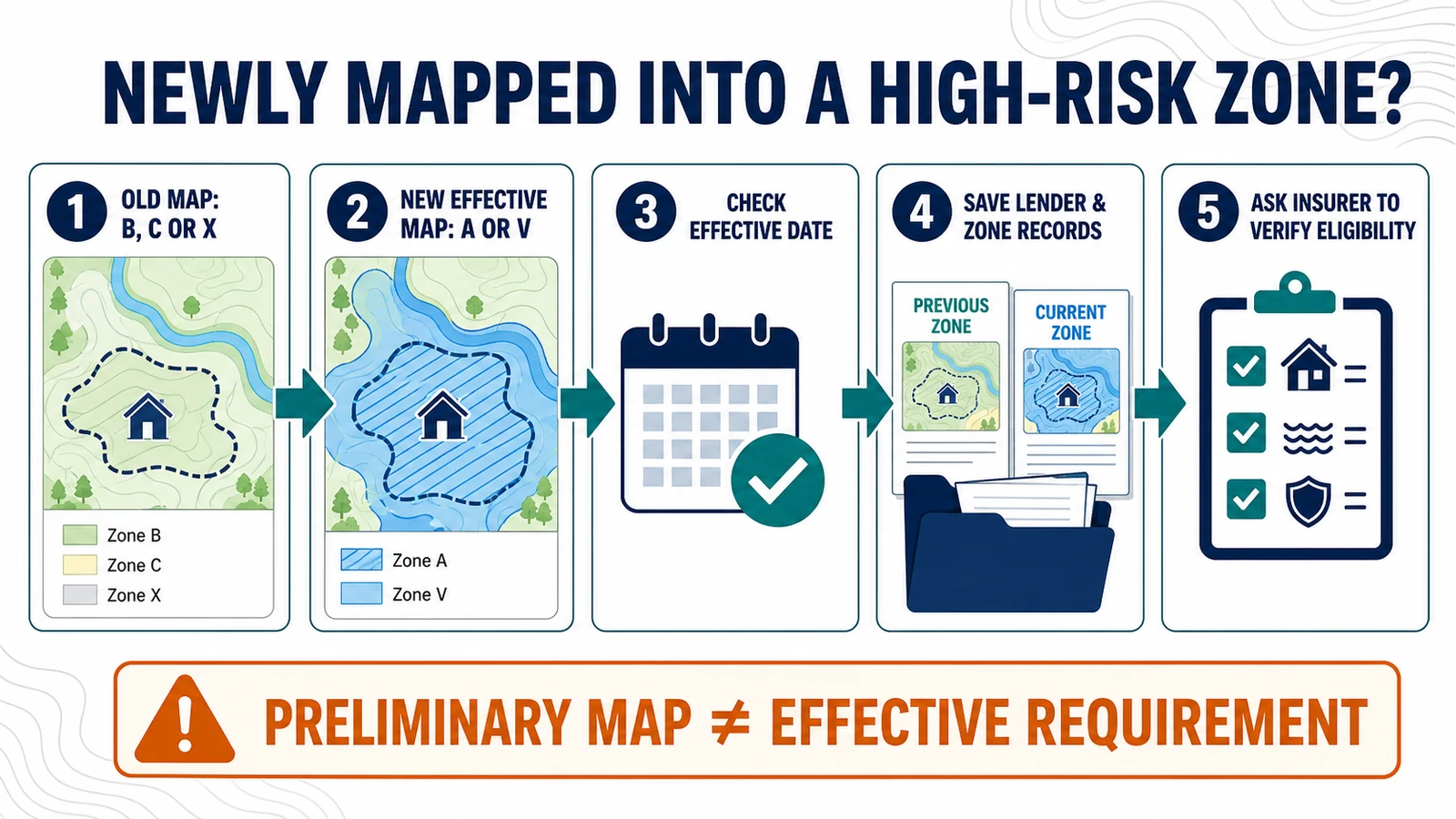
If FEMA’s revised effective map places your building in a Special Flood Hazard Area, record the map’s effective date before doing anything else. Ask the lender for its Standard Flood Hazard Determination, compare the previous and current effective FIRMs at the building location, and send both the insurance agent and lender the same evidence. A government-backed or federally regulated mortgage may trigger a flood-insurance requirement, and an NFIP policy may qualify for the Newly Mapped discount, but neither result is automatic. Preliminary mapping, policy pricing, lender requirements, and FEMA map-change decisions follow different rules.
Last checked: July 29, 2026, against FEMA and NFIP materials, including the October 2025 NFIP Flood Insurance Manual. Map status, program rules, policy forms, and lender decisions can change. Confirm the dates and property-specific outcome with the community floodplain administrator, lender, and insurer.
First confirm whether the new map is preliminary or effective
A proposed zone shown in a public meeting, mailed community notice, or online comparison tool may not yet be the zone that controls the federal mandatory-purchase decision. FEMA’s Flood Map Changes Viewer instructions say Preliminary and Pending National Flood Hazard Layer data are for awareness, review, and guidance and cannot be used for flood-insurance policy rating or mandatory flood-insurance purchase requirements. The current effective FIRM remains the controlling map for those federal purposes until the revision becomes effective.
That does not make preliminary data irrelevant. It gives an owner time to verify the proposed boundary, ask about the formal appeal period, obtain insurance quotes, and plan for a possible lender notice. A community may also use best-available data or adopted higher standards for development decisions, and a lender can impose a contractual insurance condition beyond the federal minimum. Ask each party which authority and map date it is using rather than assuming one rule controls every decision.
| Map status | What it tells you now | What to do |
|---|---|---|
| Preliminary | A proposed hazard designation that remains subject to review and change | Compare it with the effective map, verify the appeal dates through the community, and prepare before the stated effective date |
| Pending | Final mapping delivered before it becomes effective | Record the future effective date and complete lender and insurance preparation |
| Effective | The FIRM used for current federal mapping, lender, and NFIP eligibility decisions | Save the panel, suffix, effective date, zone, and any applicable LOMC; respond to the lender and insurer promptly |
Use the FEMA Map Service Center to retrieve the effective map and available historic or preliminary products. The site’s address-to-effective-FIRM workflow explains how to preserve the panel number, suffix, effective date, and zone without mistaking a general web-map point for a final building determination.
Build a before-and-after record for the exact building
“Newly mapped” is a map-history conclusion. A current Zone AE label alone does not prove that the property moved from outside the SFHA, when the change happened, or whether the building qualifies for an insurance discount. The insurer must be able to verify the previous designation and the current one. Location matters at the building footprint, especially where a zone boundary crosses a large parcel or runs close to a structure.
- Save the property’s legal address, parcel identifier, and the location of the insured building.
- Download or identify the previous effective FIRM panel, suffix, effective date, and zone at the building.
- Do the same for the revised effective FIRM, including the exact revision effective date.
- Keep any lender notice, Standard Flood Hazard Determination Form, policy declarations, elevation documentation, and FEMA Letter of Map Change.
- If the line is close, ask what additional survey or community documentation the insurer or lender will accept before ordering it.
The October 2025 NFIP Flood Insurance Manual lists several ways an insurer may document the previous and current zones: a Special Flood Hazard Determination Form, an effective flood map marked with the building location, a signed local-official letter, an Elevation Certificate from an authorized professional or official, a LOMA, or a LOMR. FEMA may require more documentation near a boundary. Ask the insurer which item is needed for this application; submitting a map screenshot does not force acceptance.
The map, the lender, and the premium answer separate questions
The most common mistake is to treat “Zone AE” as a single decision that sets the loan requirement, insurance price, and map accuracy. It does not. FEMA publishes the effective hazard map. The lender or its determination provider identifies whether the building securing the loan is in an SFHA and applies the loan rules. The insurer verifies NFIP eligibility, coverage, effective date, and price.
| Question | Responsible record or party | What the answer does not prove |
|---|---|---|
| Is the building shown in an SFHA on the current map? | Effective FIRM, valid LOMCs, community records, and property-location evidence | It does not calculate the premium or decide a disputed building location by itself |
| Is flood insurance required for this loan? | Lender’s determination, loan type, applicable federal rules, and loan contract | An SFHA map label does not show every loan fact or private contractual requirement |
| Does this policy receive a Newly Mapped discount? | NFIP insurer’s verification under the current manual | Being in a newly effective A or V zone does not guarantee eligibility |
| What will coverage cost? | Property-specific quote and policy rating inputs | The zone change alone does not state the full-risk premium |
FEMA’s Risk Rating 2.0 guidance says lenders continue to use current effective FIRMs for mandatory-purchase decisions, while premiums reflect multiple building and flood-risk characteristics rather than the flood zone and base flood elevation alone. A revised zone can therefore change a lender requirement without producing a simple, predictable premium change. Obtain a written quote instead of applying a zone-based percentage to an old premium.
A lender notice is not the same as an insurance quote
The federal mandatory-purchase rule generally applies to a designated loan secured by a building or mobile home in an SFHA where flood insurance is available through an NFIP-participating community; a regulated lending institution applies the rule when it makes, increases, extends, or renews the loan. Federal agency and government-backed loan programs can have related requirements or restrictions. FEMA’s Flood Insurance 101 guidance summarizes the consumer-facing rule. A lender may also require coverage under its loan documents even when the federal mandate does not apply or the building is outside the SFHA.
Ask the lender for the completed determination, not only a payment demand. Confirm the building address, census or community information, map panel and suffix, effective date, flood zone, and whether a valid LOMA or LOMR was considered. The Standard Flood Hazard Determination Form guide shows how to read the form and route a location or map-version dispute. Do not ignore the deadline while investigating; ask the lender in writing what coverage and evidence it needs, and whether its deadline changes during review.
What the Newly Mapped discount actually requires
The Newly Mapped discount is an NFIP rating provision, not a general promise for every owner whose zone becomes higher risk. Under the current manual, a property may be eligible when it was previously shown in Zone B, C, or X and a map revision places it in an SFHA. The manual also includes a property previously shown in Zone D, A99, or AR that is newly mapped into a different SFHA zone. It does not apply when the property enters the SFHA on the community’s initial FIRM, and buildings or contents in Emergency Program communities are ineligible.
Timing is another gate. The manual states that a property newly mapped into an SFHA after April 1, 2015 may be eligible when the policy effective date is within 12 months of the effective FIRM revision date. It also provides a lender-notification route: the policyholder applies within 45 days of the initial lender notice when that notice occurred within 24 months of the effective revision date, and the insurer retains the notice. Those dates are not a self-service approval. Give the actual documents to an NFIP insurer and ask for a written eligibility explanation.
FEMA’s December 2025 Newly Mapped guidance for agents describes the current discount as 70% on the first $35,000 of building coverage and the first $10,000 of contents coverage. That is not a 70% reduction of the entire policy premium, and it does not guarantee a particular dollar price. The provision phases out as the policy moves toward its full-risk premium, subject to applicable annual limits. Coverage amounts, deductibles, building characteristics, loss information, fees, other discounts, and current program rules can affect the quote.
| Eligibility item to verify | Evidence to preserve | Why it can fail |
|---|---|---|
| Prior effective zone | Historic effective FIRM, accepted SFHDF, official letter, EC, LOMA, or LOMR | The prior map already showed an SFHA, or the building location is not established |
| Current effective zone | Revised effective FIRM and valid LOMCs | Only preliminary data was supplied, or the wrong panel or structure was used |
| Revision type | Initial-FIRM date and revision effective date | The SFHA designation came from the community’s initial FIRM |
| Policy timing | Application, payment, policy effective date, and map effective date | The applicable timing window was missed |
| Lender-notice route | First written lender notice and proof of application date | The notice or application falls outside the manual’s time limits |
| Community and policy status | NFIP community status and insurer underwriting file | The community or policy does not meet current NFIP requirements |
Policy timing has more than one clock
Do not confuse the discount deadline with the waiting period. The Newly Mapped discount generally looks to a policy effective date within 12 months of the FIRM revision, subject to the lender-notification path described above. Separately, the current NFIP guidance describes a map-revision exception to the usual 30-day waiting period: a qualifying new policy or endorsement that adds or increases coverage can use a one-day waiting period when the insurer receives the Application Form (or endorsement request) and full amount due within 13 months after a revision newly identifies the building in an SFHA. A policy bought in connection with making, increasing, extending, or renewing a covered loan may have a different loan exception.
The plain-language FloodSmart policy-purchase page summarizes the standard 30-day wait and its exceptions. Ask the insurer to state the application date, payment date, policy effective date, and the exception it applied. Buying a policy during threatening weather does not backdate coverage, and the Standard Flood Insurance Policy does not cover a flood already in progress when coverage begins.
- Write down the revised FIRM effective date.
- Save the first lender notice and its delivery date.
- Ask the agent when the application and full payment must be received.
- Confirm the proposed policy effective date before paying.
- Keep the application, receipt, declarations, and any eligibility documentation together.
Keep prior and continuous coverage records
If the building already has an NFIP policy, do not cancel it merely because a new quote is pending or the lender has not yet sent a notice. Prior coverage can help establish the record, and renewal timing may matter. FEMA’s flood-map update guidance for agents states that continuous coverage is required to maintain the Newly Mapped discount. The current manual says a policyholder generally loses the discount if a policy receiving it lapses and the same applicant later seeks it again for the building. Its narrow community-suspension exception requires reinstatement within 180 days after the community is reinstated in the NFIP.
A prior NFIP lapse while the policy was not receiving the Newly Mapped discount does not by itself bar later eligibility under the current manual, including when the lapse occurred before the property was newly mapped. A sale can also involve policy-transfer questions. Do not assume the old declarations page automatically transfers the discount or the policy. Give the insurer the policy number, expiration date, named insured, ownership-change date, and closing date, then ask how renewal, assignment, cancellation, and a new application would affect this transaction.
- Preserve every declarations page showing the policy term and building address.
- Pay attention to the expiration date, renewal invoice, payment-clearing date, and any grace-period instructions.
- Ask for written confirmation before canceling or replacing coverage.
- At a sale, coordinate the current carrier, buyer’s agent, lender, and closing professional before the ownership date.
Use the right challenge process for the map stage
A preliminary-map appeal, a Letter of Map Change, and a lender-determination review are not interchangeable. During the formal 90-day appeal period for preliminary flood-hazard determinations, an owner or lessee generally routes scientific or technical evidence through the community. The FEMA appeals-and-comments overview explains the map-finalization sequence. Use the site’s preliminary-map appeal guide to separate a technical appeal from a nontechnical comment and to verify the local deadline.
Once the map is effective, a building or parcel on natural high ground may fit a LOMA request; property elevated by fill may fit a LOMR-F; broader physical or hydrologic changes generally require a LOMR. FEMA’s LOMA and LOMR-F request guide describes those evidence paths. The site’s LOMR and CLOMR guide explains when a project or changed flood data goes beyond a single natural-ground determination.
Filing does not suspend the lender’s deadline, guarantee FEMA approval, set the insurance premium, or force a lender to waive a contractual requirement. A previously issued LOMA or LOMR may also need to be checked against the new FIRM. Before relying on an old letter, follow the LOMC revalidation-status workflow and send the current determination to both lender and insurer.
A practical response file for the next two business days
Start one folder and name files by date. The goal is not to prove the answer yourself; it is to give each decision maker enough consistent evidence to answer quickly.
- Map: save the previous and revised effective panels, effective dates, zones, and the exact building location.
- Lender: request the completed SFHDF, written coverage requirement, amount, deadline, and review contact.
- Insurer: request both an ordinary current-risk quote and a written Newly Mapped eligibility check using the same map documents.
- Existing policy: preserve declarations, renewal notices, receipts, claims correspondence, and lapse or transfer history.
- Boundary issue: ask which process fits the current stage and which elevation, survey, or community certification is required.
- Calendar: track map effective date, lender-notice date, application date, payment date, policy effective date, renewal date, and closing date separately.
Do not wait for one office to finish before contacting the others. The lender can explain the loan requirement while the insurer checks eligibility and the community confirms the applicable map and local records. If their answers conflict, send the same panel number, suffix, effective date, building-location evidence, and LOMC to all three and ask each party to identify the specific field it disputes.
Related official record checks
Use the guide that matches the exact agency, jurisdiction, tool, product, program, or record type; verify the live official source before acting.
Questions owners ask after a zone-change notice
Does a preliminary Zone AE make flood insurance federally mandatory now?
Not by itself. FEMA says preliminary and pending map data cannot be used for federal mandatory-purchase or NFIP rating purposes. The current effective FIRM controls those decisions until the revision becomes effective. A lender may still have a separate contractual right to require coverage, and local development rules may use other adopted data.
Will everyone newly mapped into an SFHA receive the discount?
No. The insurer must verify the prior and current effective zones, the type and date of the map revision, policy timing, community status, lapse history, and other current requirements. An initial FIRM mapping a property into the SFHA does not qualify under the current Newly Mapped rule.
Is the 12-month discount window the same as the waiting-period window?
No. They are different rules. The discount generally uses a policy-effective-date test within 12 months, with a separate lender-notification route. Current NFIP guidance describes a map-revision waiting-period exception during a 13-month period. Ask the insurer to apply the dates to the application rather than assuming one deadline covers both.
Can I wait for the lender’s letter before buying coverage?
You can ask the lender when it expects to complete its determination, but waiting can affect available timing paths and leave the building uninsured. Obtain quotes before the effective date when possible. Coverage does not protect against a flood that began before the policy became effective.
Does an Elevation Certificate remove the lender requirement?
No. An Elevation Certificate documents building and elevation information. It may support an insurance application or a FEMA map-change request, but it is not itself a LOMA, LOMR, lender waiver, or policy quote.
What if only part of the parcel is inside the SFHA?
The location of the building securing the loan is central to the federal lender determination, not merely whether any corner of a parcel intersects the shaded area. Boundary cases often need better building-location evidence. Ask the lender and insurer what survey, map, or official letter they require.
Will a LOMA automatically cancel my policy or refund the premium?
No. A FEMA determination does not cancel a policy by itself. Send the letter to the lender and insurer, ask whether the lender will remove its requirement, and obtain the insurer’s cancellation and refund instructions. Keep coverage in force until the parties confirm the change in writing.
FloodMapCheck routes readers to official map, lender, and insurance sources and explains how to keep the records aligned. It does not issue flood-zone determinations, approve NFIP discounts, quote premiums, waive lender conditions, or decide FEMA appeals and map-change requests.