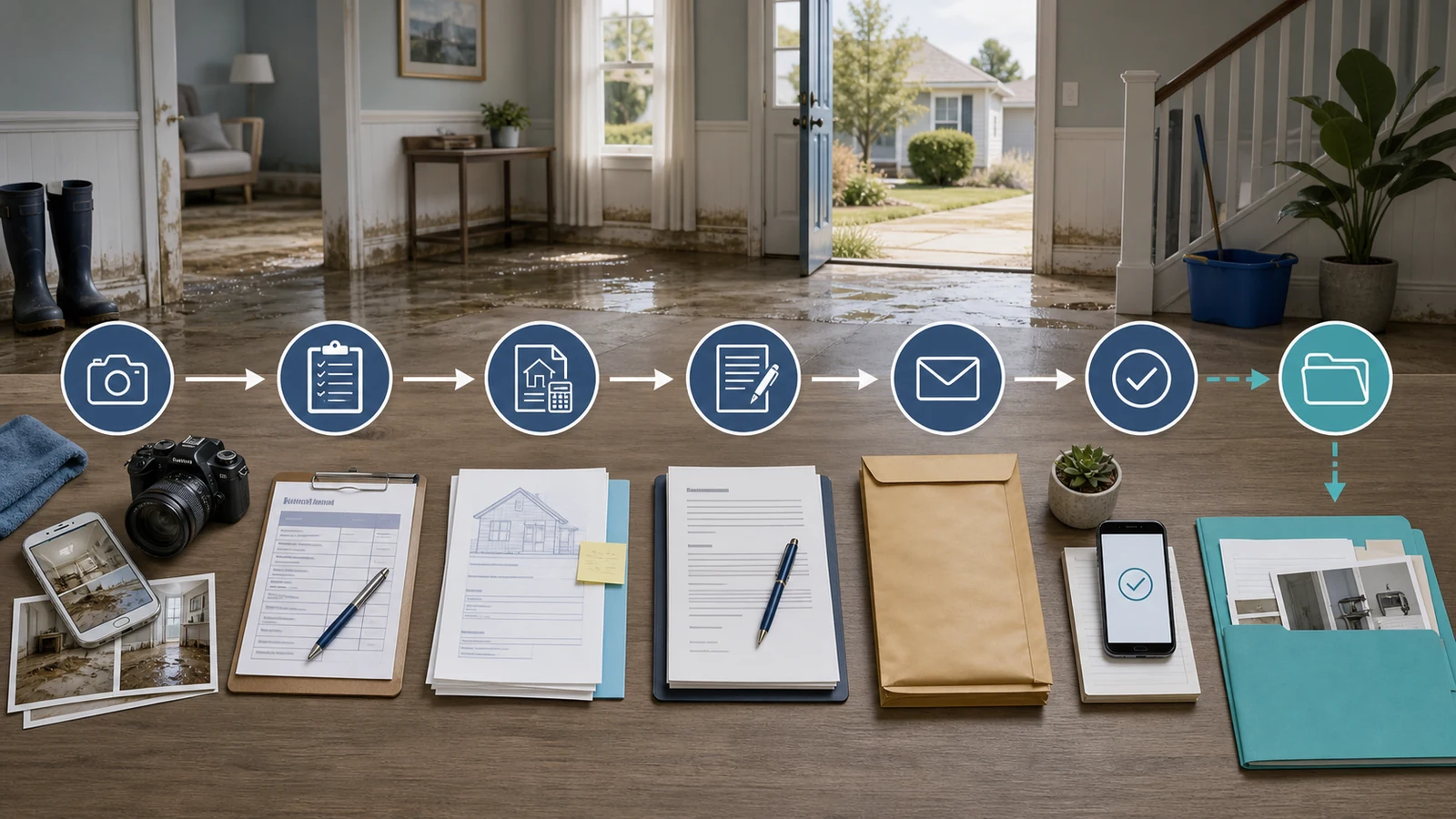
For an NFIP flood claim, report the loss to the insurance company immediately, then send the insurer a signed and sworn Proof of Loss stating the amount you claim with documents that support it. The Standard Flood Insurance Policy normally requires the Proof of Loss within 60 days after the date of loss unless FEMA grants a written waiver or extension. The adjuster can help, but the policyholder remains responsible for a timely, complete submission.
This guide covers the ordinary building and contents Proof of Loss for Coverage A and Coverage B. Increased Cost of Compliance under Coverage D uses a distinct ICC Proof of Loss and community compliance records. One flood event still produces one claim even when the policyholder submits more than one Proof of Loss or later requests additional payment.
Start the claim before the paperwork is complete
FloodSmart’s claim-start guidance tells policyholders to report the flood and loss to the insurance provider as soon as possible. Use the carrier shown on the declarations page or the agent who wrote the policy. If the policy was issued through NFIP Direct, use NFIP Direct’s claim route; if a Write Your Own company issued it, submit through that company.
- Policy number and the insured property address.
- Date and approximate time of loss.
- How to reach you if the property is not habitable.
- A short description of the flood and visible damage.
- Any urgent safety, mitigation, or access problem.
- The current mortgagee or loss payee shown on the policy.
A notice of loss starts the claim process; it is not the Proof of Loss. Do not wait for a contractor’s final scope, a presidential disaster declaration, or a complete inventory before reporting the claim. Ask the insurer for the claim number, assigned adjuster, Proof of Loss instructions, submission address or portal, and any FEMA extension that applies to the event.
The default Proof of Loss deadline is 60 days
The current June 2025 NFIP Claims Manual states that all three Standard Flood Insurance Policy forms include a 60-day Proof of Loss deadline. The policy language in the Dwelling Form, General Property Form, and Residential Condominium Building Association Policy measures it from the loss.
Count from the date of loss, not the date of inspection, estimate, first payment, contractor visit, or denial letter. If the insurer gives a specific written deadline based on a FEMA waiver or extension, keep that document with the claim file and follow it. An adjuster, agent, contractor, or local official cannot personally extend an SFIP deadline.
| Document or event | Does it replace the Proof of Loss? | What to do |
|---|---|---|
| Notice of loss | No | Report promptly, get the claim number, then complete the Proof of Loss requirements |
| Adjuster’s estimate | Not automatically | Review it; the insurer may choose to accept a signed adjuster report in lieu of a separate Proof of Loss, but obtain that direction from the insurer |
| Advance payment | No | Treat it as part of the eventual claim payment and continue the required documentation |
| FEMA event-specific extension | It changes the deadline only as written | Save the bulletin or insurer notice and comply with its scope and date |
| Contractor estimate or invoice | No | Use it as support for the amount claimed |
When in doubt, work toward the default 60-day deadline. Do not rely on a general news report that FEMA extended deadlines for another storm, state, or loss date. Match the written extension to the event, policyholders, and deadline it actually covers.
Know what the Proof of Loss must state
A Proof of Loss is the policyholder’s signed and sworn statement of the amount requested under the policy, supported by documentation. The Proof of Loss is not the claim itself, and it is not merely a photo packet. The amount and evidence must connect to the policy, covered property, and this flood event.
The SFIP requires information that includes:
- Date and time of loss.
- A brief explanation of how the loss happened.
- The policyholder’s interest in the property and any interests of others.
- Details of other insurance that may cover the loss.
- Changes in title or occupancy during the policy term.
- Specifications of damaged buildings and detailed repair estimates.
- Names of mortgagees, lienholders, or others with a claim against the insured property.
- Who occupied the insured building at the time of loss and for what purpose.
- An inventory of damaged personal property with quantity, description, actual cash value, and amount of loss, plus bills, receipts, and related records.
The policyholder must use their own judgment concerning the amount of loss and justify it. An adjuster may prepare a form as a courtesy, but the policyholder should not sign until the property, coverage columns, deductibles, prior payments, and requested amount have been checked against the supporting documents.
Separate building evidence from contents evidence
| Claim part | Useful evidence | Frequent gap |
|---|---|---|
| Coverage A — Building Property | Room-by-room photos, waterline, measurements, material and labor estimates, invoices, permits, equipment model numbers, mitigation records | A lump-sum contractor quote that does not identify flood-damaged components or quantities |
| Coverage B — Personal Property | Item inventory, quantity, age, make/model/serial number, purchase evidence, photos, replacement comparison, salvage disposition | Photos with no item list or values, or a list that does not distinguish damaged from undamaged property |
| Cleanup and mitigation | Invoices, labor logs, equipment records, moisture or drying records, before-and-after photos | No link between the service and covered flood-damaged property |
| Other insurance | Policy declarations, claim numbers, decisions, and payments from other carriers | Omitting another policy or a wind/property claim from the file |
| Prior damage and repairs | Earlier claim records, repair invoices, completion photos, permits | Claiming an item again without showing that prior flood damage was repaired |
Follow FloodSmart’s damage-documentation guidance: take wide and close photos before cleanup, record make, model, and serial numbers, and keep receipts and small samples when it is safe and practical. Dispose of health hazards when necessary, but photograph them first and record why they could not be retained.
Build a claim file that reconciles to one number
The signed amount should be traceable. Create one worksheet for building and one for contents, then reconcile them to the Proof of Loss. Keep columns for claimed replacement or repair cost, applicable depreciation or actual cash value, deductible, prior advance or payment, and the net amount now requested. The insurer may calculate coverage differently, but a transparent worksheet makes disagreements specific.
- Number photographs and link each photo to a room, building item, or inventory line.
- Use line-item estimates with dimensions, quantities, labor, material, tax, and unit price where possible.
- Mark which invoices are paid, estimated, or emergency mitigation only.
- Identify items that were not covered, not damaged by flood, or below a policy limitation instead of mixing them into the requested amount.
- Show advances and earlier payments so the supplemental amount is not accidentally duplicated.
- Keep a version log when the estimate changes after demolition or a contractor inspection.
Do not inflate a Proof of Loss to create negotiating room. Sign only figures you can support. If the adjuster’s scope misses an item, document the exact component, flood damage, quantity, and repair cost rather than replacing the entire estimate with an unexplained total.
Use the current form and send it to the insurer
Use the form or signed format the insurer provides and confirm it against FEMA’s current policyholder claims forms page. The current form collection distinguishes a policyholder-prepared Building and Contents Proof of Loss, an adjuster-prepared version, and a separate ICC Proof of Loss. Avoid third-party copies when a live FEMA or insurer form is available.
- Enter the policy and claim numbers exactly as shown by the insurer.
- Use the insured property address, which may differ from a mailing address.
- Separate building and contents amounts and account for prior payments.
- List the mortgagee or other legal interests accurately.
- Attach the detailed estimates, inventory, photos, receipts, and other support referenced by the amount.
- Sign and swear to the completed Proof of Loss as required; confirm whether every named insured must sign.
- Submit to the NFIP insurer using its specified portal, email, mail, or other route and retain proof of delivery.
Send it to the insurance company handling the NFIP claim, not to the adjuster’s personal address unless the insurer’s written instructions make that the official submission route. Ask for confirmation that the insurer received the signed Proof of Loss and attachments before the deadline. A portal upload receipt that lists the filenames is especially useful.
Review the adjuster-prepared Proof of Loss before signing
The insurer may use an adjuster-prepared form, and the SFIP allows the insurer, at its option, to accept a signed adjuster report instead of the policyholder’s separate Proof of Loss. That is the insurer’s option, not an assumption the policyholder should make. Ask in writing whether the signed report satisfies the Proof of Loss requirement for the amounts shown.
- Does the form identify the correct policy, property, flood date, and claim?
- Are the building and contents amounts separated correctly?
- Does the estimate include every documented flood-damaged item you are claiming?
- Are depreciation, deductible, salvage, advances, and earlier payments reflected accurately?
- Are excluded or disputed items described rather than silently omitted?
- Do the attachments support the amount you are swearing to?
If you disagree, write down each missing or mispriced line and give the adjuster and insurer the supporting evidence. Do not sign a figure you know is incomplete merely because the deadline is close. Ask the insurer how to submit the timely undisputed amount and the additional documented amount within the governing deadline.
Request additional payment with a supplemental Proof of Loss
The NFIP Claims Manual says a policyholder may submit a supplemental Proof of Loss for amounts above the initial request and must support the additional amount. FloodSmart’s current Claims Checklist also tells policyholders to request additional payment when later damage is found, an item was missed or misidentified, or covered repair cost exceeds the earlier estimate.
A supplemental Proof of Loss does not create a second claim. It adds a documented request within the same flood-event claim. The Claims Manual says additional Proofs of Loss must follow the same time constraints, so do not assume that discovering damage later restarts the 60-day period. Use any applicable written FEMA extension and ask the insurer for the precise submission route.
| Reason for more payment | Evidence to add | Reconciliation step |
|---|---|---|
| Hidden damage found during authorized demolition | Photos, contractor narrative, measurements, revised line items | Subtract amounts already paid for the same component |
| Item omitted from the original estimate | Original photos, inventory entry, purchase or value support | Explain why it was omitted and show the new amount only |
| Material or labor cost exceeds the estimate | Comparable bids, invoices, scope details, local price support | Separate price change from a change in scope |
| Component was misidentified | Manufacturer data, serial number, professional report | Replace the old line rather than claim both versions |
| Additional contents documentation located | Receipts, statements, photographs, model and age information | Update the inventory and net request |
Title the package as a supplemental Proof of Loss, identify the prior signed amount and payments, and state the additional amount now requested. Include a short change log. A reviewer should be able to see what changed without re-creating the entire claim from email attachments.
Do not mix ordinary building and contents with ICC
Coverage A pays eligible direct physical loss to insured building property, and Coverage B pays eligible direct physical loss to insured personal property when that coverage was purchased. Increased Cost of Compliance is Coverage D. It addresses eligible costs to comply with a community’s floodplain-management requirements after a qualifying substantial-damage or repetitive-loss determination.
ICC requires its own Proof of Loss and records such as the community determination, permit, mitigation contract, and completion evidence. Use the NFIP ICC claim guide for that track and the substantial-damage determination guide for the local government decision. Keep the ICC request distinct from the ordinary building and contents calculation even though both arise from the same flood-event claim.
Map status and claim coverage are also separate questions. A new effective map can affect a lender or insurance workflow, but it does not decide whether a particular loss meets the SFIP definition of flood or whether an item is covered. The Newly Mapped insurance and lender guide explains that separate map-change track; keep it outside the Proof of Loss calculation for the current damage.
If the insurer disputes, underpays, or denies the request
Start with the insurer. Ask for a written explanation identifying the policy provision, scope item, quantity, price, depreciation, deductible, or documentation issue. Respond with issue-specific evidence. A general statement that the payment is too low is harder to resolve than a table showing each disputed line and the supporting document.
- Save the written denial or partial-denial letter and its date.
- Request the estimate, payment breakdown, and claim correspondence in the insurer’s file.
- Compare the decision with the signed Proof of Loss and every supplemental submission.
- Ask the insurer to correct factual or arithmetic errors before escalating.
- Keep every deadline separate: Proof of Loss, FEMA administrative appeal, and federal lawsuit are not the same clock.
FloodSmart’s appeal guidance states that an eligible FEMA appeal generally must be filed within 60 days of the insurer’s denial letter. The SFIP also contains a one-year deadline to file suit in the appropriate United States District Court after the written denial of all or part of the claim. An administrative appeal does not extend the lawsuit deadline, and filing suit ends FEMA’s ability to consider the appeal. Obtain qualified legal advice promptly when litigation rights may be involved.
Keep the complete claim file after payment
- Declarations page, policy form, endorsements, and insurer contact information.
- Notice of loss, claim number, adjuster assignment, and communication log.
- Every Proof of Loss version, signed page, attachment, and delivery receipt.
- Building estimates, contents inventories, photos, videos, samples, invoices, and receipts.
- Advances, payment letters, checks, depreciation calculations, and mortgagee correspondence.
- Supplemental requests, denials, appeals, settlement communications, and repair completion evidence.
Photograph completed repairs and retain paid invoices. A later flood claim may require evidence that prior damage was repaired. Keep cloud and offline copies because the claim file itself can be lost in a future disaster.
Related official record checks
Use the guide that matches the exact agency, jurisdiction, tool, product, program, or record type; verify the live official source before acting.
Questions policyholders ask about Proof of Loss
Is a Proof of Loss the same as reporting the claim?
No. Reporting the loss starts the claim. The Proof of Loss is the signed and sworn amount requested with supporting documentation and a separate policy deadline.
Can the adjuster file it for me?
The adjuster may prepare or help with the form, and the insurer may choose to accept a signed adjuster report. The policyholder remains responsible for reviewing, signing, supporting, and timely submitting the required statement.
Can I ask for more money after signing the first form?
Yes, when additional covered damage or cost is documented. Submit a supplemental Proof of Loss through the insurer and comply with the same Proof of Loss deadline or any applicable written FEMA extension.
Does every Proof of Loss create a new claim?
No. Multiple or supplemental Proofs of Loss can support additional amounts, but one flood event still gives rise to one claim under the policy.
Is the ICC Proof of Loss part of my building and contents form?
No. ICC is Coverage D and uses a distinct Proof of Loss and compliance documentation. Keep it separate from Coverage A building and Coverage B contents even though the requests relate to the same flood event.
What if FEMA announced an extension after a major disaster?
Save the official written notice and confirm that it applies to your loss date, event, policy, and requested amount. Do not apply an extension from another disaster or rely only on an oral statement.
The June 2025 NFIP Claims Manual, NFIP Claims Handbook, May 2026 policyholder checklist, and current SFIP text were rechecked August 1, 2026. Your policy and the insurer’s written directions control the individual claim. This guide is educational and is not legal advice or a coverage decision.