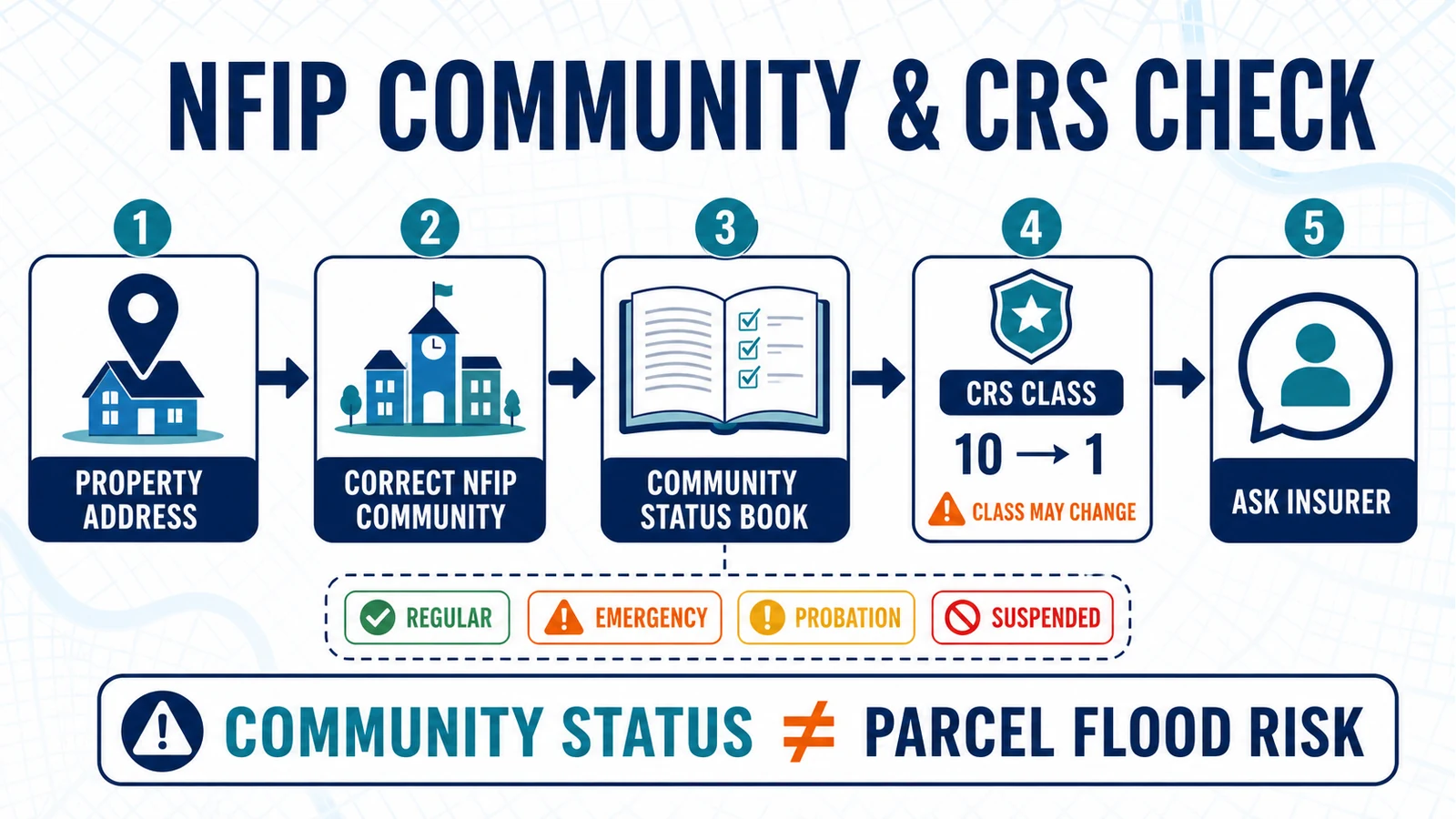
To check whether your city, county, town, parish, borough, tribal government, or other jurisdiction participates in the National Flood Insurance Program, identify the government that regulates the property and look it up in FEMA’s NFIP Community Status Book. Confirm the community name, county, six-digit Community Identification Number, participation status, and current map date. Then read the CRS fields separately: a Community Rating System class can indicate a potential NFIP premium discount, but it does not prove that a particular property is insurable or that a quoted premium is wrong.
Last checked: July 29, 2026. NFIP participation, probation or suspension status, map dates, CRS classes, and discount eligibility can change. Use the live FEMA record and confirm a time-sensitive result with the local floodplain administrator or the policy’s insurer.
Start with the government that has authority over the property
A mailing city is not always the NFIP community. A house can use a city’s name in its postal address while sitting in the unincorporated part of a county. Another address may be inside an incorporated city that participates separately from the surrounding county. Tribal governments, parishes, boroughs, villages, and towns can also have their own records. Searching only the ZIP Code can therefore lead to the right place name but the wrong NFIP jurisdiction.
Use a current property-tax or assessor record, parcel viewer, deed, or local planning record to identify the governing jurisdiction. If a lender has already sent a flood notice, the community number and map information may also appear on the determination form; the Standard Flood Hazard Determination Form field guide explains where to look. Do not assume that the county row controls merely because the county name appears in the address.
- Record the legal property address and parcel number.
- Identify whether the parcel is inside an incorporated municipality or an unincorporated county area.
- Keep the county name, community name, and state together when searching.
- Ask the local floodplain administrator which NFIP community regulates the parcel if two plausible rows remain.
Find the official Community Status Book record
FEMA publishes state reports and a national Community Status Book report. Open the state report when possible because it is easier to search and compare similar community names. Search the PDF for the exact jurisdiction, then confirm the county and CID before reading across the row. The report separates participating and nonparticipating communities, so finding a name without checking its section is not enough.
- Open FEMA’s Community Status Book and choose the state or national report.
- Search for the legal community name, not just the postal city.
- Match the county and government type. A city and the unincorporated county can be separate entries.
- Copy the CID, participation line, regular or emergency program date, current effective map date, CRS class, class effective date, and discount shown.
- Save the report date or the date you checked it. Recheck before a closing, policy purchase, renewal, permit, or grant application.
Readers who need machine-readable confirmation can also inspect FEMA’s live OpenFEMA Community Status Book endpoint. The API exposes fields such as participatingInNFIP, communityIdNumber, classRating, sfhaDiscount, and lastRefresh. The state report remains easier for most property owners, while the API is useful for data teams that can filter records carefully.
Read Emergency, Regular, probation, and suspension as different states
FEMA’s current NFIP Flood Insurance Manual treats these as different program states, not interchangeable labels. Match the live Community Status Book record and any effective date before relying on a policy consequence.
| Community status | What FEMA says it means | Immediate policy consequence to confirm |
|---|---|---|
| Emergency Program | The initial phase of NFIP participation, with limited amounts of coverage available | The community participates, but Emergency Program policies do not receive a CRS discount |
| Regular Program | The final phase of NFIP participation; the completed FIRM is in effect and full coverage limits are available | Regular status still does not approve a particular building or set its premium |
| Probation | The community remains participating while FEMA addresses floodplain-management deficiencies | Insurance remains available; FEMA applies a $50 probation surcharge to policies in the community issued on or after the probation effective date, except Group Flood Insurance Policies. Unresolved deficiencies may lead to suspension |
| Suspended | FEMA has suspended the community from the NFIP | The NFIP may not sell or renew coverage. A policy already in force remains effective only until expiration; after reinstatement, the owner must submit a new application and the applicable waiting period applies |
| Nonparticipating | The community does not currently participate in the NFIP | The NFIP may not sell or renew coverage in the community |
Save the exact label, effective date, CID, and date checked. A scheduled suspension notice is not the same as a completed suspension, and probation is not suspension. When a closing or renewal depends on the distinction, ask the insurer to confirm the current policy consequence in writing.
What each field can and cannot tell you
| Community Status Book field | Use it for | Do not treat it as |
|---|---|---|
| CID | Matching the exact NFIP community and the identifier used in program and policy records | A parcel number, FIRM panel number, or proof that a building is in a flood zone |
| Participating / program date | Checking whether the jurisdiction is in the NFIP and whether the record shows Regular or Emergency Program history | A promise that every building qualifies for a new policy |
| Current effective map date | Starting the map-version check for the community | Proof that a downloaded panel or Letter of Map Change is current for the exact building |
| CRS entry, class, and effective date | Checking whether the community has a current CRS classification | A property-level premium calculation |
| Discount fields | Understanding the community-level CRS discount associated with the class | A guaranteed reduction from the amount on a particular quote or renewal |
| Tribal indicator | Identifying a participating tribal jurisdiction | A substitute for confirming which government has authority over the parcel |
Participation, flood zone, and insurance price answer different questions
NFIP participation is a community-level program status. A flood zone is a mapped hazard designation for a location. A policy quote applies underwriting and rating rules to a specific building and coverage request. One result cannot replace the other two. A participating community can contain buildings both inside and outside a Special Flood Hazard Area, and a CRS class does not change the boundary of any flood zone.
| Question | Best official route | Record to save |
|---|---|---|
| Does the jurisdiction participate in the NFIP? | FEMA Community Status Book | Community name, county, CID, participation status, date checked |
| Which effective map applies to the location? | FEMA Map Service Center plus current LOMC history | Panel number, suffix, effective date, zone, relevant determination |
| What will this building’s coverage cost? | NFIP insurer or licensed flood insurance provider | Quote inputs, coverage limits, deductibles, discounts, effective date |
If the immediate task is the map rather than participation, follow the site’s effective FIRM, panel, and zone workflow. If the confusion is why a zone and a premium seem inconsistent, use the separate guide to FEMA maps and Risk Rating 2.0. Keeping these tasks separate prevents a community row from being mistaken for a building determination.
Read the CRS class as a ceiling, not a promised dollar amount
The CRS is a voluntary program for NFIP communities that carry out floodplain-management activities beyond minimum program requirements. FEMA’s CRS discount FAQ lists classes from 10 to 1. Class 10 carries no CRS reduction; each step from Class 9 through Class 1 adds five percentage points, up to 45 percent. The FAQ describes these as potential or “up to” premium reductions because policy rules still control the amount applied.
| CRS class | Maximum CRS reduction shown by FEMA | How to use the number |
|---|---|---|
| 10 | 0% | No CRS premium reduction is attached to the class |
| 9 / 8 / 7 | 5% / 10% / 15% | Confirm the current class effective date and the policy’s eligibility |
| 6 / 5 / 4 | 20% / 25% / 30% | Compare the insurer’s declaration or quote, not a home-price estimate |
| 3 / 2 / 1 | 35% / 40% / 45% | Treat the percentage as a program discount level, not a guarantee of the same dollar savings |
FEMA’s FAQ says the rating engine normally applies the CRS discount using the community’s CID, so a policyholder does not file a separate CRS application. It also identifies exceptions: Emergency Program policies, Group Flood Insurance Policies, provisionally rated policies, buildings with known floodplain-management violations, and policies whose other rate caps or discounts affect the calculation may receive less or no CRS reduction. Consult the current NFIP Flood Insurance Manual and ask the insurer to explain the policy-specific result.
Resolve a missing or conflicting community record
A missing name often means the wrong jurisdiction was searched, not that the address has no NFIP status. Try the county’s unincorporated-area entry, an alternate government name, or the municipality shown on the assessor record. Compare the CID on the lender’s determination, policy declarations, and Community Status Book. Small spelling differences matter less than a mismatched county or CID.
- Ask the assessor, planning office, or floodplain administrator whether the parcel is incorporated.
- Show the official the two rows or CIDs that appear plausible and ask which jurisdiction administers the property.
- If the report and insurer disagree, provide the report date, CID, property address, policy number, and the specific field in conflict.
- If a community appears suspended, on probation, or in the Emergency Program, do not infer the policy outcome yourself. Request a current written explanation from the insurer or local official.
- Recheck the record after a map adoption, annexation, community merger, CRS class change, or policy renewal.
FEMA explains that each state has an NFIP State Coordinating Agency that helps communities with program requirements. The agency role is described in FEMA’s intergovernmental floodplain-management guidance. A state coordinator or FEMA regional office can help route a program-status question, while the insurer remains the right party for the application, price, and policy.
What this check does not prove
A Community Status Book record does not establish a parcel boundary, determine whether a building is in an SFHA, remove a lender’s insurance requirement, approve development, or quote insurance. It also does not show every local rule that may exceed the NFIP minimum. For a purchase, pair the community check with the flood-zone due-diligence steps for buyers, then obtain property-specific answers from the responsible official and insurer.
Questions property owners ask after finding the row
Can I buy an NFIP policy if my community participates?
Participation is the necessary community-level starting point, but it is not a coverage approval for a particular building. Give the CID and property information to an NFIP provider and ask it to confirm eligibility, coverage, waiting-period rules, and price.
Does a blank CRS field mean Class 10?
Do not fill in a blank yourself. It may mean the record does not show current CRS participation, while a displayed Class 10 is an actual class with no CRS reduction. Confirm the live record and class effective date with FEMA, the local CRS coordinator, or the insurer.
Why is my discount smaller than the CRS percentage?
The table shows the CRS level, not a guaranteed dollar reduction from any comparison quote. Other discounts, statutory premium caps, policy type, compliance status, and rating calculations can change what appears. Ask the insurer to identify the CID, CRS class, and reason the displayed premium differs.
Does CRS participation mean the community is safe from flooding?
No. CRS recognizes credited community activities; it does not guarantee that a property will not flood. Read the effective map, local drainage information, past events, and building-level risk separately.
How often should I check the status?
Check again when the answer affects a closing, policy, renewal, permit, or assistance application. Save the date and source each time. Community participation and CRS classifications are administrative statuses that can change.