A FEMA LOMC status describes where a request sits in the review process; it does not predict whether FEMA will grant the map change. Match the case number and submission, read the exact status description, then respond to any data, fee, comment-period, appeal-period, or final-letter deadline shown in the official record.
Last checked: August 7, 2026.
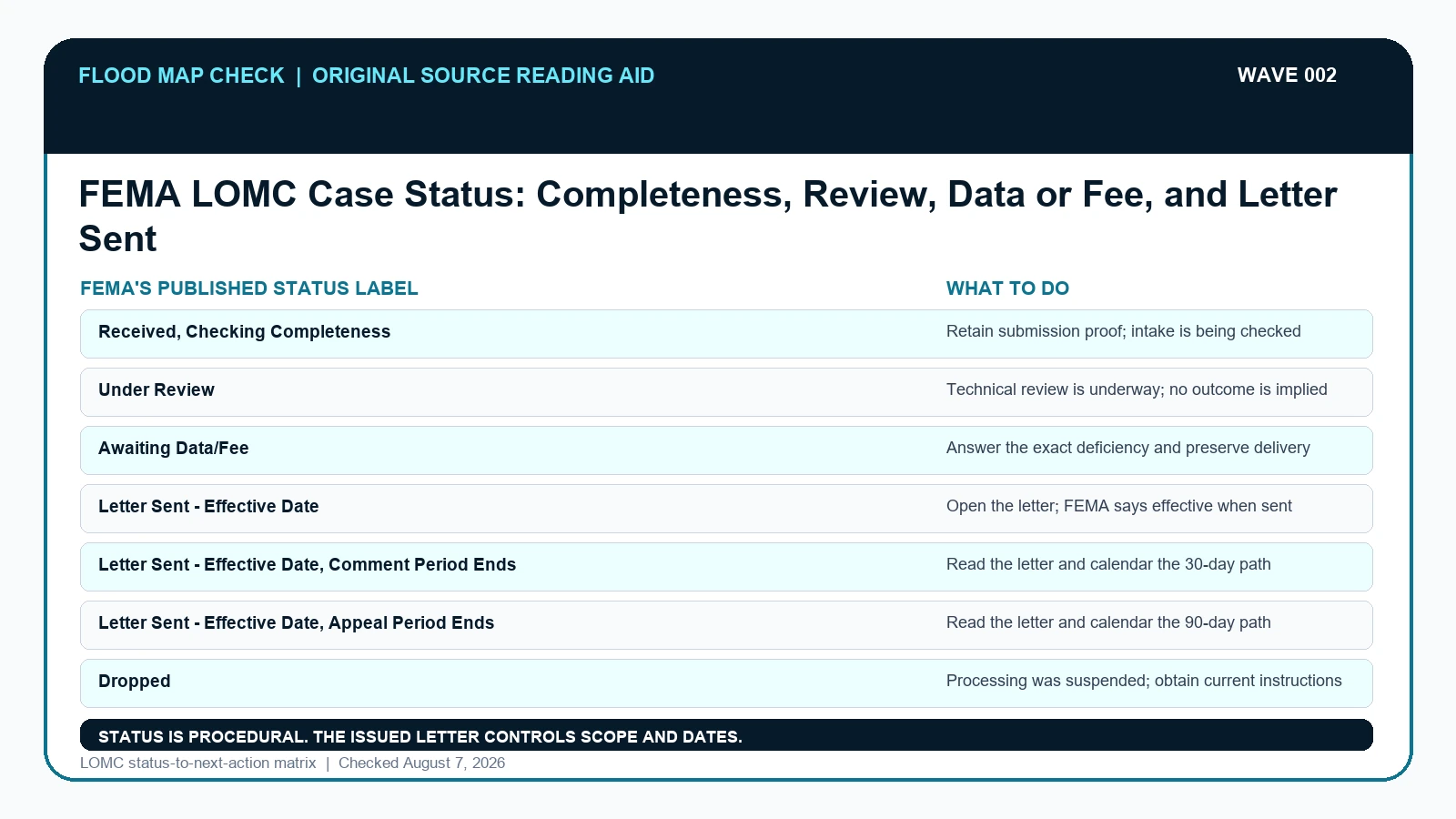
The practical difference among statuses is the applicant's next move. 'Received, Checking Completeness' means the intake screen is still underway. 'Under Review' means technical material is being evaluated. 'Awaiting Data/Fee' means the file cannot advance until the identified gap is resolved. A letter-sent label can carry an immediate, 30-day, or 90-day effective path; 'Dropped' means processing was suspended, not that the requested mapping conclusion was approved or denied on its merits.
Read a status as an action and deadline
The FEMA status list is procedural, not predictive. Received, Checking Completeness covers the intake screen; Under Review covers technical review; Awaiting Data/Fee identifies a specific impediment. The three Letter Sent labels are materially different because FEMA describes an immediate effective date, a 30-day comment-period path, and a 90-day appeal-period path. Dropped means processing was suspended after required data or a fee was not received within the regulatory time frame. None of these labels should be translated into a guessed chance of approval.
Deadline handling should begin with the letter, not the day someone happened to notice a portal change. For a letter issued on March 4 with a 30-day comment period, keep March 4 as the agency date, identify the final day under the letter's instructions, and retain proof of delivery for any scientific or technical response. A portal screenshot taken on March 10 is useful evidence of what was displayed, but it does not move the issue date forward by six days.
Status lag is a common edge case. An applicant may have courier proof that a requested survey was delivered while the case still displays Awaiting Data/Fee. Keep both facts and confirm receipt against the exact case number instead of declaring the portal wrong. Likewise, a Letter Sent label is not a substitute for opening the determination, because the document controls property scope, effective language, review rights, and any conditions that a short status row cannot carry.
The FEMA table that defines each published status
FEMA Coordinated Needs Management Strategy Technical Reference supplies FEMA's direction that LOMR determination documents can be found through MSC Product ID searches, typically using the LOMC case number; this guide cites it for Case number/request type. FEMA LOMC status and description table supplies FEMA's exact public LOMC status labels, including completeness, review, data or fee, three Letter Sent paths, and Dropped; this guide cites it for Received, Checking Completeness / Under Review / Awaiting Data/Fee / Letter Sent / Dropped. FEMA flood-map tutorials supplies FEMA's public Online LOMC application and status purpose plus current LOMA and LOMR-F training routes; this guide cites it for Case number/request type.
The FEMA LOMC case status crosswalk keeps these assignments explicit: FEMA Coordinated Needs Management Strategy Technical Reference → Case number/request type; FEMA LOMC status and description table → Received, Checking Completeness / Under Review / Awaiting Data/Fee / Letter Sent / Dropped; FEMA flood-map tutorials → Case number/request type. If Case number/request type or another named field is absent from its cited record, leave that fact unresolved and obtain it from the responsible official source instead of expanding a different citation beyond scope.
| Official record | What it actually supplies | Field used here |
|---|---|---|
| FEMA Coordinated Needs Management Strategy Technical Reference | FEMA's direction that LOMR determination documents can be found through MSC Product ID searches, typically using the LOMC case number | Case number/request type |
| FEMA LOMC status and description table | FEMA's exact public LOMC status labels, including completeness, review, data or fee, three Letter Sent paths, and Dropped | Received, Checking Completeness / Under Review / Awaiting Data/Fee / Letter Sent / Dropped |
| FEMA flood-map tutorials | FEMA's public Online LOMC application and status purpose plus current LOMA and LOMR-F training routes | Case number/request type |
The source boundary follows the mapped fields: Case number/request type establishes one part of the record, Awaiting Data/Fee affects interpretation, and Dropped limits the conclusion. Document any missing fact instead of inferring a replacement value while working to translate the current status into the next applicant action.
The status table or issued FEMA letter controls the exact label and deadline. The tutorial supports navigation and workflow only.
How Case number/request type connects to Dropped
| Field | Meaning in this check | Error it exposes | Response |
|---|---|---|---|
| Case number/request type | Identifies the exact LOMC submission whose status is being read | A status from another case or request type is irrelevant | Match the identifier and request before interpreting the label |
| Received, Checking Completeness | Initial data and fees are being checked | No technical outcome is implied | Monitor the case and retain submission proof |
| Under Review | FEMA is reviewing technical support | Review duration is not an approval signal | Keep contacts current and wait for a formal request |
| Awaiting Data/Fee | The file needs specified material or payment | Silence can lead to suspension | Answer the exact deficiency and document delivery |
| Letter Sent | A determination document has been issued | Effective timing varies by letter/status | Open the letter and calendar its controlling dates |
| Dropped | Processing was suspended for an unmet requirement | It is not the requested favorable determination | Ask what a renewed or new submission requires |
A sound FEMA LOMC case status check pairs Case number/request type with Under Review. The first answers “Identifies the exact LOMC submission whose status is being read”; the second answers “FEMA is reviewing technical support”. The pair is incomplete if the evidence shows “Review duration is not an approval signal”, even when the first identifier looks credible.
Received, Checking Completeness is not background metadata. It answers “Initial data and fees are being checked”. If the contrary condition is “No technical outcome is implied”, correct it by following “Monitor the case and retain submission proof”. That correction can change which official record belongs in the check.
The last comparison joins Letter Sent to Dropped. They answer separate questions: “A determination document has been issued” and “Processing was suspended for an unmet requirement”. Keeping both in the FEMA LOMC case status record prevents an observation from being mistaken for an agency, community, insurer, lender, or professional determination.
From intake to the issued letter without guessing the outcome
The order matters most around Under Review. First, “Copy the full status label and the portal's description; do not shorten it to approved, pending, or denied”. Next, “Open every linked data request, fee notice, determination, comment notice, or appeal notice”. Reversing those actions can attach a sound interpretation to the wrong date, place, product, or case for Under Review.
- Open the case using the exact identifier from the submission confirmation or determination letter.
- Match applicant, community, property, request type, and submission date before reading the status.
- Copy the full status label and the portal's description; do not shorten it to approved, pending, or denied.
- Open every linked data request, fee notice, determination, comment notice, or appeal notice.
- Record the agency issue date, response deadline, delivery method, and person responsible for the response.
- After responding, preserve confirmation and recheck the official case rather than assuming the status changed.
- When a final letter exists, use the letter's scope and effective language instead of the portal label alone.
End with “When a final letter exists, use the letter's scope and effective language instead of the portal label alone”. That preserves Dropped beside the source and date instead of leaving a detached number, color, category, or status that another reader could overinterpret.
An Awaiting Data/Fee notice with a real deadline
If the portal says 'Awaiting Data/Fee,' do not upload a random replacement document. Open the official request, identify the missing item, confirm who must sign or certify it, and preserve the delivery evidence. If a letter-sent status includes a comment or appeal period, calculate from the date stated by FEMA and read the letter itself; a calendar reminder based only on the day the applicant noticed the portal can be late.
In this example, Case number/request type identifies the relevant record, while Under Review is the fact most likely to change the interpretation. Conclude “Current procedural evidence” only when the evidence shows “Same case, status, issue date, and property”.
For FEMA LOMC case status, if the facts instead fit “Case marked dropped”, the result changes to “Suspended processing”. Respond by following “Obtain current resubmission instructions before acting”. Do not substitute the more favorable conclusion from the earlier example.
Agreement, portal lag, letter periods, and dropped processing
| Observed state | Evidence test | Limited conclusion | Next response |
|---|---|---|---|
| Portal and letter agree | Same case, status, issue date, and property | Current procedural evidence | Carry out the letter's stated next step |
| Portal changed after a data response | Delivery exists but status is unchanged | Update may lag or the response may be incomplete | Confirm receipt using the case number |
| Letter sent with 30-day period | Status and letter state a comment period | Timing is controlled by the official document | Preserve scientific or technical response evidence |
| Case marked dropped | Required data or fee was not received in time | Suspended processing | Obtain current resubmission instructions before acting |
“Portal and letter agree” and “Portal changed after a data response” are not better and worse versions of one answer. The former supports “Current procedural evidence”; the latter supports “Update may lag or the response may be incomplete”. Preserve the different evidence tests before taking either listed response.
The two unresolved branches also differ. “Letter sent with 30-day period” supports only “Timing is controlled by the official document”, whereas “Case marked dropped” supports only “Suspended processing”. Apply the response shown for the matching branch.
Handle portal lag, missed data, and a dropped case
- Avoid calling under review likely approval. Recheck Under Review. The mapped warning is “Review duration is not an approval signal”; the corresponding response is “Keep contacts current and wait for a formal request”.
- Avoid missing an awaiting-data deadline. Recheck Awaiting Data/Fee. The mapped warning is “Silence can lead to suspension”; the corresponding response is “Answer the exact deficiency and document delivery”.
- Avoid using a portal update date as the legal effective date. Recheck Letter Sent. The mapped warning is “Effective timing varies by letter/status”; the corresponding response is “Open the letter and calendar its controlling dates”.
- Avoid treating dropped as a map decision. Recheck Dropped. The mapped warning is “It is not the requested favorable determination”; the corresponding response is “Ask what a renewed or new submission requires”.
Two field-specific corrections are required. For “calling under review likely approval”, follow “Keep contacts current and wait for a formal request”. For “missing an awaiting-data deadline”, follow “Answer the exact deficiency and document delivery”. Keeping Under Review separate from Awaiting Data/Fee prevents one repaired field from hiding the other error.
“using a portal update date as the legal effective date” can trigger Effective timing varies by letter/status; correct the mapped Letter Sent field or fields by following “Open the letter and calendar its controlling dates”. “treating dropped as a map decision” affects Dropped, so use “Ask what a renewed or new submission requires” before relying on the result.
What this LOMC status-to-next-action matrix cannot decide
Scope: United States FEMA mapping projects and formal map-change cases. Limitation: Portal status is procedural and does not predict approval or the final mapped outcome.
Use the LOMC status-to-next-action matrix as a reading aid for Case number/request type and Dropped. The official source, community, insurer, surveyor, or emergency authority still controls the outcome, especially when the evidence shows “Required data or fee was not received in time”.
Keep form choice and final map questions outside the status page
- FEMA LOMA LOMR F Lookup extends the work built from Case number/request type; it does not replace this check.
- FEMA Preliminary vs. Effective Flood Map is the next reference when the unresolved fact is Under Review.
- FEMA LOMR CLOMR Map Revision addresses the separate decision that may follow from Dropped.
Use this guide to translate the current status into the next applicant action. The linked guides address separate questions raised by Case number/request type, Under Review, or Dropped.
Before acting on a displayed LOMC status
Does Case number/request type settle the question by itself?
No. Case number/request type answers “Identifies the exact LOMC submission whose status is being read”, but it can fail when “A status from another case or request type is irrelevant”. Pair it with Received, Checking Completeness, Under Review, and the checked date.
What if the evidence shows Case marked dropped?
Confirm the stated evidence test: “Required data or fee was not received in time”. The limited conclusion is “Suspended processing”. The documented response is “Obtain current resubmission instructions before acting”; a more favorable branch should not be substituted.
When should Dropped be checked again?
Reopen the official case after submitting requested data or a fee, and again whenever FEMA posts a Letter Sent status. The issue date and instructions in the actual letter—not the date someone noticed a portal change—control any 30-day or 90-day response period.
FEMA LOMC Case Status: Completeness, Review, Data or Fee, and Letter Sent is independent public-record guidance for the limited action to translate the current status into the next applicant action. The cited government records retain authority over Case number/request type and Dropped. Last checked: August 7, 2026.