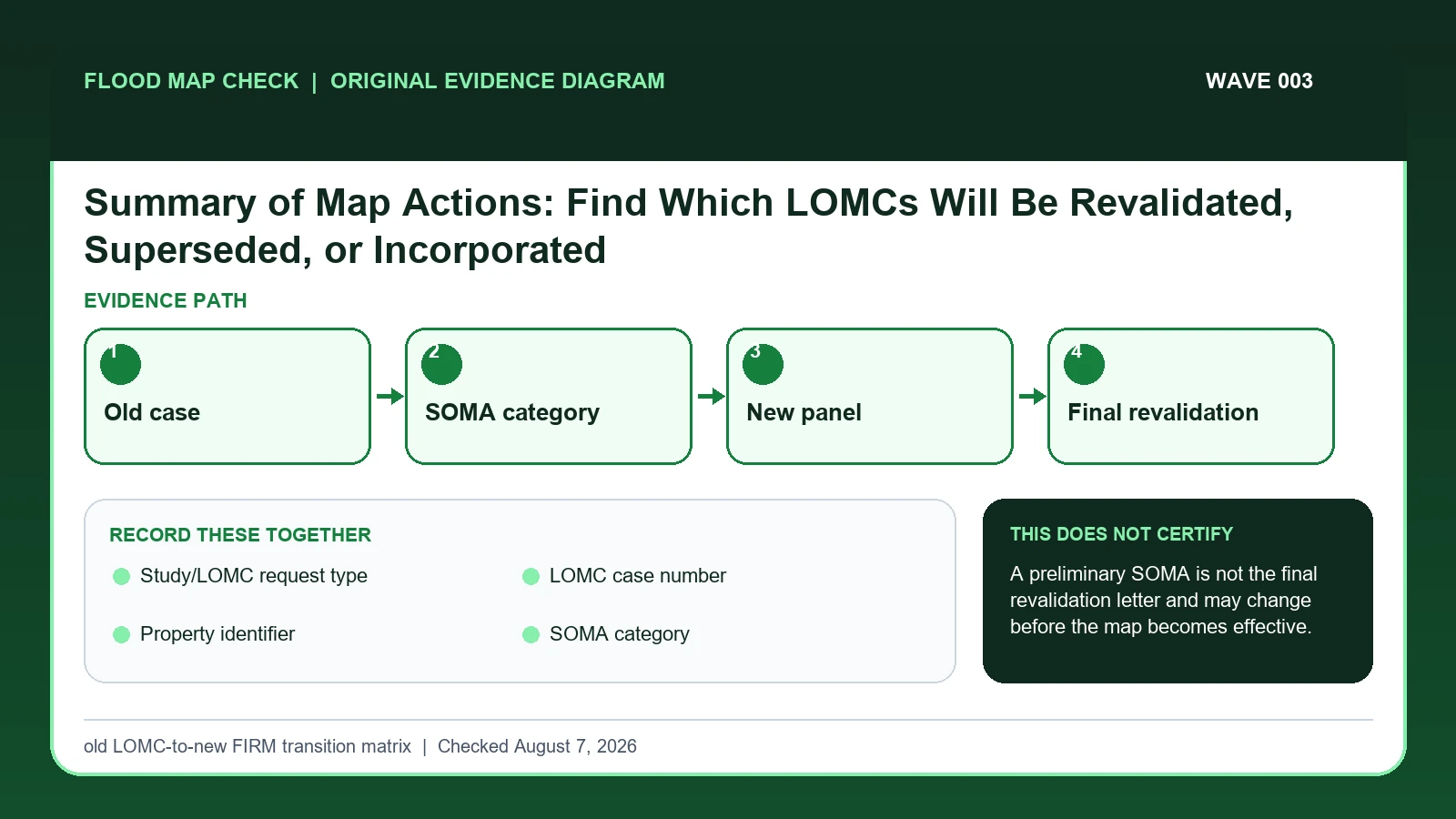
A FEMA Summary of Map Actions shows the expected treatment of previously issued map-change determinations when a new or revised FIRM is prepared. Match the SOMA entry to the exact LOMC case, property, study, and new panel, then wait for the final map and any revalidation letter before calling the older determination current.
Last checked: August 7, 2026.
FEMA's current Flood Risk Analysis and Mapping Policy Standards, Revision 14, uses Standard Identifier (SID) 553 for the SOMA transition categories. SOMA work separates earlier determinations into paths such as incorporated, not incorporated, superseded, or needing reevaluation. It gives the community and affected owner a structured preview of what the map revision may do to a LOMA, LOMR-F, or LOMR. The preliminary table is valuable evidence, but it is not itself the final revalidation letter and can change as the study moves through revised preliminary and final stages.
Categories 1, 2A, 2B, 3, and 4 are transition paths
FEMA's current Flood Risk Analysis and Mapping Policy Standards, Revision 14, identifies the SOMA rule as Standard Identifier (SID) 553. SID 553 gives the transition vocabulary: Category 1 for incorporated LOMCs; Category 2A for valid LOMCs not incorporated on revised panels; Category 2B for valid LOMCs on unrevised panels; Category 3 for superseded determinations; and Category 4 for certain multi-property determinations that must be redetermined. Those categories describe how prior map changes relate to a new study. They are more precise than a generic current or expired label.
A useful crosswalk has one row per old case number. Keep the community, old panel, study case, new panel, SOMA category, preliminary or final document date, and revalidation evidence together. If a LOMA appears as 2A, the next question is not whether the preliminary table looks favorable; it is whether the final process and revalidation material preserve that specific determination when the revised map becomes effective. A 2B entry requires equal care because its panel relationship differs.
SOMA documents can change during the mapping process, and a property description mismatch defeats an otherwise matching case number. Category 3 should never be paraphrased as merely not shown; it indicates that the prior result will be superseded under the standard's conditions. Category 4 is also not an automatic adverse result for every lot in a multi-property letter. The affected determinations must be resolved individually using the final study and issued FEMA material.
Revision 14 SID 553 supplies the SOMA categories
FEMA Flood Risk Analysis and Mapping Policy Standards, Revision 14 supplies the current Standard Identifier (SID) 553 definitions for SOMA Categories 1, 2A, 2B, 3, and 4; this guide cites it for SOMA category. FEMA MSC Search All Products lesson supplies the current effective map plus preliminary maps, historic FIRM panels, Flood Insurance Studies, Letters of Map Change, and other community products; this guide cites it for LOMC case number / Property identifier / New panel/effective date. FEMA Change Your Flood Zone supplies LOMA, LOMR-F, CLOMR, and LOMR request routes and limitations; this guide cites it for Study/LOMC request type.
The FEMA Summary of Map Actions crosswalk keeps these assignments explicit: FEMA Flood Risk Analysis and Mapping Policy Standards, Revision 14 → SOMA category; FEMA MSC Search All Products lesson → LOMC case number / Property identifier / New panel/effective date; FEMA Change Your Flood Zone → Study/LOMC request type. If SOMA category or another named field is absent from its cited record, leave that fact unresolved and obtain it from the responsible official source instead of expanding a different citation beyond scope.
| Official record | What it actually supplies | Field used here |
|---|---|---|
| FEMA Flood Risk Analysis and Mapping Policy Standards, Revision 14 | the current Standard Identifier (SID) 553 definitions for SOMA Categories 1, 2A, 2B, 3, and 4 | SOMA category |
| FEMA MSC Search All Products lesson | the current effective map plus preliminary maps, historic FIRM panels, Flood Insurance Studies, Letters of Map Change, and other community products | LOMC case number / Property identifier / New panel/effective date |
| FEMA Change Your Flood Zone | LOMA, LOMR-F, CLOMR, and LOMR request routes and limitations | Study/LOMC request type |
Do not extend a citation beyond its mapped fields. Evidence for SOMA category cannot automatically establish Study/LOMC request type; keep either unanswered item visible before taking the action to interpret the preliminary SOMA disposition for an existing determination.
How Study/LOMC request type connects to New panel/effective date
| Field | Meaning in this check | Error it exposes | Response |
|---|---|---|---|
| Study/LOMC request type | Identifies the mapping study and the kind of earlier determination evaluated in the SOMA | Wrong study or request type means the wrong transition record | Match the community, study, case, and request type |
| LOMC case number | Links the prior determination to the table | A similar case is not enough | Copy exactly from the old letter |
| Property identifier | Address, lot, structure, or legal description | Scope may be narrower than the parcel | Confirm the subject is covered |
| SOMA category | Expected transition treatment | Preliminary category can change | Quote it without expanding its meaning |
| New panel/effective date | Ties the transition to the revised map | Preliminary and effective dates differ | Recheck at final effectiveness |
Study/LOMC request type is the starting identifier, but it is usable only when LOMC case number and Property identifier agree. Two conflicts can break that agreement: “Wrong study or request type means the wrong transition record” and “Scope may be narrower than the parcel”. A polished screenshot cannot repair either one.
For interpretation, LOMC case number answers “Links the prior determination to the table”, while SOMA category answers “Expected transition treatment”. They are not interchangeable. A failure in the first calls for “Copy exactly from the old letter”; a failure in the second calls for “Quote it without expanding its meaning”.
The final safeguard is New panel/effective date, which answers “Ties the transition to the revised map”. Its warning condition is “Preliminary and effective dates differ”. At that point in the FEMA Summary of Map Actions check, document the limited result or take the unresolved issue to the official decision owner.
Crosswalk each old case to the study and new panel
Treat “Open the SOMA tied to that study rather than a general community search result” as a prerequisite for “Match case number, property text, panel, and category in the same row”. Together they determine whether Property identifier belongs to the same subject, period, and official product as Study/LOMC request type.
- Collect the full older LOMA, LOMR-F, LOMR, or other determination and transcribe its case number.
- Identify the new mapping study, community, preliminary panel, and expected effective date.
- Open the SOMA tied to that study rather than a general community search result.
- Match case number, property text, panel, and category in the same row.
- Save the preliminary or revised-preliminary document date and do not call it final.
- At the map's effective stage, retrieve the final transition or revalidation evidence.
- Keep the old letter, SOMA row, new FIRM, and final status record together as a dated evidence chain.
Do not close the file at the first plausible result. Carry out “Keep the old letter, SOMA row, new FIRM, and final status record together as a dated evidence chain”, then preserve the version of New panel/effective date that was current on the checked date.
One old LOMA moving through a revised study
An owner may see the old case number in a preliminary SOMA and assume the letter survives. Instead, copy the category, case number, property identifier, study case, and affected new panel into one row. When the FIRM becomes effective, retrieve the final SOMA or revalidation material and compare it with the issued map. If the entry is missing or the property text differs, treat status as unresolved.
In this example, Study/LOMC request type identifies the relevant record, while Property identifier is the fact most likely to change the interpretation. Conclude “The revised map work carries the determination” only when the evidence shows “The earlier LOMC result is incorporated into the revised FIRM”.
For FEMA Summary of Map Actions, if the facts instead fit “Category 4 — To be redetermined”, the result changes to “The final result is not yet established”. Respond by following “Follow the redetermination and retain both the prior and replacement records”. Do not substitute the more favorable conclusion from the earlier example.
Incorporated, 2A or 2B, superseded, and redetermined
| Observed state | Evidence test | Limited conclusion | Next response |
|---|---|---|---|
| Category 1 — Incorporated | The earlier LOMC result is incorporated into the revised FIRM | The revised map work carries the determination | Verify the final effective panel and mapped result |
| Category 2A — Not incorporated, revised panel | The LOMC is not incorporated and the affected area lies on a revised panel | A separate revalidation path may be needed when the map becomes effective | Retrieve the final revalidation material before relying on the old letter |
| Category 2B — Not incorporated, unrevised panel | The LOMC is not incorporated because the affected area lies on a panel that is not being revised | The panel path differs from Category 2A | Retain the unrevised-panel evidence and verify final status |
| Category 3 — Superseded | The earlier determination is superseded by another map action or determination | The older letter should not be treated as controlling | Use the superseding case and new effective evidence |
| Category 4 — To be redetermined | The earlier determination must be reevaluated because the new study changes relevant conditions | The final result is not yet established | Follow the redetermination and retain both the prior and replacement records |
For “Category 1 — Incorporated”, the evidence test is “The earlier LOMC result is incorporated into the revised FIRM”; the limited conclusion is “The revised map work carries the determination” and the response is “Verify the final effective panel and mapped result”. For “Category 2A — Not incorporated, revised panel”, the evidence test is “The LOMC is not incorporated and the affected area lies on a revised panel”; the limited conclusion is “A separate revalidation path may be needed when the map becomes effective” and the response is “Retrieve the final revalidation material before relying on the old letter”.
Keep “Category 2B — Not incorporated, unrevised panel” separate: it supports “The panel path differs from Category 2A” and calls for “Retain the unrevised-panel evidence and verify final status”. Keep “Category 3 — Superseded” separate: it supports “The older letter should not be treated as controlling” and calls for “Use the superseding case and new effective evidence”. Keep “Category 4 — To be redetermined” separate: it supports “The final result is not yet established” and calls for “Follow the redetermination and retain both the prior and replacement records”.
Missing entries, changed property text, and preliminary status
- Avoid treating preliminary SOMA as final. Recheck SOMA category / New panel/effective date. The mapped warning is “Preliminary category can change; Preliminary and effective dates differ”; the corresponding response is “Quote it without expanding its meaning; Recheck at final effectiveness”.
- Avoid matching only the address. Recheck Property identifier. The mapped warning is “Scope may be narrower than the parcel”; the corresponding response is “Confirm the subject is covered”.
- Avoid assuming incorporated means every structure is covered. Recheck Property identifier. The mapped warning is “Scope may be narrower than the parcel”; the corresponding response is “Confirm the subject is covered”.
- Avoid ignoring the new panel effective date. Recheck New panel/effective date. The mapped warning is “Preliminary and effective dates differ”; the corresponding response is “Recheck at final effectiveness”.
The remedy for “treating preliminary SOMA as final” is tied to SOMA category / New panel/effective date: “Quote it without expanding its meaning; Recheck at final effectiveness”. The separate mistake “matching only the address” is exposed by “Scope may be narrower than the parcel”; answer it with “Confirm the subject is covered”.
Check Property identifier when the risk is “assuming incorporated means every structure is covered”, because the mapped warning is “Scope may be narrower than the parcel”. Check New panel/effective date separately for “ignoring the new panel effective date” and use “Recheck at final effectiveness” as the recovery step.
What this old LOMC-to-new FIRM transition matrix cannot decide
Scope: United States FEMA mapping projects and formal map-change cases. Limitation: A preliminary SOMA is not the final revalidation letter and may change before the map becomes effective.
The value of the old LOMC-to-new FIRM transition matrix is traceability: it places Study/LOMC request type, Property identifier, and New panel/effective date beside their sources. Authority to decide the underlying Study/LOMC request type remains with the organization named in the official record.
Follow the case into final-map and revalidation records
- Consult FEMA LOMA LOMR F Lookup after Study/LOMC request type has been matched to the correct subject and date.
- Consult FEMA Preliminary vs. Effective Flood Map for the distinct issue revealed by Property identifier.
- Consult FEMA LOMR CLOMR Map Revision when New panel/effective date changes the next official step beyond the action to interpret the preliminary SOMA disposition for an existing determination.
Use this guide to interpret the preliminary SOMA disposition for an existing determination. The linked guides address separate questions raised by Study/LOMC request type, Property identifier, or New panel/effective date.
Before saying an older LOMC remains effective
Does Study/LOMC request type settle the question by itself?
No. Study/LOMC request type answers “Identifies the mapping study and the kind of earlier determination evaluated in the SOMA”, but it can fail when “Wrong study or request type means the wrong transition record”. Pair it with LOMC case number, Property identifier, and the checked date.
What if the evidence shows Category 4 — To be redetermined?
Confirm the stated evidence test: “The earlier determination must be reevaluated because the new study changes relevant conditions”. The limited conclusion is “The final result is not yet established”. The documented response is “Follow the redetermination and retain both the prior and replacement records”; a more favorable branch should not be substituted.
When should New panel/effective date be checked again?
Check the LOMC transition again at revised-preliminary publication, final map issuance, the FIRM effective date, and release of any revalidation letter. A preliminary SID 553 category is evidence of the mapping process, not permission to skip the final transition record.
Summary of Map Actions: Find Which LOMCs Will Be Revalidated, Superseded, or Incorporated is independent public-record guidance for the limited action to interpret the preliminary SOMA disposition for an existing determination. The cited government records retain authority over Study/LOMC request type and New panel/effective date. Last checked: August 7, 2026.