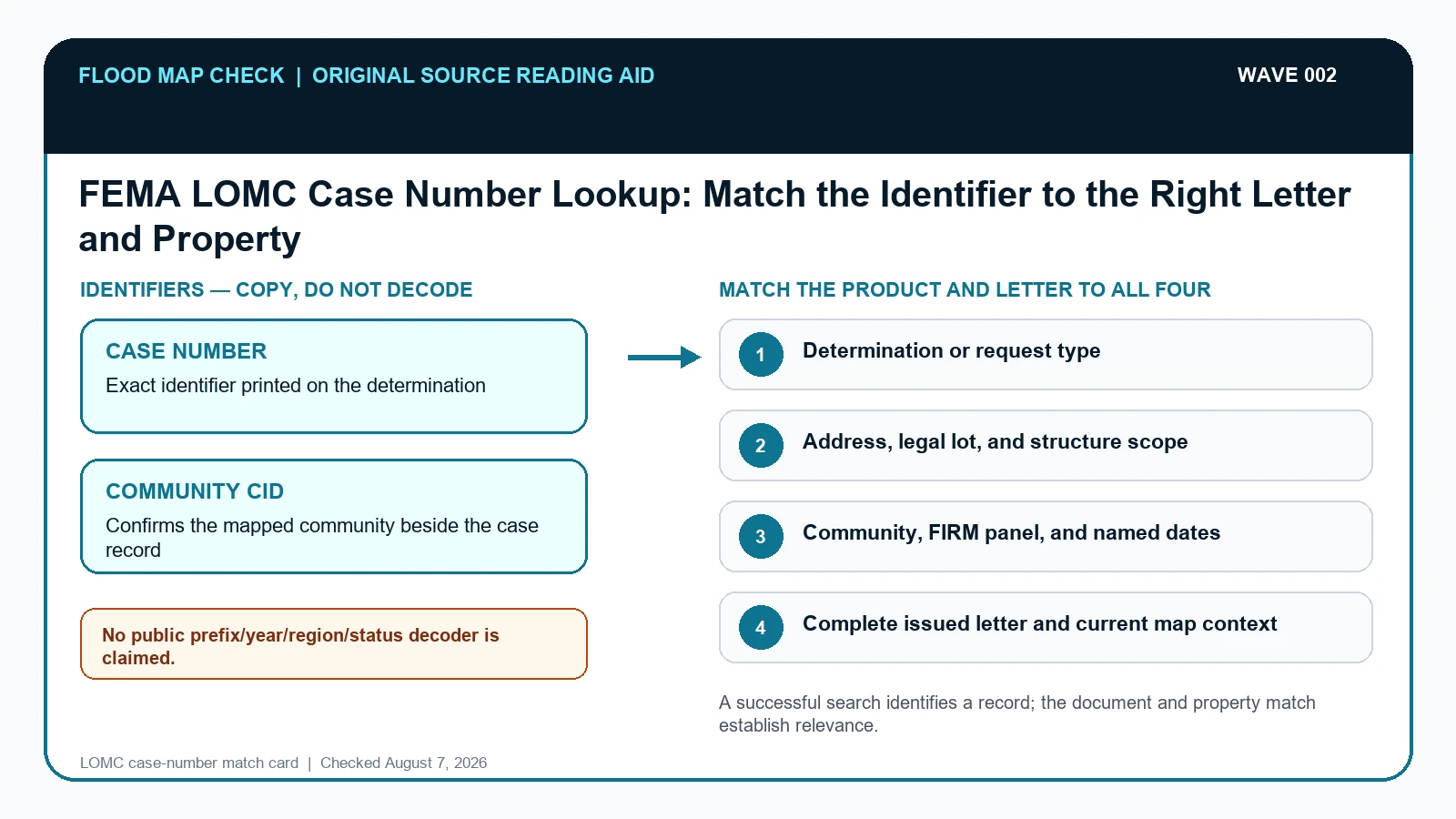
A FEMA Letter of Map Change case number is a tracking key, not proof that a letter covers a particular building. Copy the identifier exactly, then match it to the determination letter, property description, affected FIRM panel, determination date, and current case record before relying on it.
Last checked: August 7, 2026.
FEMA's technical reference directs users to locate LOMR determination documents in the Map Service Center through a Product ID search, typically using the LOMC case number. The current public material used here does not publish a dependable prefix-by-prefix decoder, so a year-looking or region-looking segment must not be interpreted as an effective date, office, outcome, or request type. Keep the correct community CID beside the result as a jurisdiction cross-check, but let the signed determination and its property description control. A valid identifier found on a neighbor's letter, a former parcel description, or a superseded panel is still the wrong evidence for the reader's property.
Why the number is a search key, not a decoder ring
FEMA's technical reference says LOMR determinations can be located in the Map Service Center through a Product ID search, typically using the LOMC case number. It does not provide a dependable current decoder that turns each case-number segment into a year, region, request type, or outcome. That is an important negative finding. A number that looks meaningful should be copied as an opaque identifier. The useful anatomy is therefore the evidence around it: the exact case number, community CID as a jurisdiction check, determination, property description, request type, and map products in force when the letter was issued.
A closing file illustrates why this distinction matters. Imagine that a seller supplies a case number and a one-page scan, while the legal description covers Lot 12 and the house being sold sits on reconfigured Lot 12A. The number may retrieve a genuine FEMA record and still fail the subject match. The reviewer should compare the complete letter, community and panel references, affected land or structure language, and issue date. A clean match is a chain of facts, not a successful search box result.
Older determinations need a second temporal check. If a revised FIRM became effective after the letter, the case number does not reveal whether the result was incorporated, revalidated, superseded, or otherwise affected. Preserve the old letter exactly as issued and look for the transition record tied to the new study. Do not rewrite the old panel or date in the archived evidence merely because a newer map exists; record the historical and current contexts in separate columns.
Which FEMA records can actually identify the case
FEMA Coordinated Needs Management Strategy Technical Reference supplies FEMA's direction that LOMR determination documents can be found through MSC Product ID searches, typically using the LOMC case number; this guide cites it for Case number. FEMA community-number lesson supplies the six-digit CID, the five-digit countywide identifier plus C, and where those identifiers appear in a map number and panel title block; this guide cites it for Community CID. FEMA Change Your Flood Zone supplies LOMA, LOMR-F, CLOMR, and LOMR request routes and limitations; this guide cites it for Determination type.
The FEMA LOMC case number lookup crosswalk keeps these assignments explicit: FEMA Coordinated Needs Management Strategy Technical Reference → Case number; FEMA community-number lesson → Community CID; FEMA Change Your Flood Zone → Determination type. If Case number or another named field is absent from its cited record, leave that fact unresolved and obtain it from the responsible official source instead of expanding a different citation beyond scope.
| Official record | What it actually supplies | Field used here |
|---|---|---|
| FEMA Coordinated Needs Management Strategy Technical Reference | FEMA's direction that LOMR determination documents can be found through MSC Product ID searches, typically using the LOMC case number | Case number |
| FEMA community-number lesson | the six-digit CID, the five-digit countywide identifier plus C, and where those identifiers appear in a map number and panel title block | Community CID |
| FEMA Change Your Flood Zone | LOMA, LOMR-F, CLOMR, and LOMR request routes and limitations | Determination type |
For this check, the cited evidence is limited to Case number, Community CID, and Determination type plus the other fields named in the crosswalk. Record a changed or missing Community CID value with the retrieval date before taking the action to match a FEMA LOMC case identifier to the correct determination and property before relying on it, then request clarification from its publishing agency.
How Case number connects to Case disposition
| Field | Meaning in this check | Error it exposes | Response |
|---|---|---|---|
| Case number | Copy every digit, hyphen, and ending from the FEMA letter | A near match may be a different request | Use the exact value for the MSC Product ID search and keep the community CID as a cross-check |
| Community CID | Confirms the community or countywide map jurisdiction | A plausible case can belong to a different community | Match the CID to the property jurisdiction and current map set |
| Determination type | Read LOMA, LOMR-F, CLOMA, CLOMR-F, LOMR, or other label on the letter | Different request types answer different map questions | Match the result to the task being performed |
| Property identifier | Record address, legal description, structure, lot, and community | The case can apply to less than the whole parcel | Confirm the searched property is expressly covered |
| Panel and date | Save panel number, suffix, effective date, and letter date separately | A newer panel can change the status context | Check current map and transition records |
| Case disposition | Quote the current official record or document wording | A status label is not an approval forecast | Follow the official next action or notice |
Read the table in two passes. First confirm Case number, Community CID, and Determination type. They answer “Copy every digit, hyphen, and ending from the FEMA letter”, “Confirms the community or countywide map jurisdiction”, and “Read LOMA, LOMR-F, CLOMA, CLOMR-F, LOMR, or other label on the letter”. Any disagreement among Case number, Community CID, and Determination type should remain visible rather than being blended into one result.
Next test for two different problems: “A near match may be a different request” and “Different request types answer different map questions”. They require different corrections. For the first, follow “Use the exact value for the MSC Product ID search and keep the community CID as a cross-check”; for the second, follow “Match the result to the task being performed”.
Panel and date and Case disposition show when to stop. The warning conditions are “A newer panel can change the status context” and “A status label is not an approval forecast”. The limits on Panel and date and Case disposition keep the evidence useful without making the broader decision reserved for the named authority or professional.
Match the letter before checking the current panel
Build the evidence from Case number outward. The middle of the review should move from “Match the determination type and issue date before interpreting any segment of the number” to “Compare the address, legal description, structure designation, community number, and panel reference”. Record any conflict before continuing to the remaining checks.
- Photograph or scan the complete FEMA determination rather than copying the number from an email subject line.
- Transcribe the case number exactly and keep an image of the printed identifier beside the transcription.
- Match the determination type and issue date before interpreting any segment of the number.
- Compare the address, legal description, structure designation, community number, and panel reference.
- Open the current effective map products and note whether the panel has changed since the letter.
- Locate any SOMA, revalidation, supersession, or incorporation record that affects the older determination.
- Save the official document URL, case number, dates, scope, unresolved item, and checked date in one evidence row.
After the comparison, “Save the official document URL, case number, dates, scope, unresolved item, and checked date in one evidence row”. The saved evidence should let another reader retrace Case number through Determination type without guessing which limitation applied.
A genuine case number attached to the wrong property
Suppose a closing file contains a case number but only the first page of the letter. Treat the number as a search handle. Retrieve the complete case material, compare the legal lot or structure description, and note whether the letter addresses land, one structure, or a larger revision. If the map panel has since changed, look for incorporation, supersession, or revalidation evidence instead of assuming the old result carried forward.
In this example, Case number identifies the relevant record, while Determination type is the fact most likely to change the interpretation. Conclude “Strong identity chain” only when the evidence shows “Same property, request type, panel, and date”.
For FEMA LOMC case number lookup, if the facts instead fit “MSC product lookup has no result”, the result changes to “Absence is not cancellation”. Respond by following “Recheck the case number and CID, then ask FEMA with the full letter context”. Do not substitute the more favorable conclusion from the earlier example.
Complete match, wrong subject, later FIRM, or no search result
| Observed state | Evidence test | Limited conclusion | Next response |
|---|---|---|---|
| Identifier and complete letter match | Same property, request type, panel, and date | Strong identity chain | Save the complete determination and current-map check |
| Identifier matches but property text differs | Different lot, structure, or legal description | Wrong subject despite a plausible number | Stop and locate the correct case |
| Old letter predates a revised FIRM | New effective panel or study exists | Transition status is unresolved | Find SOMA, incorporation, or revalidation evidence |
| MSC product lookup has no result | Only a partial or retyped number is available | Absence is not cancellation | Recheck the case number and CID, then ask FEMA with the full letter context |
Use “Same property, request type, panel, and date” to recognize “Identifier and complete letter match”. If the facts instead meet “Different lot, structure, or legal description”, report “Wrong subject despite a plausible number” and follow “Stop and locate the correct case”.
If the observation matches “New effective panel or study exists”, stop at “Transition status is unresolved”. If it matches “Only a partial or retyped number is available”, stop at “Absence is not cancellation”. The corresponding actions are “Find SOMA, incorporation, or revalidation evidence” and “Recheck the case number and CID, then ask FEMA with the full letter context”.
Recover from a partial number, partial letter, or later FIRM
- Avoid guessing the case from an incomplete number. Recheck Case number. The mapped warning is “A near match may be a different request”; the corresponding response is “Use the exact value for the MSC Product ID search and keep the community CID as a cross-check”.
- Avoid treating the year-like segment as an effective date. Recheck Panel and date. The mapped warning is “A newer panel can change the status context”; the corresponding response is “Check current map and transition records”.
- Avoid assuming one letter covers every building on a parcel. Recheck Property identifier. The mapped warning is “The case can apply to less than the whole parcel”; the corresponding response is “Confirm the searched property is expressly covered”.
- Avoid calling a plausible identifier a current determination. Recheck Case disposition. The mapped warning is “A status label is not an approval forecast”; the corresponding response is “Follow the official next action or notice”.
Check Case number when the risk is “guessing the case from an incomplete number”, because the mapped warning is “A near match may be a different request”. Check Panel and date separately for “treating the year-like segment as an effective date” and use “Check current map and transition records” as the recovery step.
Two field-specific corrections are required. For “assuming one letter covers every building on a parcel”, follow “Confirm the searched property is expressly covered”. For “calling a plausible identifier a current determination”, follow “Follow the official next action or notice”. Keeping Property identifier separate from Case disposition prevents one repaired field from hiding the other error.
What this LOMC case-number match card cannot decide
Scope: United States FEMA mapping projects and formal map-change cases. Limitation: A plausible-looking case number does not prove that a letter applies to the searched property.
This comparison can expose a conflict between Case number and Determination type, but it cannot resolve “MSC product lookup has no result”. In that condition, the defensible next step remains “Recheck the case number and CID, then ask FEMA with the full letter context”.
Carry the verified case into map-transition research
- Carry the verified Case number to FEMA LOMA LOMR F Lookup if that linked topic is the reader’s next question.
- Keep Determination type attached to its source when moving to FEMA Preliminary vs. Effective Flood Map.
- Treat FEMA LOMR CLOMR Map Revision as a separate review triggered by Case disposition while working to match a FEMA LOMC case identifier to the correct determination and property before relying on it, not as confirmation of the result here.
Use this guide to match a FEMA LOMC case identifier to the correct determination and property before relying on it. The linked guides address separate questions raised by Case number, Determination type, or Case disposition.
Before treating a LOMC case as relevant
Does Case number settle the question by itself?
No. Case number answers “Copy every digit, hyphen, and ending from the FEMA letter”, but it can fail when “A near match may be a different request”. Pair it with Community CID, Determination type, and the checked date.
What if the evidence shows MSC product lookup has no result?
Confirm the stated evidence test: “Only a partial or retyped number is available”. The limited conclusion is “Absence is not cancellation”. The documented response is “Recheck the case number and CID, then ask FEMA with the full letter context”; a more favorable branch should not be substituted.
When should Case disposition be checked again?
Repeat the case check when FEMA issues a corrected determination, the community CID changes, or a revised FIRM becomes effective. Keep the original letter beside any SOMA, incorporation, supersession, or revalidation record so the older case is not silently treated as current.
FEMA LOMC Case Number Lookup: Match the Identifier to the Right Letter and Property is independent public-record guidance for the limited action to match a FEMA LOMC case identifier to the correct determination and property before relying on it. The cited government records retain authority over Case number and Case disposition. Last checked: August 7, 2026.