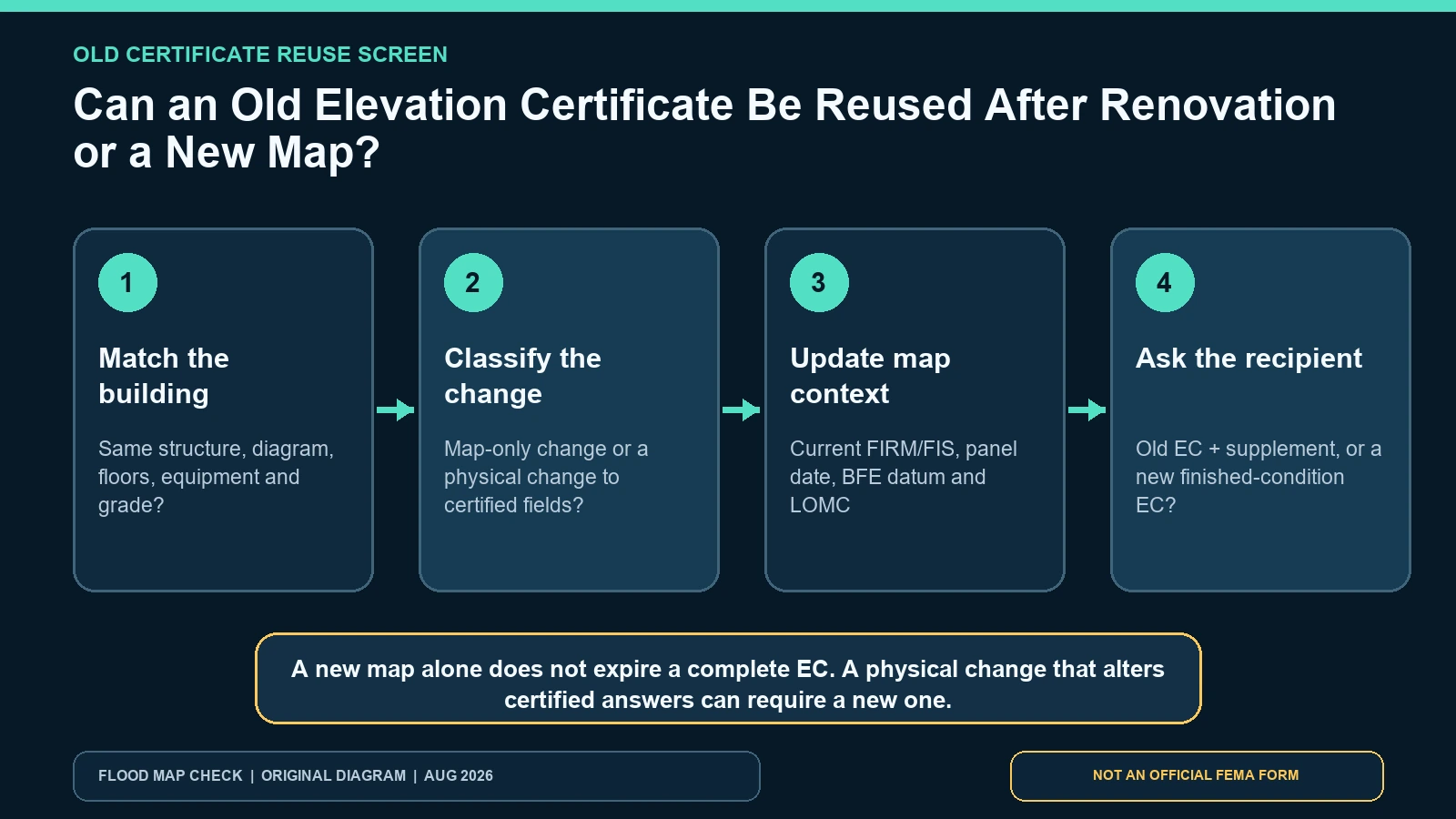
An old Elevation Certificate does not automatically expire because FEMA issued a new map or because the date printed on the form has passed. FEMA’s Elevation Certificate FAQ says a complete and correct certificate already prepared for a building remains usable unless a physical change invalidates information that was certified. A new FIRM or Letter of Map Change by itself does not require a new certificate. Renovation, an addition, changed adjacent grade, or finished construction can require a new one when the change alters answers in Sections A, C, E, or H.
Last checked: August 7, 2026.
That rule is a starting screen, not a promise that a lender, insurer, buyer, or local official will accept a particular file. Download the version FEMA currently posts through its underwriting forms page, compare the old certificate with the building as it exists today, and retrieve the current map products from the FEMA Map Service Center. Treat building validity and map currency as two separate questions.
The certificate’s date is not the same thing as its usefulness
An Elevation Certificate records facts observed or assembled at a point in time: the identified building, building diagram, openings, surveyed elevations, adjacent grades, machinery elevation, map panel, flood zone, BFE source, and datums. The certification date tells you when the professional signed that record. It does not create a universal shelf life. Reuse depends on whether the certified building facts remain true and whether the user can pair them with the map information needed for today’s decision.
Start by asking what the old file will be used for. A buyer may need a reliable description before closing. A designer may need baseline elevations before planning work. A community may need permit-compliance documentation. An insurance agent may need information that meets current underwriting requirements. The same old certificate may be useful background for one task yet insufficient for another. Ask the receiving party which edition, attachments, photographs, and supplemental map records it requires before ordering expensive fieldwork.
| Change since certification | Likely effect on reuse screen | Evidence to compare | Practical next step |
|---|---|---|---|
| New effective FIRM or LOMC; building unchanged | FEMA FAQ says map change alone does not necessitate a new EC | Old Section B, current FIRM/FIS, LOMC case and date | Keep the old surveyed building data, but update the map context with the receiving official |
| Substantial improvement | FEMA FAQ identifies this as requiring a new EC | Permit scope, construction stage, new elevations and grades | Arrange the certificate stages required by the local permit process |
| Repair that changes no answer in A, C, E, or H | Old EC may remain useful | Plans, site photographs, grade and equipment check | Document why the certified fields did not change and confirm acceptance |
| Addition, regrading, enclosure, raised equipment, or altered floor | A changed certified answer can invalidate reuse | As-built geometry, new survey, diagram, M&E and adjacent grade | Ask the authorized professional for a new finished-construction EC |
| Certificate based on construction drawings or building under construction | The form itself calls for a new EC when construction is complete | C1 selection and completed as-built work | Obtain the post-construction certificate |
Inspect the building before updating the map fields
Walk the property with the old certificate rather than reviewing only the PDF. Match the exact building address and parcel description. Compare the structure with the selected Building Diagram. Look for lateral additions, enclosed areas below an elevated floor, crawlspace changes, garage conversion, new flood openings, filled openings, deck or stair work, equipment moved to another platform, and grading or landscaping that changed the lowest or highest adjacent grade. A cosmetic interior remodel may leave every relevant answer intact; a small exterior project can change several certified fields.
Do not decide from project cost alone. The FEMA FAQ frames the reuse issue around whether physical work changes the certificate’s answers. Local substantial-improvement rules are a related but distinct compliance question. Bring the permit history and as-built scope to the local floodplain administrator. If a licensed professional cannot verify concealed or altered conditions, the safest operational result is not “valid” or “invalid”; it is “new field evidence required.”
Update Section B without overwriting the historic record
Use the Map Service Center to locate the current effective FIRM, panel number and suffix, effective or revised date, Flood Insurance Study, and any Letters of Map Change. FEMA’s official MSC training explains that Search by Address is for the current effective map, while Show All Products can expose historic and preliminary products, FIS reports, and LOMCs. Save the current result beside the old certificate; do not silently type new map values onto a signed and sealed historic document.
A map change can alter the flood zone or BFE associated with the location while the building’s surveyed elevations remain the same. That is why map currency and certificate reuse must be reported separately. Record both dates: the certificate’s certification date and the effective date of the map product used for the present review. If a LOMA or LOMR applies, save its case number, letter date, and affected structure or parcel. Do not assume that a map letter for one lot or building automatically covers every structure on a multi-building property.
| Official record | Use it to verify | Record this evidence | What it cannot decide |
|---|---|---|---|
| FEMA Elevation Certificate FAQ | Whether an existing complete EC expires and which physical-change scenarios call for a new EC | FAQ date, scenario, and the changed sections | Whether a particular recipient will accept the old packet |
| FEMA EC form and instructions | C1 construction status and the fields that describe the building | Form edition, signed date, C1, A7, C2, attachments | Whether post-certification work left every answer unchanged |
| FEMA Map Service Center | Current effective and historic map products and LOMCs | Panel, suffix, effective date, FIS and case number | The building’s as-built elevation or condition |
| Local floodplain administrator | Local permit, substantial-improvement and document-acceptance requirements | Name, date, project scope and written response | The insurer’s underwriting decision |
Give the receiving party a two-date evidence packet
A useful reuse packet preserves the old signed certificate and adds a dated review sheet. The sheet should identify the structure, state the intended use, list every physical change since certification, name the current effective map and any LOMC, and flag fields that could no longer be verified. Attach permit records, dated exterior photographs, as-built plans, and correspondence only when they help prove a specific comparison. Never alter the original signature, seal, elevation numbers, or comments.
- Confirm that the PDF is complete, legible, signed, dated, and includes referenced attachments.
- Match the building, not merely the mailing address or parcel, on a multi-structure site.
- Compare the old Building Diagram and every field affected by additions, enclosures, equipment, decks, stairs, or grading.
- Retrieve the effective FIRM/FIS and map-change history; record their effective dates separately from the EC date.
- Ask the community and intended insurance or lending recipient what current documentation they will accept.
- Order a new field survey when a changed or unverifiable fact affects the intended decision.
For help finding the official copy and the correct recipient, use the Elevation Certificate source and routing guide. If Section B no longer matches, follow the FIRM and FIS BFE lookup workflow before asking a professional to reconcile datums or map changes.
Three reuse failures that deserve an immediate stop
First, stop when the certificate describes the wrong structure. Address matches are not enough when a parcel contains a house, detached garage, guest unit, or replacement building. Second, stop when grading, lowest-floor geometry, flood openings, or machinery has changed and no qualified person has verified the new condition. Third, stop when someone proposes editing the old signed form to show a new map panel or elevation. Preserve the historic record and obtain an authorized update or replacement.
Also stop when only selected pages survive, the seal or signature is unreadable, comments refer to missing attachments, the C1 box says construction drawings or building under construction, or the vertical datum cannot be reconciled with the current BFE. A lender letter or online flood-zone result does not repair those gaps. It answers a different question.
What reuse does not establish
Reusing an old Elevation Certificate does not guarantee that a building complies with the current ordinance, that insurance is available at a particular price, that a lender will waive coverage, or that the property will not flood. It does not update a map, establish a parcel boundary, prove that no substantial improvement occurred, or authorize construction. It means only that identified facts in an older certified record may still be usable for a defined purpose after the building and map context have been checked.
When a lender has issued a flood determination, compare that separate record using the Standard Flood Hazard Determination guide rather than treating it as a replacement EC. Keep the question narrow: does the old certificate still describe this building well enough for the receiving party’s stated use?
Questions to resolve before paying for a new survey
Does a new FEMA map automatically invalidate my old certificate?
No. FEMA’s 2023 FAQ says a map change alone does not necessitate a new EC when one already exists. The current zone, BFE, panel, and LOMC context may still need to be paired with the old building data.
Does a renovation always require a replacement?
No. The relevant screen is whether the work changes answers in the certificate and whether it is a substantial improvement under the local process. Additions, regrading, changed floors, enclosures, and moved machinery deserve specific review.
Can I correct Section B myself and keep the old signature?
Do not alter a signed and sealed record. Preserve the original and ask the local official or original certifier how the current map information should be documented for the intended use.
The practical reuse decision
Use the old certificate when it is complete, the identified building is unchanged in every relevant certified respect, and the receiving party agrees that the record plus current map evidence is sufficient. Obtain a new certificate when physical work or finished construction changes a recorded answer, when the structure cannot be matched, or when the needed fields cannot be verified. Source scope and links were checked August 7, 2026; FEMA forms and recipient requirements can change, so reopen the official pages before submission.