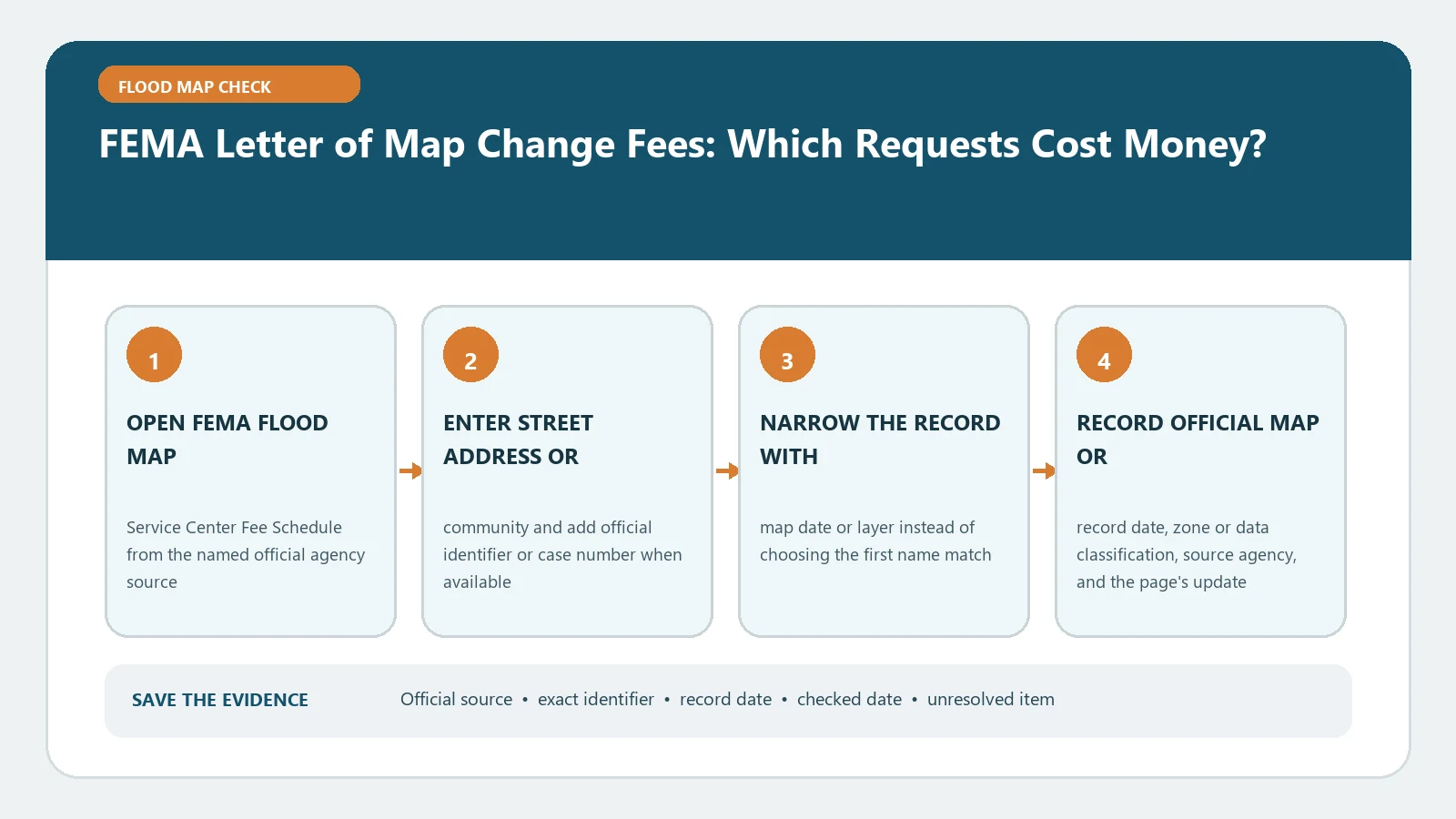
Whether a FEMA Letter of Map Change request costs money depends on the exact request type, the physical basis for the change, and the current FEMA fee schedule. Identify the intended product before looking for a dollar amount. A no-fill LOMA, a fill-based revision, and a project that changes flood elevations may all aim to change a map result, but FEMA does not process or charge for them as one category.
Use FEMA’s live Flood Map-Related Fees page for the current amount. Pair it with the Paper Application Forms for Letter of Map Changes, which distinguishes MT-EZ, MT-1, and MT-2 requests and explains when payment information accompanies a package. Sources checked August 26, 2026. This page intentionally does not copy volatile dollar figures; recheck immediately before paying.
Name the determination, not the desired outcome
Start with what happened to the land and what FEMA is being asked to issue. A Letter of Map Amendment generally addresses natural ground or a structure that a requester believes was inadvertently included in the Special Flood Hazard Area. A Letter of Map Revision Based on Fill addresses eligible property elevated by fill. A Conditional letter comments on a proposed condition. A LOMR can revise floodplain boundaries, floodways, or flood elevations based on technical data.
Write one line that includes the product, existing or proposed condition, fill status, number of lots or structures, and whether hydraulic or hydrologic data change. If those facts are unknown, the fee question is premature. MT-EZ vs MT-1 can narrow the property-level form family without pretending to choose a professional engineering route.
Understand why some amendments and revisions differ
FEMA’s MT-1 instructions state that single or multiple lot or structure LOMA requests do not have a review and processing fee, while specified conditional and fill-based requests are subject to cost recovery. That distinction depends on the request qualifying as the named product. Calling a fill-based case a LOMA does not make it a no-fill amendment.
Keep survey, title, deed, plat, effective-map, and grading evidence aligned with the request. FEMA LOMA Application Documents shows the evidence chain for natural-grade amendment work. If fill was placed, use the route that discloses it rather than selecting a form because its fee appears lower.
Treat MT-2 projects as technical reviews
CLOMR and LOMR requests may involve changes to a floodway, flood elevations, hydrology, hydraulics, channel, bridge, culvert, grading plan, or other mapped conditions. FEMA’s LOMR and CLOMR page explains the conditional-versus-final distinction and notes that online submittals can offer a reduced review and processing fee.
The application fee is only one project cost. Engineering models, survey work, environmental documentation, notices, local reviews, revisions after a data request, and record preparation can exceed the federal filing charge. Keep those costs in separate rows so a requester does not mistake FEMA’s fee for a complete budget.
Compare online and paper routes before paying
The paper-forms page directs fee-bearing packages to include payment information and gives the clearinghouse route. Online LOMC can accept submissions and associated payment for supported request types. The LOMR and CLOMR page indicates that online submission may reduce review and processing charges for those products.
Before choosing a channel, confirm that it accepts the exact request. Do not create duplicate online and paper cases to see which moves faster. Save the submission route, account or case identifier, fee category, current schedule date, amount, payment method, and receipt. Never place card or bank details in a shared editorial packet.
Build the classification table before opening the schedule
Use one row per proposed FEMA product and capture the facts that drive the fee route:
- natural ground, fill, or broader physical map revision;
- existing condition or proposed condition;
- structure, lot, multiple lots, or mapped reach and floodplain area;
- MT-EZ, MT-1, or MT-2 form family;
- amendment, fill-based revision, conditional review, or final revision;
- online or paper submission availability;
- possible fee exemption and the official basis still needing confirmation.
Only after the row is complete should the live schedule be consulted. This makes it harder to choose a product merely because one listed amount is lower.
Keep lender disputes outside the LOMC fee calculation
A borrower disputing a lender’s flood-zone determination may have an administrative review route that is not the same as asking FEMA to amend or revise a map. First identify whether the problem is the lender’s selected location, a map determination, or the underlying effective map. FEMA Letter of Determination Review explains that separate dispute path.
Paying for a map-change case is not automatically the fastest or correct response to a geocoding error or lender-document mismatch. Preserve the lender notice, property identity, effective map, and any existing LOMC before choosing a federal filing.
Resolve an uncertain fee without guessing
If the fee page and form instructions appear inconsistent, first check their dates and whether one describes a broader or different product. Confirm fill status, conditional versus final state, project scale, and whether FEMA has asked for additional data or a fee on an existing case. Use the FEMA Mapping and Insurance eXchange contact route named in the instructions when classification remains unclear.
After filing, a case status such as Awaiting Data/Fee means FEMA is waiting for an item; it does not reveal whether the original classification was correct. FEMA LOMC Case Status explains how to preserve a response and case number without inventing a decision.
Record what the payment does not prove
A paid fee is not approval, technical sufficiency, map removal, permit clearance, or lender acceptance. It funds the applicable review and processing path. FEMA may request more information, and a conditional finding does not replace the final submission after work is completed.
Keep a fee-decision sheet with request acronym and plain-English basis, form package, fill status, structures or area covered, technical-change category, official fee-page URL and checked date, selected channel, quoted amount, fee-exemption basis if any, case number, and unresolved questions. That record lets another reviewer reproduce why a charge or no-fee route was selected without freezing today’s dollar figure into tomorrow’s instructions.