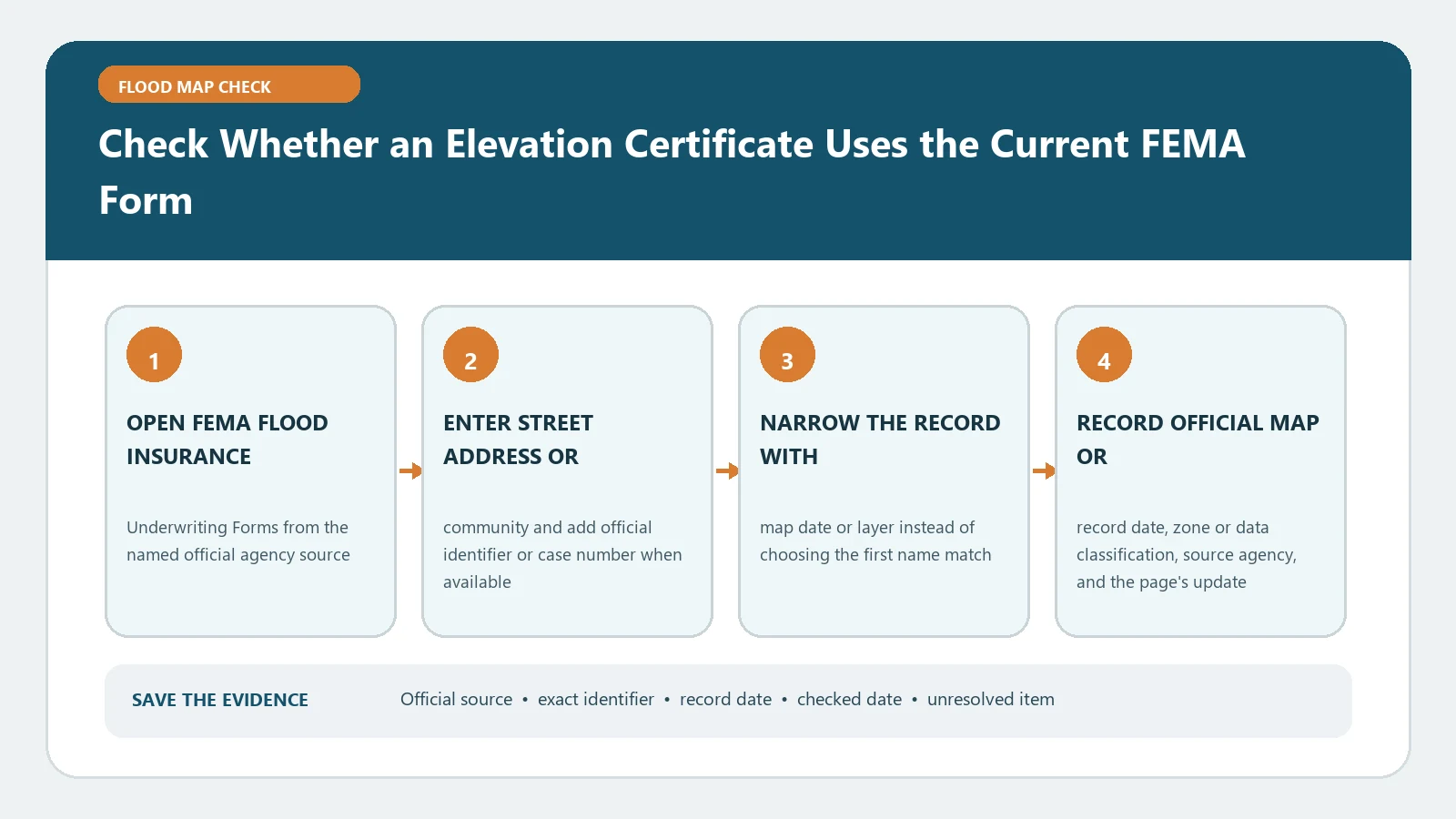
Check an Elevation Certificate’s current status against FEMA’s live underwriting-forms page and the latest NFIP bulletin, not only the expiration date printed on a saved PDF. As of August 26, 2026, NFIP bulletin W-26002 directs continued use of the existing Elevation Certificate while updated forms are under review. That instruction can change when FEMA approves and posts a replacement, so the live source controls new work.
Open FEMA’s Underwriting Forms page, then read NFIP bulletin W-26002. Compare those sources with the Elevation Certificate form and instructions in front of you. Each source was checked on August 26, 2026.
Inventory the edition before judging it
Record the FEMA form number, former form number if printed, revision notation, OMB control number, expiration date, page count, and any footer date. Also record where the file came from and when it was downloaded. A filename such as elevation-certificate-final is not edition evidence.
Check that the pages belong to one edition. Mixed packages occur when someone replaces only the first page or combines instructions from another download. The field labels, building-diagram pages, instructions, and certification page should form one coherent set. Preserve the original file hash or an unedited copy when the record will support a transaction.
Let the live FEMA route answer the current-use question
The underwriting page is the operational starting point because FEMA can replace its downloadable form without changing an old bookmark or local office folder. Follow the link from that page and compare the form number and revision details with the candidate document.
Then check the latest bulletin. W-26002, dated July 15, 2026, says the Elevation Certificate and Floodproofing Certificate were under review and instructs users to continue using the existing forms until the review is complete. It also says FEMA will issue another memorandum and update the website when the newly approved forms are ready for immediate use.
Do not convert that temporary instruction into a permanent rule. Save the bulletin number and check date. For work completed after a later FEMA announcement, reopen the live forms page and look for superseding guidance.
Separate a new assignment from an old property record
Current form means the edition FEMA directs a professional or official to use for work being completed now. A historical certificate asks another question: whether the document accurately records a building and map context at its completion date and whether the receiving party will accept it for today’s purpose.
An older certificate does not become factually empty because a form edition changes. Its surveyed elevations, building description, map panel, photographs, and certification may remain important evidence. Yet renovations, a new FIRM, altered grades, a changed datum workflow, missing pages, or a recipient’s rules can require review or a new certificate. Use Can an Old Elevation Certificate Be Reused for that decision rather than labeling every older footer invalid.
Check whether all required evidence survived
Edition review is not a substitute for completeness review. Confirm that the property information, flood-map fields, building diagram, elevation rows, vertical datum, benchmark or conversion note, photographs when required, comments, signature, seal, license details, and attachments are present for the certificate’s purpose.
The form instructions assign different sections to property information, flood-hazard information, building elevations, certification, and community review. A document can use the currently directed edition and still be unusable because the selected building is wrong, a page is absent, the map date is stale, or the certification is incomplete. Elevation Certificate Sections A and B provides a property-and-map crosscheck before any C2 number is used.
Treat edits and corrections as a new evidence event
Do not overwrite a date, zone, diagram, or elevation on the saved certificate to make it resemble the current form. If the problem is a clerical mistake, unclear comment, or changed site condition, document the discrepancy and return it to the appropriate certifier or official. Correcting an Elevation Certificate separates amendment, replacement, and supporting-note routes.
Preserve both versions when a correction is issued. The audit trail should show who changed what, why, and when. A clean-looking replacement without that provenance can make later map, insurance, or permit review harder.
Sort the document into one of four version outcomes
After the source and completeness checks, place the certificate in one outcome rather than declaring it simply valid or expired:
- current edition directed for new completion, with all needed pages and certifications;
- historical certificate that remains reviewable for the stated building and map date;
- superseded or mixed form package that should not be used to start new work;
- unresolved document whose source, edition, or page set cannot yet be verified.
That classification keeps edition status separate from factual accuracy. A current blank form is not evidence about a building. A complete older certificate is evidence, but it may not satisfy today’s receiver or changed site conditions.
Answer an expiration-date objection with source evidence
When a recipient rejects a form solely because the printed expiration date has passed, provide the live underwriting page, applicable FEMA or NFIP bulletin, form number, and checked date. Ask the recipient to identify any newer controlling instruction it is applying. Do not promise acceptance. A local office, insurer, lender, or other program may impose its own current-document rule in addition to FEMA’s publication status.
Conversely, do not use an extension bulletin to excuse a stale map, missing signature, changed structure, or wrong property. The bulletin answers which form edition FEMA directs during a transition; it does not cure unrelated content defects.
Build a current-form evidence note
For a new assignment, save the live FEMA forms URL, form number, revision and expiration markings, bulletin number, bulletin date, checked date, and the downloaded file. For an existing certificate, add its completion date, property and building identity, effective map reference, completeness findings, later site changes, and the recipient’s stated requirement.
The conclusion should use bounded language: FEMA’s live sources on the checked date directed use of the identified edition, or the old certificate remains a historical record that needs recipient and site-condition review. Only FEMA’s current source can settle the edition question; only the responsible professional, local official, insurer, or lender can decide whether the specific document satisfies its present use.