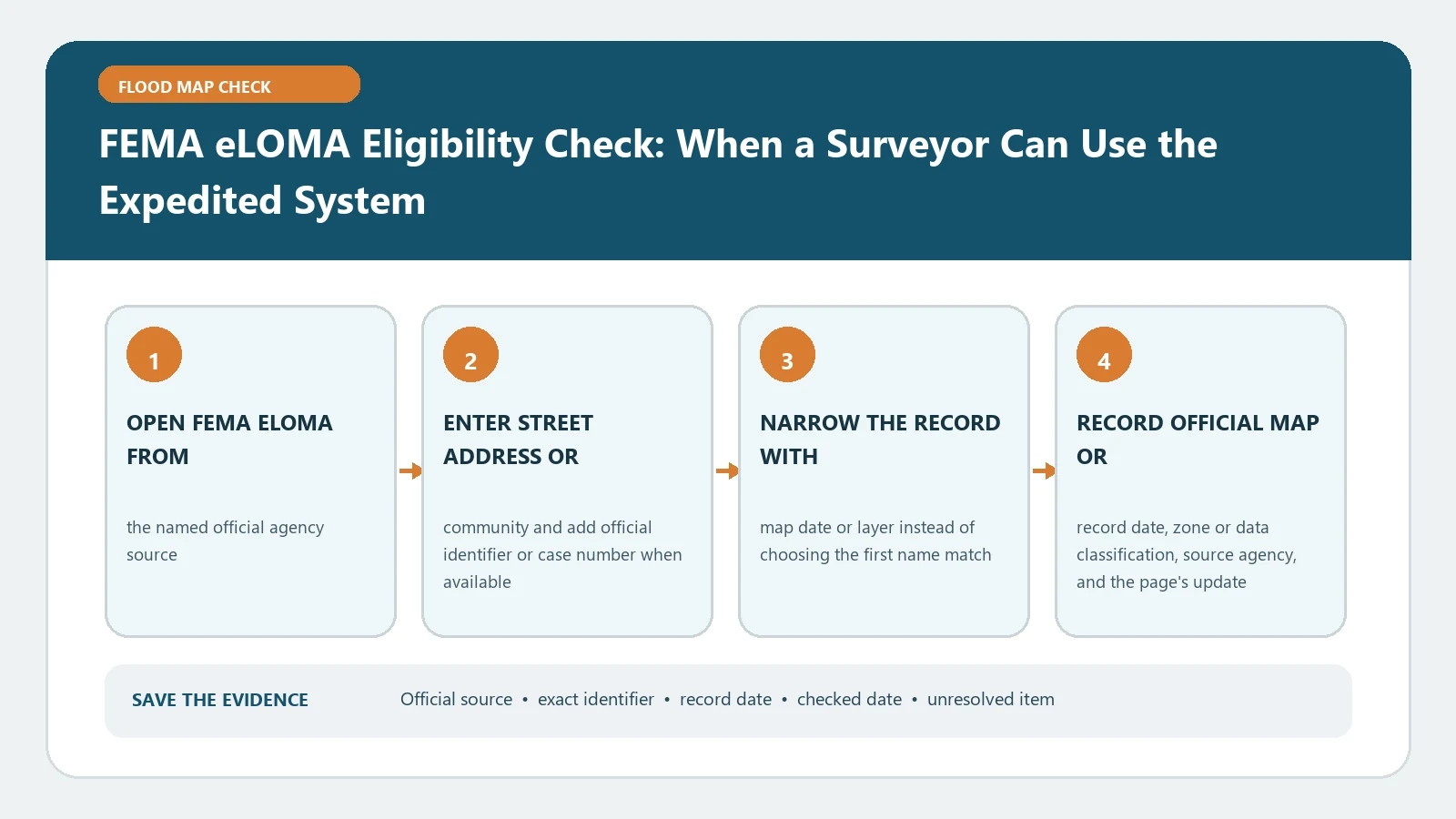
Use FEMA eLOMA to locate the dated official flood record for United States licensed land surveyors and professional engineers screening simple LOMA requests, then compare the map, identifier, and effective date before acting. The result is a screening record, not a survey, lender determination, insurance quote, or local permit decision.
For United States licensed land surveyors and professional engineers screening simple LOMA requests, the safest path is source-first: use FEMA and FEMA, compare identifiers literally, and record both the authority’s date and your checked date.
Choose the record system before entering data
| Official source | Use it for | Save with the result |
|---|---|---|
| FEMA | Start the lookup and identify the current public record | Input used, matched subject, record identifier, status, and displayed date |
| FEMA | Read definitions, instructions, dates, and scope limitations | Authority name, page title, definition relied on, and review date |
Do not cite every official link as though it proved the same proposition. Use the search system for identity, its instructions for field meaning, and the controlling document for the dated decision. A record for United States licensed land surveyors and professional engineers screening simple LOMA requests is easier to audit when each observation names its source and access date.
Match the subject before interpreting a result
Write the subject record before searching. At minimum capture street address or community, official identifier or case number, and map date or layer. This makes alternate searches comparable and exposes a change in spelling or jurisdiction. A nearby address, related company, similar model, or shared name is not a match merely because it appears first.
| Input to collect | How to record it | Mistake to avoid |
|---|---|---|
| street address or community | Keep a second corroborating identifier when names or addresses can repeat. | The field may be optional for search but necessary for confirmation. |
| official identifier or case number | Use the format requested by the official search form. | Do not publish personal or sensitive identifiers in a shared note. |
| map date or layer | Use the format requested by the official search form. | A close match can still belong to a different record. |
A reproducible note does not need every private document. Retain the public search field, matched public identifier, and the values needed to distinguish the record; redact sensitive numbers and application materials. If FEMA eLOMA has several search modes, record the one used and whether a broader query produced unresolved candidates.
Run the lookup in a reproducible sequence
Do not stop at the first plausible row. Move from search input to identity match, then from status to definition, and finally to the dated next action. For FEMA eLOMA Eligibility Check: When a Surveyor Can Use the Expedited System, a second search using official identifier or case number is a useful control. Save database silence as a limited observation rather than a clearance.
Translate the result one field at a time
Transcribe official map or record date, zone or data classification, and other labels exactly as displayed. Words such as active, effective, closed, pending, corrected, failed, recalled, or eligible acquire their meaning from the issuing authority. Read the legend or linked instruction before turning a database label into an action.
| Result field | Verification action | Interpretation limit |
|---|---|---|
| official map or record date | Keep current and historical entries in separate rows. | Only the responsible agency, lender, insurer, surveyor, or floodplain administrator can make the decision within its authority. |
| zone or data classification | Transcribe the displayed wording and date exactly. | A public map can be preliminary, effective, advisory, or locally modeled; those labels are not interchangeable. |
| source agency | Open the detailed record or linked document before interpreting it. | Address geocoding and parcel boundaries can place the marker on the wrong structure or lot. |
| next verification step | Open the detailed record or linked document before interpreting it. | Address geocoding and parcel boundaries can place the marker on the wrong structure or lot. |
Dates answer different questions: when the event occurred, when the rule took effect, when the record changed, and when you saw it. Preserve the authority’s date names for FEMA eLOMA eligibility. If the system supplies no update date, say so instead of treating the page footer as the record date.
Turn the lookup into a citation asset by recording both evidence and uncertainty. For FEMA eLOMA eligibility, the strongest reusable note shows the exact official URL, matched identifier, observed value, governing date, access date, and the next unresolved agency question.
| Evidence field | What to enter | Why it matters |
|---|---|---|
| Target | FEMA eLOMA Eligibility Check: When a Surveyor Can Use the Expedited System | Names the exact record or decision being checked |
| Official source | FEMA | Preserves the issuing authority rather than a copied summary |
| Search input | Exact name, address, number, parcel, model, route, or other identifier used | Makes the result reproducible |
| Matched record | Displayed identifier, jurisdiction, and record type | Shows why the result belongs to the intended subject |
| Observed result | Status or field copied without expanding its meaning | Separates evidence from interpretation |
| Dates | Record date, effective date, and checked date in separate fields | Exposes stale or superseded information |
| Unresolved item | Specific missing field, conflict, or agency question | Prevents silence from becoming a false conclusion |
If you save an image of FEMA eLOMA, include enough surrounding text to identify the authority and field definitions. Cropped status text is easy to misread after an update. Pair every file with its source URL, access date, and a note explaining which fact it supports.
When the official systems disagree
A stale record often looks complete. Check for renewal, modification, follow-up, expansion, rescission, or replacement activity after the displayed date. Keep the earlier record for history, label the newer source clearly, and obtain confirmation if the conflict changes the decision tied to United States licensed land surveyors and professional engineers screening simple LOMA requests.
- A public map can be preliminary, effective, advisory, or locally modeled; those labels are not interchangeable.
- Address geocoding and parcel boundaries can place the marker on the wrong structure or lot.
- Only the responsible agency, lender, insurer, surveyor, or floodplain administrator can make the decision within its authority.
- State the exact unresolved question and include the record identifier in a private agency inquiry.
- Recheck after an agency update, correction, inspection, filing, map revision, or policy effective date.
- Keep the earlier result when change history matters; label it superseded rather than silently replacing it.
For surrounding preparation, consult fema loma lomr f lookup, fema lomr clomr map revision and fema preliminary vs effective flood map. Do not use those summaries to fill a blank in FEMA eLOMA. Missing or conflicting official evidence should remain visible and go back to the responsible authority.
Does an official search result prove the final outcome?
No. It establishes only what FEMA eLOMA displayed for the recorded input and date. A final outcome may require an identity match, controlling document, later inspection, agency decision, professional review, or another jurisdiction. Quote the field and carry its limitation beside it.
Keep the no-result screen as limited evidence, verify the strongest second identifier, and search only another official system identified by the authority. Escalate the exact subject and query when the unresolved gap matters.
How often should the result be checked again?
Use the event that can change official map or record date as the trigger. Reopen the live source after that event and immediately before a time-sensitive action, even when the earlier record appeared complete.
Use this page to structure the work, but cite FEMA and FEMA for the fact. Include the record or document title, public identifier, relevant date, live URL, and access date so another reader can return to the evidence.
Last reviewed August 6, 2026.