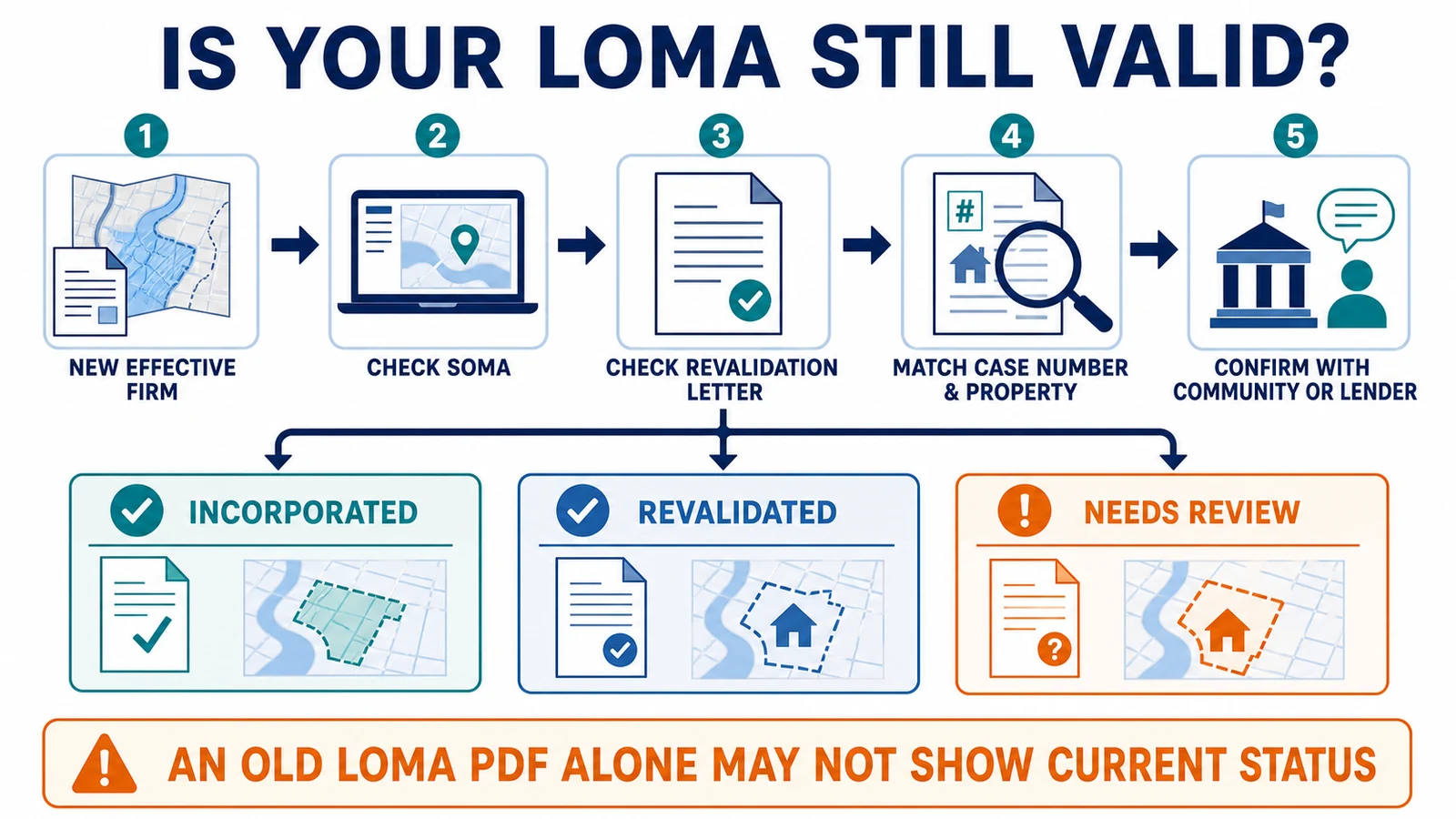
Do not assume an old FEMA Letter of Map Amendment remains effective after a revised Flood Insurance Rate Map takes effect. Match the original LOMA case and panel to the current effective FIRM, then check FEMA’s current LOMA status, the community’s final Summary of Map Actions, and any revalidation letter. A revalidation letter is a community-level list that reaffirms earlier LOMCs that remain valid after the new map; it is not a new property-specific determination, does not add a property that was not in the original case, and cannot cure a case that FEMA marked superseded or needing reevaluation.
Keep the original LOMA with the revalidation evidence. The original determination identifies the property or structure and the facts FEMA decided. The revalidation letter shows that a listed determination continues under the revised panel. You need both the map-change context and the case-specific record. This guide focuses on United States FEMA map revisions; it does not decide a flood zone, issue a LOMA, direct a lender, or replace FEMA or the community floodplain administrator.
| Current record or status | What it means for the earlier LOMA | Next action |
|---|---|---|
| Valid on the current FEMA status layer | The LOMA remains current with the latest FIRM; it may not have required revalidation | Save the current status, original determination, and current panel date |
| Listed in the community revalidation letter | The earlier LOMC is reaffirmed after the revised FIRM | Keep the original LOMC and the exact revalidation-letter row together |
| Incorporated | The old LOMA is no longer the current standalone map action because its effect is reflected in the revised map | Use the new effective FIRM and ask what record is needed for the transaction |
| Contact Community for Revalidation Status | The LOMA predates the current FIRM, but the viewer does not yet supply a final status | Request the final SOMA and revalidation record from the community |
| Reevaluation Needed | The case could not be automatically revalidated, often because a multiple-lot or multiple-structure result must be separated | Ask FEMA or the community which property needs a new determination |
| Superseded | The earlier LOMA is no longer effective under the revised flood data or available evidence | Follow current map requirements and ask whether a new MT-1 request is appropriate |
A new FIRM forces old map actions to be checked again
A LOMA is a property-specific FEMA amendment to an effective map. It commonly determines that a legally described parcel or structure on natural ground was inadvertently shown in the Special Flood Hazard Area. The original letter is tied to a particular effective map, panel, flood data, property description, and elevation evidence. When FEMA replaces that panel with a revised FIRM, the underlying flood elevations, boundaries, datum, or study information may change.
FEMA’s Summary of Map Actions and Revalidation Letters guidance explains the reason for the review: previously valid Letters of Map Change on a revised panel are evaluated against the updated FIRM during the map project’s preliminary, final-determination, and effective stages. Some results are incorporated into the new map, some continue through revalidation, some are superseded, and some need a new determination.
This is different from checking whether a single PDF can still be opened online. The question is whether that case remains effective in relation to the current panel. Use the preliminary-versus-effective map guide if you first need to separate a proposed map from the regulatory map in force today.
Revalidation continues an earlier decision; it does not make a new one
The revalidation process is organized by community and revised panel. FEMA’s guidance says the revalidation letter, when one is needed, becomes effective one day after the revised FIRM effective date. It identifies previously issued LOMCs that remain valid after the new map takes effect. The letter reaffirms those earlier determinations; it does not repeat all of the parcel description, surveyed elevations, conditions, exhibits, or reasoning in the original case.
That boundary matters. A revalidation letter does not survey the property again, correct a legal description, add a neighboring lot, update a building that was not part of the original determination, or decide a new application. It does not convert a superseded case into a valid case. If FEMA indicates that some lots or structures require reevaluation, the community-wide administrative letter cannot substitute for those new property-specific determinations.
The FEMA guidance also separates the map-project process from the LOMC determination process. A property owner or authorized representative may request a property-specific determination through the proper MT-1 or MT-2 path even while a flood-risk project is underway. In other words, waiting for a revalidation list and applying for a new determination are different actions.
Collect the identifiers that tie the case to the revised panel
Before searching, build a one-page case sheet. Revalidation records are community and panel based, while the original LOMA may use a street address, legal description, structure description, and FEMA case number. A mismatch in any of those fields can send you to the wrong map action.
- The complete FEMA case number and the issue or effective date shown on the original LOMA.
- The exact property description covered: structure only, parcel, portion of parcel, lot numbers, or multiple structures.
- The old FIRM panel number and suffix cited by the determination.
- The current FIRM panel number, suffix, and effective date for the same building location.
- The FEMA community name and community identification number, which may not match the postal city.
- Any newer LOMC, subdivision, lot-line change, fill, construction, address change, or map amendment affecting the site.
If the original letter is missing, begin with the LOMA and LOMR-F lookup guide. Do not rely on a title-company note or a lender’s abbreviated reference as the only copy. Retrieve the FEMA determination and exhibits when available, then confirm that the legal description and structure actually match the property being reviewed.
Confirm the current effective panel and map-change date
Search the building location in the official FEMA Map Service Center. Record the current effective FIRM panel, suffix, and effective date. Open the panel’s “Changes to this FIRM” information and review amendments, revisions, and revalidations. Do not stop at the map image: a letter can affect a property even when the printed panel cannot show a small parcel-level result.
Next compare the current panel with the panel named in the original LOMA. A new suffix on the same panel number can signal a later revision. A countywide conversion can also change community and panel formatting. If the address pin falls near a panel edge, verify the structure footprint, not only the parcel center. Record which revised panel contains the building and which community administers it.
The date sequence should be explicit in your file: original LOMA date, preliminary map date if relevant, Letter of Final Determination stage, revised FIRM effective date, and revalidation-letter effective date. A preliminary SOMA can warn how FEMA expects to treat the case, but it does not make a preliminary map the current regulatory FIRM.
Use the current FEMA status as a lead, not as the entire file
FEMA’s current LOMA Revalidation Statuses sheet explains labels shown for LOMA points in the National Flood Hazard Layer Viewer. The labels help route the next check, but a point and color do not reproduce the legal description or every condition in the determination.
- Valid: FEMA describes the LOMA as current with the latest panel and still valid. It may have no revalidation status or have been treated as not incorporated in an update.
- Incorporated: the modification is reflected in the revised FIRM, and FEMA’s status sheet says the old LOMA is no longer valid as a separate current action.
- Contact Community for Revalidation Status: the case predates the current FIRM, but the status is unresolved in the viewer. Get the community’s record rather than guessing.
- Reevaluation Needed: some or all of a multiple-lot or multiple-structure determination requires a new decision and cannot be automatically revalidated.
- Superseded: revised flood data, inadequate information, changed elevations, another LOMC, or another listed reason has displaced the old determination.
Save a dated screenshot or exported result for your working file, but obtain the underlying documents for a transaction, permit, or lender question. Viewer symbology can change, a point can be approximate, and an address can cover more than one structure.
Ask the community for the final SOMA and revalidation letter
The floodplain administrator, planning office, map repository, or other community contact should have the new FIRM adoption record and the map-action documents delivered during the revision. Request the final Summary of Map Actions for the correct community and revised panels, plus the revalidation letter if FEMA issued one. A revalidation letter may not exist when no cases required revalidation.
Give the official the case number, old and new panel numbers, property address, legal lot information, and original letter date. Ask for the page or row that includes the case, not only a general statement that “old LOMAs stay valid.” If the case appears on a list, confirm that the listed panel and property scope match your original determination.
The final SOMA and the revalidation letter serve different moments. The final SOMA describes expected treatment as the map project approaches effectiveness. The revalidation letter is the community-level document that reaffirms listed cases after the revised FIRM becomes effective. Do not use an early preliminary SOMA as a replacement for the later effective record.
Build the evidence packet that matches the status
A clear packet prevents a current map, old letter, and community list from being mistaken for three competing answers. Put the documents in date order and add a cover sheet explaining how they fit.
- If valid without revalidation: include the original LOMA, current FEMA status, current effective panel information, and the matching property description.
- If revalidated: include the original LOMA and exhibits, the revalidation letter page or row naming the case, the revised FIRM effective date, and the current status record.
- If incorporated: lead with the new effective FIRM and FIS or related map record. Keep the historic LOMA as background, not as the controlling standalone action.
- If the community must be contacted: document the request and obtain a written status or the relevant final SOMA and revalidation record before making a claim.
- If reevaluation is needed: identify exactly which lot or structure is unresolved and ask which new application and evidence are required.
- If superseded: treat the current FIRM and current local requirements as the starting point. Do not present the old LOMA as proof that the structure remains outside the SFHA.
For a new property-specific request, use FEMA’s current Letter of Map Change application forms and status guidance to distinguish MT-EZ, MT-1, and MT-2 routes. A natural-ground LOMA, a fill-based LOMR-F, and a project-level LOMR are not interchangeable.
A project map revision and a LOMA revalidation answer different questions
Revalidation looks backward: it asks what happens to an already issued LOMC when FEMA publishes a newer community map. A CLOMR or LOMR project review looks at proposed or completed changes to flood elevations, boundaries, or floodways. If construction, channel work, fill, new modeling, or a larger development changed the physical or modeled condition, the LOMR and CLOMR project guide is the better route.
Do not use a revalidation letter as project authorization. It does not approve building plans, fill, grading, a floodway encroachment, or a new map revision. It only addresses the continuing status of listed earlier map actions in the context of the revised FIRM.
The lender’s insurance decision remains a separate layer
A current LOMA and its revalidation evidence may be relevant to a lender’s mandatory-purchase review, but the map-action file does not itself edit the lender’s Standard Flood Hazard Determination Form or guarantee cancellation of a policy. Give the lender or determination company the documents it requests and keep the submission record.
If the disagreement is whether the lender correctly located the building on the effective map, the Letter of Determination Review guide explains the separate LODR process and its deadline. A LODR reviews the lender’s determination using the effective map information; it is not a revalidation letter and does not amend the FIRM.
Know what the revalidation check does not prove
A revalidated LOMA confirms the continuing status of the earlier FEMA determination listed in the community letter. It does not prove that every part of a parcel is outside every flood hazard, that the building has never flooded, that local drainage or future-risk layers show no hazard, or that all later construction complied with permits. It also does not carry an old determination to a subdivided or reconfigured property without checking the legal description.
Use the revalidation result for the specific decision it supports. A permit official applies the current map and ordinance. A lender applies federal and contractual insurance requirements. An insurer evaluates coverage and rating information. A surveyor or engineer establishes current site facts. Flood Map Check can help organize the source path, but none of those decisions belongs to this site.
Questions that usually surface when an old LOMA meets a new map
Does a LOMA expire automatically?
A LOMA is not best treated as a document with a simple calendar expiration date. Its continuing effect depends on the current FIRM and later map actions. When FEMA revises the panel, check whether the case remains valid, was revalidated, was incorporated, needs reevaluation, or was superseded.
When does a revalidation letter take effect?
FEMA’s current guidance states that the revalidation letter is effective one day after the revised FIRM effective date. Before that transition, use the map-project documents for planning and confirm which map is legally effective.
Is a final SOMA the same as a revalidation letter?
No. The final SOMA categorizes prior LOMCs as the revised map approaches effectiveness. The revalidation letter, when applicable, lists the earlier LOMCs reaffirmed after the new map becomes effective. Keep the stage and date of each document visible.
What if the FEMA viewer says to contact the community?
Do exactly that before relying on the old letter. Ask for the final SOMA, revalidation letter, and a written explanation tied to the case and panel. The label means the viewer does not provide enough information to declare the old LOMA current.
Can one revalidated LOMA cover a neighbor or a newly split lot?
Not automatically. The revalidation continues the earlier determination for the property or structures described in that case. A different parcel, changed legal description, newly built structure, or lot split may require its own review.
Does revalidation force my lender to remove flood insurance?
No. Submit the current map-action evidence to the lender and ask for its written decision. A lender may need to update its determination and may impose insurance requirements beyond the federal minimum under the loan agreement.
What should I keep after the check is finished?
Keep the original LOMA and exhibits, current FIRM panel information, FEMA status result, final SOMA page, revalidation-letter row if applicable, community correspondence, and every lender or permit submission. Record the date each source was checked.
Last checked July 29, 2026. FEMA’s revalidation-status sheet, Summary of Map Actions guidance, Map Service Center path, and LOMC application route were reviewed for this guide. Map projects, viewer labels, effective dates, and community records change. Confirm the case with FEMA and the responsible community before relying on an old LOMA for a permit, loan, insurance, or property transaction.