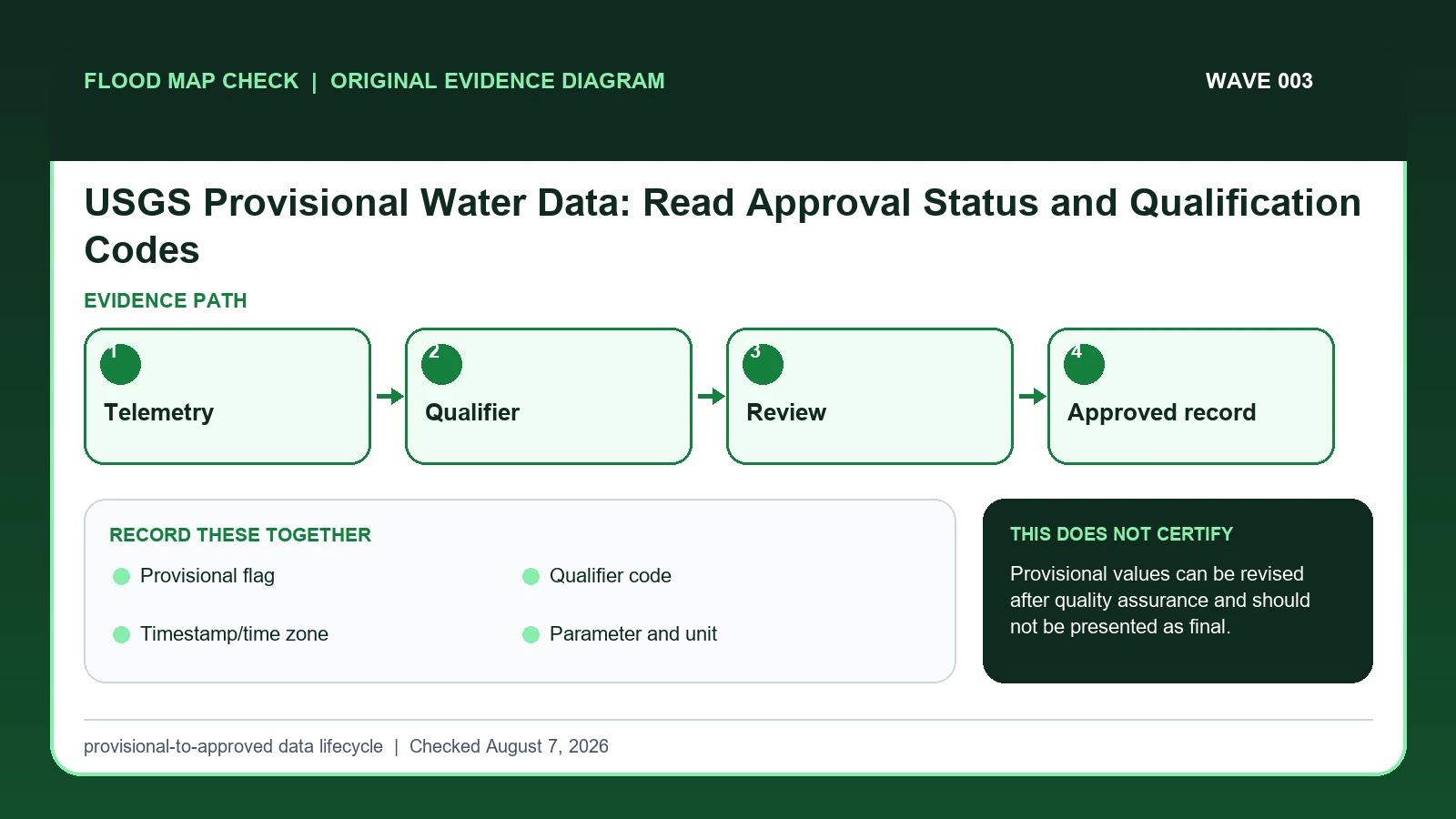
Treat every USGS provisional water value as a dated observation that can change after station, rating, datum, qualifier, and approval review. Preserve the station, parameter, timestamp, time zone, unit, qualifier, approval state, and retrieval date with the number. For stable historical analysis, return after review and record any difference between the operational snapshot and the approved series.
Last checked: August 7, 2026.
Telemetry can deliver a useful observation within minutes, but sensors drift, rating curves change, ice or debris affects readings, and field measurements can reveal an error. USGS reviews and may correct provisional data before approval. A qualifier is part of the value, not an optional footnote; removing it makes the number appear more certain than the official record.
A qualifier belongs to the number
USGS provisional data are released before final review so current conditions can be used quickly, but they remain subject to correction. A qualifier, approval state, or remark belongs to the value. Copying only the number removes the agency's statement about how settled the record is. The same observation may later be revised after rating analysis, datum checks, instrument review, or correction of an identified error.
A reproducible comparison stores the station, parameter, date and time zone, value, unit, qualifier, retrieval time, and the later approved value if one appears. If a provisional discharge of 8,200 cubic feet per second is later approved at 7,900, report the 300-cfs difference as a revision between two record states. Do not overwrite the original screenshot and then claim the earlier publication never existed.
Provisional does not mean useless, and approved does not mean error-free for every future purpose. Near-real-time emergency awareness often depends on provisional data, while engineering or historical frequency work may require reviewed records and station documentation. A missing value can reflect equipment or transmission trouble rather than zero flow. When a qualifier is unfamiliar, retrieve its definition for that service instead of guessing from a one-letter code used by another dataset.
USGS explains why current values can change
USGS provisional-data statement supplies why near-real-time records are subject to review, correction, and approval; this guide cites it for Provisional flag / Approval/revision. USGS Water Data for the Nation supplies monitoring-location metadata, instantaneous values, daily values, peaks, and qualification codes; this guide cites it for Provisional flag / Qualifier code / Timestamp/time zone / Parameter and unit / Approval/revision. USGS Water Data OGC API documentation supplies current peaks and monitoring-location collection definitions and query fields; this guide cites it for Qualifier code / Timestamp/time zone / Parameter and unit.
The USGS provisional water data crosswalk keeps these assignments explicit: USGS provisional-data statement → Provisional flag / Approval/revision; USGS Water Data for the Nation → Provisional flag / Qualifier code / Timestamp/time zone / Parameter and unit / Approval/revision; USGS Water Data OGC API documentation → Qualifier code / Timestamp/time zone / Parameter and unit. If Provisional flag or another named field is absent from its cited record, leave that fact unresolved and obtain it from the responsible official source instead of expanding a different citation beyond scope.
| Official record | What it actually supplies | Field used here |
|---|---|---|
| USGS provisional-data statement | why near-real-time records are subject to review, correction, and approval | Provisional flag / Approval/revision |
| USGS Water Data for the Nation | monitoring-location metadata, instantaneous values, daily values, peaks, and qualification codes | Provisional flag / Qualifier code / Timestamp/time zone / Parameter and unit / Approval/revision |
| USGS Water Data OGC API documentation | current peaks and monitoring-location collection definitions and query fields | Qualifier code / Timestamp/time zone / Parameter and unit |
For this check, the cited evidence is limited to Provisional flag, Qualifier code, and Parameter and unit plus the other fields named in the crosswalk. Record a changed or missing Qualifier code value with the retrieval date before taking the action to preserve data status and qualifiers in any downstream table, then request clarification from its publishing agency.
How Provisional flag connects to Approval/revision
| Field | Meaning in this check | Error it exposes | Response |
|---|---|---|---|
| Provisional flag | Value has not completed review | May change | Display the flag with the number |
| Qualifier code | Context such as estimated or affected condition | Limits use/comparison | Retain code and definition |
| Timestamp/time zone | When observation applies | Not retrieval time | Store both separately |
| Parameter and unit | What was measured or computed | Stage and flow are different | Keep code and unit |
| Approval/revision | Later reviewed value or record state | Can differ from live display | Refresh analytical datasets |
Read the table in two passes. First confirm Provisional flag, Qualifier code, and Timestamp/time zone. They answer “Value has not completed review”, “Context such as estimated or affected condition”, and “When observation applies”. Any disagreement among Provisional flag, Qualifier code, and Timestamp/time zone should remain visible rather than being blended into one result.
Next test for two different problems: “May change” and “Not retrieval time”. They require different corrections. For the first, follow “Display the flag with the number”; for the second, follow “Store both separately”.
Parameter and unit and Approval/revision show when to stop. The warning conditions are “Stage and flow are different” and “Can differ from live display”. The limits on Parameter and unit and Approval/revision keep the evidence useful without making the broader decision reserved for the named authority or professional.
Preserve provisional and approved record states
The order matters most around Timestamp/time zone. First, “Save retrieval date and URL so the operational snapshot can be reconstructed”. Next, “Read station-specific notes for ice, regulation, equipment, rating, or datum conditions”. Reversing those actions can attach a sound interpretation to the wrong date, place, product, or case for Timestamp/time zone.
- Confirm the station and parameter before copying any number from a chart.
- Record observation time, time zone, unit, provisional label, and all qualifiers.
- Save retrieval date and URL so the operational snapshot can be reconstructed.
- Read station-specific notes for ice, regulation, equipment, rating, or datum conditions.
- For a live decision, pair observations with official forecasts, warnings, and local directions.
- For analysis, revisit the period after USGS has reviewed and approved the data.
- Create a revision log when a published provisional value changes materially.
End with “Create a revision log when a published provisional value changes materially”. That preserves Approval/revision beside the source and date instead of leaving a detached number, color, category, or status that another reader could overinterpret.
A provisional value revised after station review
A peak displayed during a storm may later be adjusted after the gauge is inspected or the rating is revised. Keep the original retrieval for operational history, but re-download the approved series for analysis. If a report uses the provisional peak, say exactly when it was retrieved and never silently substitute a revised value without recording the change.
In this example, Provisional flag identifies the relevant record, while Timestamp/time zone is the fact most likely to change the interpretation. Conclude “Useful with warnings and caveats” only when the evidence shows “Current provisional observation”.
For USGS provisional water data, if the facts instead fit “Value later revised”, the result changes to “Official record evolved”. Respond by following “Preserve both and document revision”. Do not substitute the more favorable conclusion from the earlier example.
Current provisional, later approved, revised period, and data gap
| Observed state | Evidence test | Limited conclusion | Next response |
|---|---|---|---|
| Live safety awareness | Current provisional observation | Useful with warnings and caveats | Monitor official NWS/local messages |
| Historical publication | Approved values available | Stable record preferred | Use approved download |
| Qualified/estimated value | Special code accompanies value | Uncertainty is elevated | Explain or exclude by stated rule |
| Value later revised | Archived capture differs | Official record evolved | Preserve both and document revision |
Use “Current provisional observation” to recognize “Live safety awareness”. If the facts instead meet “Approved values available”, report “Stable record preferred” and follow “Use approved download”.
If the observation matches “Special code accompanies value”, stop at “Uncertainty is elevated”. If it matches “Archived capture differs”, stop at “Official record evolved”. The corresponding actions are “Explain or exclude by stated rule” and “Preserve both and document revision”.
Gaps, revisions, and unfamiliar service codes
- Avoid cropping away the provisional banner. Recheck Provisional flag. The mapped warning is “May change”; the corresponding response is “Display the flag with the number”.
- Avoid dropping qualifiers. Recheck Qualifier code. The mapped warning is “Limits use/comparison”; the corresponding response is “Retain code and definition”.
- Avoid mixing observation and retrieval times. Recheck Timestamp/time zone. The mapped warning is “Not retrieval time”; the corresponding response is “Store both separately”.
- Avoid using live telemetry as final historical evidence. Recheck Approval/revision. The mapped warning is “Can differ from live display”; the corresponding response is “Refresh analytical datasets”.
The remedy for “cropping away the provisional banner” is tied to Provisional flag: “Display the flag with the number”. The separate mistake “dropping qualifiers” is exposed by “Limits use/comparison”; answer it with “Retain code and definition”.
Check Timestamp/time zone when the risk is “mixing observation and retrieval times”, because the mapped warning is “Not retrieval time”. Check Approval/revision separately for “using live telemetry as final historical evidence” and use “Refresh analytical datasets” as the recovery step.
What this provisional-to-approved data lifecycle cannot decide
Scope: United States observed and forecast river conditions. Limitation: Provisional values can be revised after quality assurance and should not be presented as final.
This comparison can expose a conflict between Provisional flag and Timestamp/time zone, but it cannot resolve “Value later revised”. In that condition, the defensible next step remains “Preserve both and document revision”.
Connect the record state to separate peak and daily-series checks
- Carry the verified Provisional flag to River Flood Risk Check if that linked topic is the reader’s next question.
- Keep Timestamp/time zone attached to its source when moving to USGS Streamstats Flood Frequency Report.
- Treat USGS Flood Event Viewer High Water Marks as a separate review triggered by Approval/revision while working to preserve data status and qualifiers in any downstream table, not as confirmation of the result here.
Use this guide to preserve data status and qualifiers in any downstream table. The linked guides address separate questions raised by Provisional flag, Timestamp/time zone, or Approval/revision.
Before presenting a USGS value as final
Does Provisional flag settle the question by itself?
No. Provisional flag answers “Value has not completed review”, but it can fail when “May change”. Pair it with Qualifier code, Timestamp/time zone, and the checked date.
What if the evidence shows Value later revised?
Confirm the stated evidence test: “Archived capture differs”. The limited conclusion is “Official record evolved”. The documented response is “Preserve both and document revision”; a more favorable branch should not be substituted.
When should Approval/revision be checked again?
Capture the record again when USGS changes a value from provisional to approved, revises a qualifier, fills a gap, or republishes a corrected period. Preserve both retrieval times so the revision is visible rather than overwriting the value first used.
USGS Provisional Water Data: Read Approval Status and Qualification Codes is independent public-record guidance for the limited action to preserve data status and qualifiers in any downstream table. The cited government records retain authority over Provisional flag and Approval/revision. Last checked: August 7, 2026.