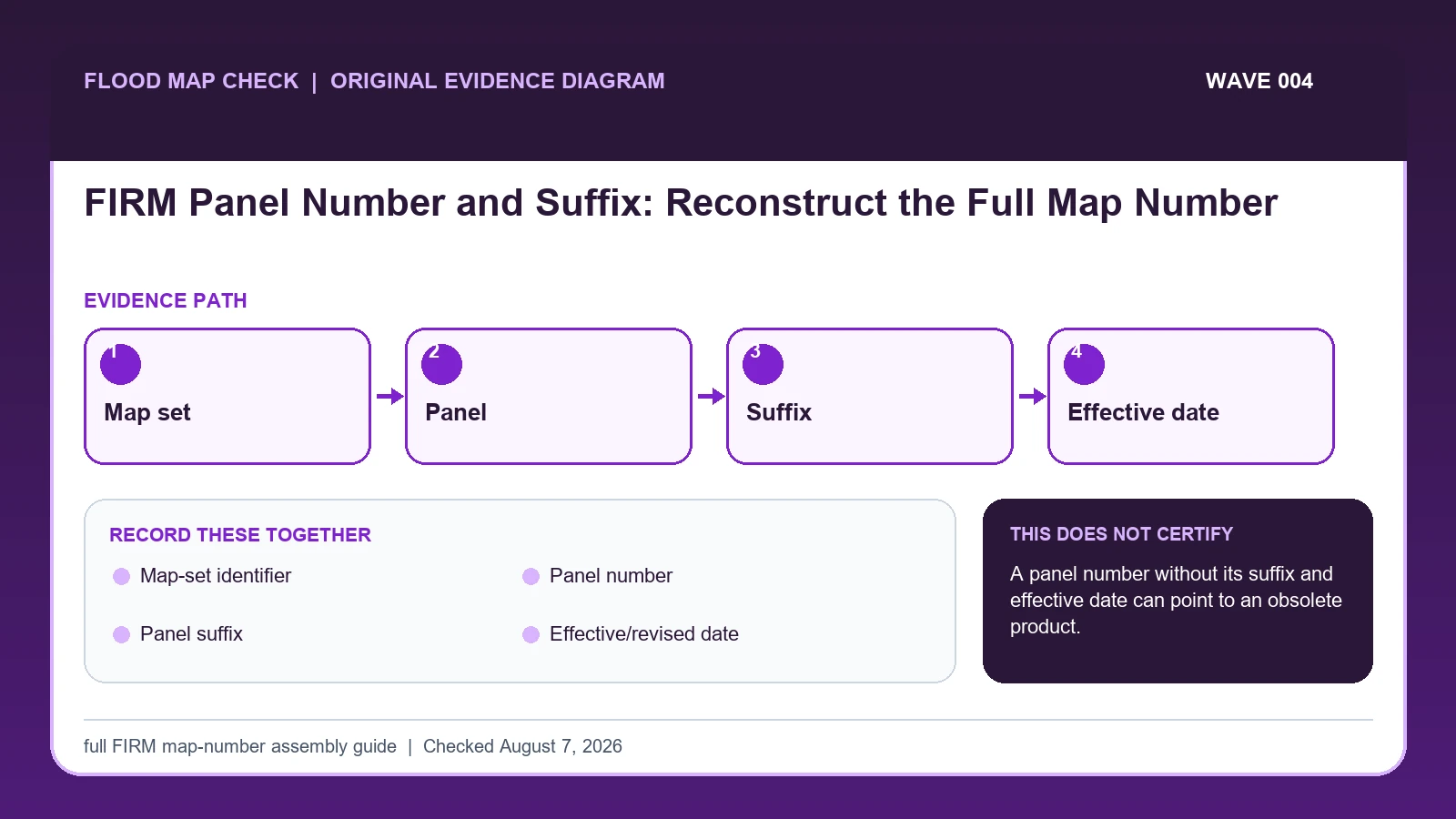
A complete FIRM panel reference combines the community or countywide map-set identifier, panel number, and current suffix, and it must be paired with the effective date. Reconstruct the value from the FIRM Index and panel title block rather than appending a guessed suffix to a partial number.
Last checked: August 7, 2026.
The suffix is not decoration. It distinguishes editions of a panel number as the map set is revised. Countywide map sets can display a five-digit countywide identifier followed by C, while community-format products use the community identifier convention. Because old reports often omit the suffix or copy only the panel digits, the title block, current MSC inventory, and index are required to identify the effective product.
Map set, four-digit panel, suffix, and date
FEMA's panel lesson describes the complete FIRM code as the six-digit CID or five-digit CWID plus C, followed by a four-digit panel number and a trailing revision suffix. In a countywide-style example such as 48029C0308D, 48029C identifies the map set, 0308 identifies the panel, and D is the revision suffix. The whole code and effective date identify the product; panel 0308 alone does not.
A historic elevation certificate may cite an earlier suffix. That does not make the certificate fraudulent or the old panel current. Save the reference exactly as signed, retrieve the corresponding historic product if needed, and add the present panel code and date in a separate field. The difference explains which map informed the original work and which map controls the current lookup.
Panel-not-printed notes and index seams require care. If the index shows a location inside a box without a separate panel product, read the footnote and current inventory rather than appending the latest neighboring suffix. A suffix is not inferred from alphabetical order, and the final letter does not state a flood zone. Once the product is identified, the parcel or building still has to be located on the correct map sheet.
FEMA's complete panel-code structure
FEMA MSC Search All Products lesson supplies the current effective map plus preliminary maps, historic FIRM panels, Flood Insurance Studies, Letters of Map Change, and other community products; this guide cites it for Map-set identifier / Panel number / Panel suffix / Effective/revised date / Printed status. FEMA flood-map technical references supplies current FIRM panel, database, domain-table, and Flood Insurance Study specifications; this guide cites it for Map-set identifier / Panel number / Panel suffix / Effective/revised date / Printed status. FEMA FIRM panel-number lesson supplies the complete panel-code structure: six-digit CID or five-digit CWID plus C, four-digit panel number, and trailing revision suffix; this guide cites it for Map-set identifier / Panel number / Panel suffix.
The FIRM panel number suffix crosswalk keeps these assignments explicit: FEMA MSC Search All Products lesson → Map-set identifier / Panel number / Panel suffix / Effective/revised date / Printed status; FEMA flood-map technical references → Map-set identifier / Panel number / Panel suffix / Effective/revised date / Printed status; FEMA FIRM panel-number lesson → Map-set identifier / Panel number / Panel suffix. If Map-set identifier or another named field is absent from its cited record, leave that fact unresolved and obtain it from the responsible official source instead of expanding a different citation beyond scope.
| Official record | What it actually supplies | Field used here |
|---|---|---|
| FEMA MSC Search All Products lesson | the current effective map plus preliminary maps, historic FIRM panels, Flood Insurance Studies, Letters of Map Change, and other community products | Map-set identifier / Panel number / Panel suffix / Effective/revised date / Printed status |
| FEMA flood-map technical references | current FIRM panel, database, domain-table, and Flood Insurance Study specifications | Map-set identifier / Panel number / Panel suffix / Effective/revised date / Printed status |
| FEMA FIRM panel-number lesson | the complete panel-code structure: six-digit CID or five-digit CWID plus C, four-digit panel number, and trailing revision suffix | Map-set identifier / Panel number / Panel suffix |
For this check, the cited evidence is limited to Map-set identifier, Panel suffix, and Printed status plus the other fields named in the crosswalk. Record a changed or missing Panel suffix value with the retrieval date before taking the action to reconstruct and verify the complete FIRM panel identifier, then request clarification from its publishing agency.
How Map-set identifier connects to Printed status
| Field | Meaning in this check | Error it exposes | Response |
|---|---|---|---|
| Map-set identifier | Community CID or countywide identifier | Formats differ | Copy from index/title block |
| Panel number | Grid panel within the map set | Partial number is ambiguous | Match index location |
| Panel suffix | Edition marker appended to panel reference | Old suffix can mean obsolete product | Use current inventory |
| Effective/revised date | Date the panel became controlling | Not the download date | Record exactly |
| Printed status | Whether a separate panel exists | No PDF may be intentional | Read index footnote |
Read the table in two passes. First confirm Map-set identifier, Panel number, and Panel suffix. They answer “Community CID or countywide identifier”, “Grid panel within the map set”, and “Edition marker appended to panel reference”. Any disagreement among Map-set identifier, Panel number, and Panel suffix should remain visible rather than being blended into one result.
Next test for two different problems: “Formats differ” and “Old suffix can mean obsolete product”. They require different corrections. For the first, follow “Copy from index/title block”; for the second, follow “Use current inventory”.
Effective/revised date and Printed status show when to stop. The warning conditions are “Not the download date” and “No PDF may be intentional”. The limits on Effective/revised date and Printed status keep the evidence useful without making the broader decision reserved for the named authority or professional.
Reconstruct the current code from Index and title block
Verify two checkpoints before interpreting Printed status: “Copy the map-set identifier, panel number, and printed-status note”, followed by “Open the panel product and transcribe the complete map number and suffix from the title block”. If the first checkpoint fails, stop before applying the second to a possibly wrong Map-set identifier subject or record.
- Identify the responsible NFIP community or countywide map set.
- Open its current FIRM Index and locate the parcel/building in the panel grid.
- Copy the map-set identifier, panel number, and printed-status note.
- Open the panel product and transcribe the complete map number and suffix from the title block.
- Record the effective or revised date separately from the file's download date.
- Compare any historic survey, certificate, or determination against the edition it cites.
- Keep historic and current references together when a change in suffix explains different results.
The file is ready for later review only after this final action: “Keep historic and current references together when a change in suffix explains different results”. Keep Map-set identifier, Panel suffix, and Printed status in that record so a future update shows exactly what changed.
Reconstructing 48029C0308D without guessing a letter
A survey note that says only 'panel 0045' cannot establish which map controlled. Locate the correct community or countywide set, find box 0045 in the current index, then copy the full map number, suffix, and effective date from the panel. If the survey predates the current suffix, preserve both references rather than silently updating the signed document. For an illustrative countywide-format label such as 12345C0678J, treat 12345C as the map-set component, 0678 as the panel component, and J as the edition suffix; the example is a parsing aid, not a real property lookup. Confirm every character against the title block. Then return to the index to inspect panel-boundary match lines, any 'panel not printed' notation, and the effective-date list. A blank product cell or an index footnote does not authorize inventing a PDF, carrying forward an older suffix, or substituting the neighboring panel. Preserve the exact note and ask the community floodplain office when the index and available product list appear inconsistent.
In this example, Map-set identifier identifies the relevant record, while Panel suffix is the fact most likely to change the interpretation. Conclude “Current product identified” only when the evidence shows “Index, panel, and MSC agree”.
For FIRM panel number suffix, if the facts instead fit “Panel not printed”, the result changes to “Cannot invent a suffix/product”. Respond by following “Use note and local official source”. Do not substitute the more favorable conclusion from the earlier example.
Current full code, missing suffix, historic edition, and no printed panel
| Observed state | Evidence test | Limited conclusion | Next response |
|---|---|---|---|
| Full number and date match | Index, panel, and MSC agree | Current product identified | Use for zone reading |
| Suffix missing | Only map-set and panel digits appear | Edition unresolved | Retrieve title block/current inventory |
| Older suffix | Historic product referenced | May explain earlier determination | Preserve history and add current map |
| Panel not printed | Index note applies | Cannot invent a suffix/product | Use note and local official source |
Use “Index, panel, and MSC agree” to recognize “Full number and date match”. If the facts instead meet “Only map-set and panel digits appear”, report “Edition unresolved” and follow “Retrieve title block/current inventory”.
If the observation matches “Historic product referenced”, stop at “May explain earlier determination”. If it matches “Index note applies”, stop at “Cannot invent a suffix/product”. The corresponding actions are “Preserve history and add current map” and “Use note and local official source”.
Historic suffixes and panels that are not printed
- Avoid guessing the suffix. Recheck Panel suffix. The mapped warning is “Old suffix can mean obsolete product”; the corresponding response is “Use current inventory”.
- Avoid dropping leading zeros. Recheck Panel number. The mapped warning is “Partial number is ambiguous”; the corresponding response is “Match index location”.
- Avoid mixing community and countywide formats. Recheck Map-set identifier. The mapped warning is “Formats differ”; the corresponding response is “Copy from index/title block”.
- Avoid using a download date as effective date. Recheck Effective/revised date. The mapped warning is “Not the download date”; the corresponding response is “Record exactly”.
“guessing the suffix” can trigger Old suffix can mean obsolete product; correct the mapped Panel suffix field or fields by following “Use current inventory”. “dropping leading zeros” affects Panel number, so use “Match index location” before relying on the result.
The remedy for “mixing community and countywide formats” is tied to Map-set identifier: “Copy from index/title block”. The separate mistake “using a download date as effective date” is exposed by “Not the download date”; answer it with “Record exactly”.
What this full FIRM map-number assembly guide cannot decide
Scope: United States effective FEMA flood map products. Limitation: A panel number without its suffix and effective date can point to an obsolete product.
This comparison can expose a conflict between Map-set identifier and Panel suffix, but it cannot resolve “Panel not printed”. In that condition, the defensible next step remains “Use note and local official source”.
Use the completed code in a separate zone lookup
- Carry the verified Map-set identifier to FEMA Flood Map Check By Address if that linked topic is the reader’s next question.
- Keep Panel suffix attached to its source when moving to Flood Risk Map By Address.
- Treat FEMA FIRM Panel Guide as a separate review triggered by Printed status while working to reconstruct and verify the complete FIRM panel identifier, not as confirmation of the result here.
Use this guide to reconstruct and verify the complete FIRM panel identifier. The linked guides address separate questions raised by Map-set identifier, Panel suffix, or Printed status.
Before copying a FIRM panel reference
Does Map-set identifier settle the question by itself?
No. Map-set identifier answers “Community CID or countywide identifier”, but it can fail when “Formats differ”. Pair it with Panel number, Panel suffix, and the checked date.
What if the evidence shows Panel not printed?
Confirm the stated evidence test: “Index note applies”. The limited conclusion is “Cannot invent a suffix/product”. The documented response is “Use note and local official source”; a more favorable branch should not be substituted.
When should Printed status be checked again?
Reconstruct the full panel code whenever FEMA posts a new suffix, revised effective date, replacement Index, or changed printed-panel status. Retain the historic code cited by an older document rather than editing it to look current.
FIRM Panel Number and Suffix: Reconstruct the Full Map Number is independent public-record guidance for the limited action to reconstruct and verify the complete FIRM panel identifier. The cited government records retain authority over Map-set identifier and Printed status. Last checked: August 7, 2026.