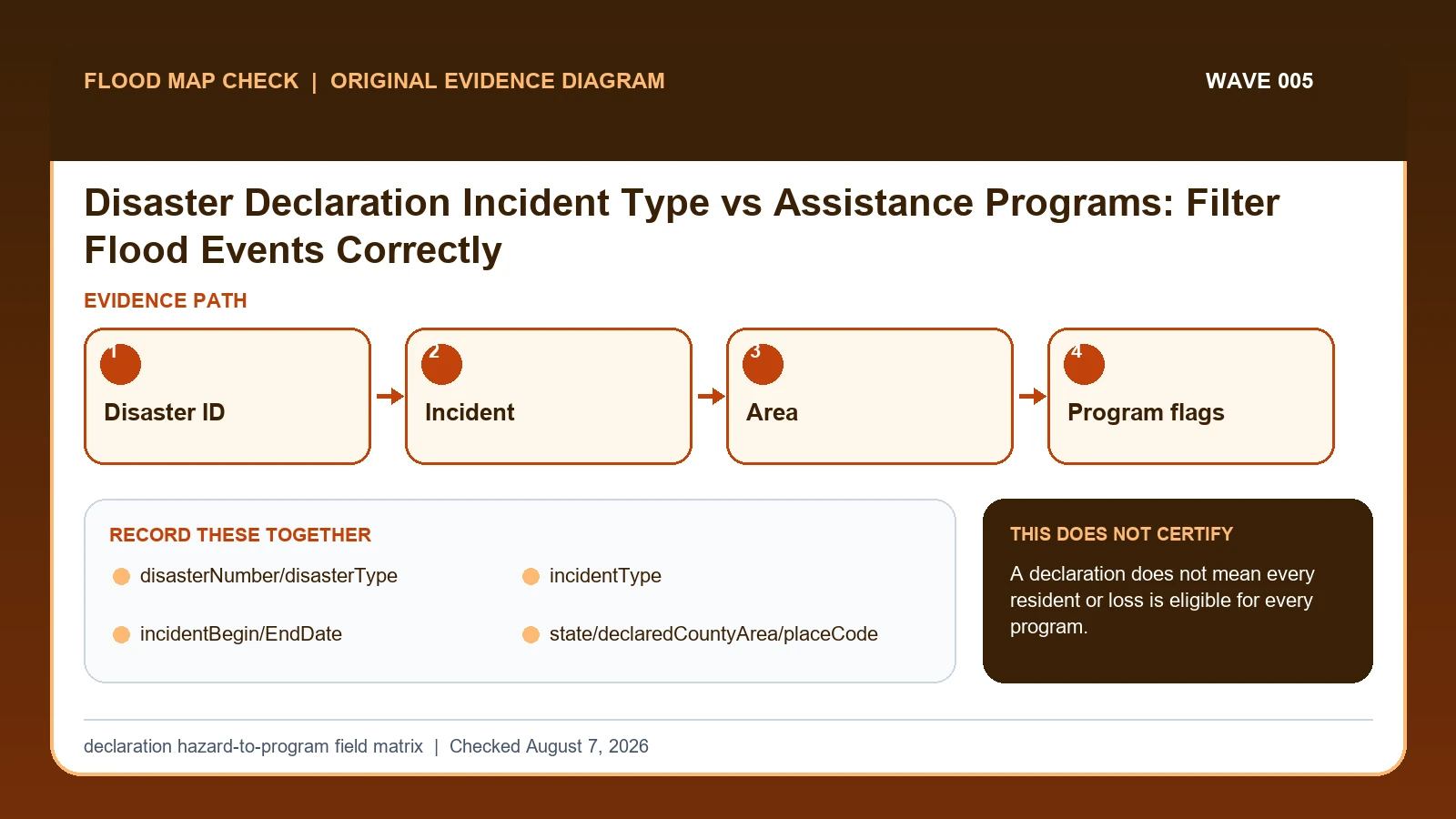
In OpenFEMA disaster data, incident type describes the hazard recorded for a declaration, while program flags show which assistance programs were declared for a particular area and record. Filter by disaster number, state, designated area, declaration type, incident dates, and current program flags; a flood label does not make every resident or loss eligible for every program.
Last checked: August 7, 2026.
Disaster Declarations Summaries includes major disaster, emergency, fire-management and other declaration records, along with incident type, incident period, geography, and flags for Individual Assistance, Public Assistance, and Hazard Mitigation. Amendments can add areas or programs after the initial declaration. Historical geography and reporting completeness vary, and the dataset is not FEMA's official financial system.
Incident type is not an eligibility flag
In Disaster Declarations Summaries, incidentType describes the recorded hazard; it does not state that every program or every applicant is eligible. Program flags such as Individual Assistance, Public Assistance, and Hazard Mitigation belong to a declaration-area record. Disaster number, declaration type, state, designated area, place code, incident period, and refresh or amendment information define the row before the flags can be interpreted.
A county analysis should retain every relevant row for a disaster number until geographic and program differences are understood. If the state-level title says Flood but the target county has no matching designated-area row, the geographic test is incomplete. If the county row has Public Assistance true and Individual Assistance false, report those separate program contexts; do not collapse them into assistance available or no assistance.
Declarations can expand through amendments, so an extract made on the first declaration date may become stale. Preserve retrieval time and compare the public disaster page and later amendments. A true program flag indicates declaration authority for that area and record, not approval of a household, business, or project. Eligibility still depends on current program rules, application facts, deadlines, and agency decisions outside this dataset.
The declaration dataset separates hazard, area, and program
OpenFEMA Disaster Declarations Summaries v2 supplies disaster number, incident type and dates, designated area, and program-declaration fields; this guide cites it for disasterNumber/disasterType / incidentType / incidentBegin/EndDate / state/declaredCountyArea/placeCode / ia/ih/pa/hm flags / lastRefresh/amendments. FEMA Disasters and Other Declarations supplies public declaration pages, incident periods, areas, assistance designations, and amendments; this guide cites it for disasterNumber/disasterType / incidentType / incidentBegin/EndDate / state/declaredCountyArea/placeCode / ia/ih/pa/hm flags / lastRefresh/amendments. OpenFEMA supplies the self-service public-data program, machine-readable access, updates, and support boundaries; this guide cites it for lastRefresh/amendments.
The FEMA disaster declaration flood data crosswalk keeps these assignments explicit: OpenFEMA Disaster Declarations Summaries v2 → disasterNumber/disasterType / incidentType / incidentBegin/EndDate / state/declaredCountyArea/placeCode / ia/ih/pa/hm flags / lastRefresh/amendments; FEMA Disasters and Other Declarations → disasterNumber/disasterType / incidentType / incidentBegin/EndDate / state/declaredCountyArea/placeCode / ia/ih/pa/hm flags / lastRefresh/amendments; OpenFEMA → lastRefresh/amendments. If disasterNumber/disasterType or another named field is absent from its cited record, leave that fact unresolved and obtain it from the responsible official source instead of expanding a different citation beyond scope.
| Official record | What it actually supplies | Field used here |
|---|---|---|
| OpenFEMA Disaster Declarations Summaries v2 | disaster number, incident type and dates, designated area, and program-declaration fields | disasterNumber/disasterType / incidentType / incidentBegin/EndDate / state/declaredCountyArea/placeCode / ia/ih/pa/hm flags / lastRefresh/amendments |
| FEMA Disasters and Other Declarations | public declaration pages, incident periods, areas, assistance designations, and amendments | disasterNumber/disasterType / incidentType / incidentBegin/EndDate / state/declaredCountyArea/placeCode / ia/ih/pa/hm flags / lastRefresh/amendments |
| OpenFEMA | the self-service public-data program, machine-readable access, updates, and support boundaries | lastRefresh/amendments |
The source boundary follows the mapped fields: disasterNumber/disasterType establishes one part of the record, state/declaredCountyArea/placeCode affects interpretation, and lastRefresh/amendments limits the conclusion. Document any missing fact instead of inferring a replacement value while working to separate the hazard label from authorized assistance programs.
The general OpenFEMA page explains API access and refresh mechanics; the declaration dataset and amendment pages control incident, area, and program fields.
How disasterNumber/disasterType connects to lastRefresh/amendments
| Field | Meaning in this check | Error it exposes | Response |
|---|---|---|---|
| disasterNumber/disasterType | Identity and DR/EM/FM class | Type affects authority/context | Keep together |
| incidentType | Recorded hazard such as flood | Not program eligibility | Use as hazard filter |
| incidentBegin/EndDate | Event period | Different from declaration date | Store separately |
| state/declaredCountyArea/placeCode | Designated geography | Coverage varies by row | Match exact area |
| ia/ih/pa/hm flags | Programs declared in record | Not household/project approval | Interpret as authorization context |
| lastRefresh/amendments | Current data state | Initial declaration can expand | Recheck before use |
A sound FEMA disaster declaration flood data check pairs disasterNumber/disasterType with incidentBegin/EndDate. The first answers “Identity and DR/EM/FM class”; the second answers “Event period”. The pair is incomplete if the evidence shows “Different from declaration date”, even when the first identifier looks credible.
incidentType is not background metadata. It answers “Recorded hazard such as flood”. If the contrary condition is “Not program eligibility”, correct it by following “Use as hazard filter”. That correction can change which official record belongs in the check.
The last comparison joins ia/ih/pa/hm flags to lastRefresh/amendments. They answer separate questions: “Programs declared in record” and “Current data state”. Keeping both in the FEMA disaster declaration flood data record prevents an observation from being mistaken for an agency, community, insurer, lender, or professional determination.
Retain area rows until amendments and programs are reconciled
The order matters most around incidentBegin/EndDate. First, “Match disaster number, declaration type, incident type, incident period, and designated-area row”. Next, “Read IA, IH, PA, and HM flags separately rather than creating one assistance field”. Reversing those actions can attach a sound interpretation to the wrong date, place, product, or case for incidentBegin/EndDate.
- Define the hazard, declaration types, state, area, and date window for the analysis.
- Query the current OpenFEMA dataset and preserve filters, version, and retrieval time.
- Match disaster number, declaration type, incident type, incident period, and designated-area row.
- Read IA, IH, PA, and HM flags separately rather than creating one assistance field.
- Open the public disaster page and amendments to confirm current area/program information.
- Deduplicate or aggregate only after deciding the correct row grain.
- State that declaration and program flags do not determine individual or project eligibility.
End with “State that declaration and program flags do not determine individual or project eligibility”. That preserves lastRefresh/amendments beside the source and date instead of leaving a detached number, color, category, or status that another reader could overinterpret.
A Flood declaration row with different program flags
To identify federally declared flood events in one county, filter incident type and state, then match declaredCountyArea and placeCode. Keep all rows for a disaster number long enough to see program differences by area and refresh date. Do not select the state-level title alone and mark every county eligible.
In this example, disasterNumber/disasterType identifies the relevant record, while incidentBegin/EndDate is the fact most likely to change the interpretation. Conclude “Declared-event evidence” only when the evidence shows “Hazard and geography match”.
For FEMA disaster declaration flood data, if the facts instead fit “Later amendment”, the result changes to “Earlier extract stale”. Respond by following “Update evidence and preserve history”. Do not substitute the more favorable conclusion from the earlier example.
Matching area, true program flag, state-only title, and later amendment
| Observed state | Evidence test | Limited conclusion | Next response |
|---|---|---|---|
| Flood incident + area row | Hazard and geography match | Declared-event evidence | Then inspect program flags |
| Program flag true | Program declared for row | Not applicant eligibility | Use official application/program rules |
| State title only | County/area not matched | Geographic evidence incomplete | Find designated-area row |
| Later amendment | Area/program changed | Earlier extract stale | Update evidence and preserve history |
“Flood incident + area row” and “Program flag true” are not better and worse versions of one answer. The former supports “Declared-event evidence”; the latter supports “Not applicant eligibility”. Preserve the different evidence tests before taking either listed response.
The two unresolved branches also differ. “State title only” supports only “Geographic evidence incomplete”, whereas “Later amendment” supports only “Earlier extract stale”. Apply the response shown for the matching branch.
State titles, later amendments, and applicant-level overclaim
- Avoid calling incident type eligibility. Recheck incidentType. The mapped warning is “Not program eligibility”; the corresponding response is “Use as hazard filter”.
- Avoid ignoring area rows. Recheck state/declaredCountyArea/placeCode. The mapped warning is “Coverage varies by row”; the corresponding response is “Match exact area”.
- Avoid mixing incident and declaration dates. Recheck incidentBegin/EndDate. The mapped warning is “Different from declaration date”; the corresponding response is “Store separately”.
- Avoid using initial flags after amendments. Recheck lastRefresh/amendments. The mapped warning is “Initial declaration can expand”; the corresponding response is “Recheck before use”.
Two field-specific corrections are required. For “calling incident type eligibility”, follow “Use as hazard filter”. For “ignoring area rows”, follow “Match exact area”. Keeping incidentType separate from state/declaredCountyArea/placeCode prevents one repaired field from hiding the other error.
“mixing incident and declaration dates” can trigger Different from declaration date; correct the mapped incidentBegin/EndDate field or fields by following “Store separately”. “using initial flags after amendments” affects lastRefresh/amendments, so use “Recheck before use” before relying on the result.
What this declaration hazard-to-program field matrix cannot decide
Scope: United States public historical flood datasets. Limitation: A declaration does not mean every resident or loss is eligible for every program.
Use the declaration hazard-to-program field matrix as a reading aid for disasterNumber/disasterType and lastRefresh/amendments. The official source, community, insurer, surveyor, or emergency authority still controls the outcome, especially when the evidence shows “Area/program changed”.
Move from declaration context to actual program rules
- OpenFEMA NFIP Claims Data By County extends the work built from disasterNumber/disasterType; it does not replace this check.
- OpenFEMA Disaster Declarations Flood Filter is the next reference when the unresolved fact is incidentBegin/EndDate.
- USGS Flood Event Viewer High Water Marks addresses the separate decision that may follow from lastRefresh/amendments.
Use this guide to separate the hazard label from authorized assistance programs. The linked guides address separate questions raised by disasterNumber/disasterType, incidentBegin/EndDate, or lastRefresh/amendments.
Before describing assistance for a declared area
Does disasterNumber/disasterType settle the question by itself?
No. disasterNumber/disasterType answers “Identity and DR/EM/FM class”, but it can fail when “Type affects authority/context”. Pair it with incidentType, incidentBegin/EndDate, and the checked date.
What if the evidence shows Later amendment?
Confirm the stated evidence test: “Area/program changed”. The limited conclusion is “Earlier extract stale”. The documented response is “Update evidence and preserve history”; a more favorable branch should not be substituted.
When should lastRefresh/amendments be checked again?
Rerun the declaration-area filter after every amendment, designated-area change, program-flag update, or dataset refresh. Preserve the earlier row so the date on which Individual Assistance, Public Assistance, or Hazard Mitigation appeared for the area remains auditable.
Disaster Declaration Incident Type vs Assistance Programs: Filter Flood Events Correctly is independent public-record guidance for the limited action to separate the hazard label from authorized assistance programs. The cited government records retain authority over disasterNumber/disasterType and lastRefresh/amendments. Last checked: August 7, 2026.