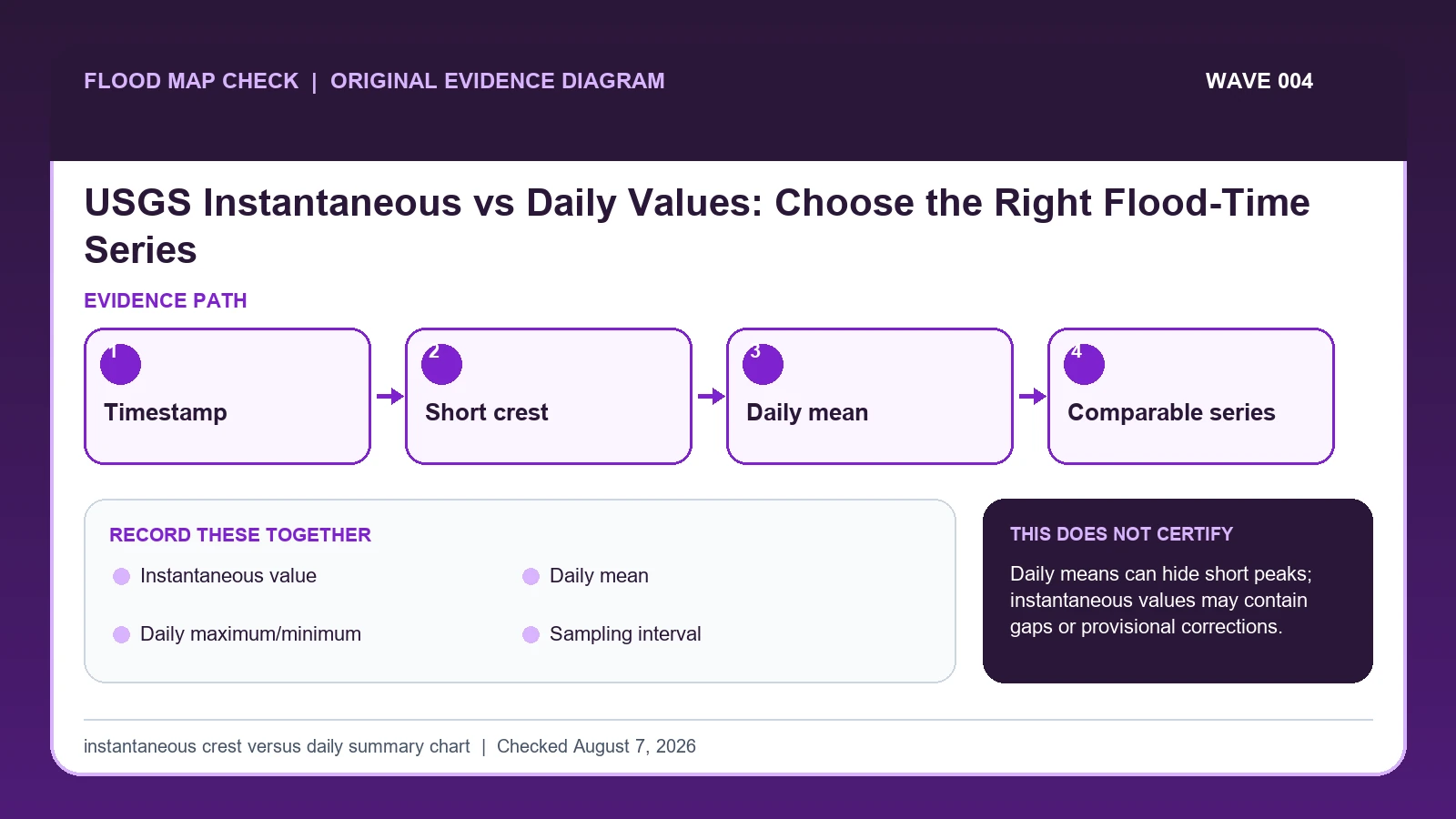
USGS instantaneous streamflow represents a reading or computed value at a specific time, while a daily value summarizes an entire day using a statistic such as daily mean. Use instantaneous data for timing and short peaks; use daily values for longer comparisons, and never label a daily mean as the day's peak.
Last checked: August 7, 2026.
A fast flood crest can pass between daily summaries and can even challenge a 15-minute sampling interval. Daily mean flow smooths those fluctuations and supports consistent long-term records, but it answers a different question from maximum instantaneous flow. Time zone, day-boundary convention, qualifiers, and provisional versus approved state matter when joining the products.
A short crest can disappear inside a daily mean
Instantaneous streamflow represents a value at a particular time or short interval; daily streamflow summarizes a day, commonly as a mean. The two can differ sharply during a fast flood. A crest of 20,000 cubic feet per second lasting two hours can coexist with a daily mean far below 20,000 because the rest of the day carried less flow. Neither number is wrong when its time basis is labeled.
For a simplified day with six hours at 16,000 cfs and eighteen hours at 4,000 cfs, a time-weighted daily mean is (6 times 16,000 plus 18 times 4,000) divided by 24, or 7,000 cfs. The instantaneous maximum remains 16,000 cfs. Use the maximum for questions about the short crest and the daily series for questions requiring daily aggregation; never present the daily mean as the event peak.
Time zone, missing intervals, provisional corrections, and unit changes can alter a comparison. The daily value may be computed from more detailed observations using agency procedures, not from one reading selected at noon. If the instantaneous series has a gap near the suspected crest, the maximum is unresolved. Preserve parameter codes and approval status, and do not combine streamflow with stage or elevation unless the station's documented relation supports it.
USGS publishes values with different time bases
USGS Water Data for the Nation supplies monitoring-location metadata, instantaneous values, daily values, peaks, and qualification codes; this guide cites it for Instantaneous value / Daily mean / Daily maximum/minimum / Sampling interval / Approval state. USGS provisional-data statement supplies why near-real-time records are subject to review, correction, and approval; this guide cites it for Approval state. USGS water-data collection categories supplies the distinction between high-frequency continuous or instantaneous observations and one-value-per-day daily data; this guide cites it for Instantaneous value / Daily mean / Daily maximum/minimum / Sampling interval.
The USGS instantaneous vs daily streamflow crosswalk keeps these assignments explicit: USGS Water Data for the Nation → Instantaneous value / Daily mean / Daily maximum/minimum / Sampling interval / Approval state; USGS provisional-data statement → Approval state; USGS water-data collection categories → Instantaneous value / Daily mean / Daily maximum/minimum / Sampling interval. If Instantaneous value or another named field is absent from its cited record, leave that fact unresolved and obtain it from the responsible official source instead of expanding a different citation beyond scope.
| Official record | What it actually supplies | Field used here |
|---|---|---|
| USGS Water Data for the Nation | monitoring-location metadata, instantaneous values, daily values, peaks, and qualification codes | Instantaneous value / Daily mean / Daily maximum/minimum / Sampling interval / Approval state |
| USGS provisional-data statement | why near-real-time records are subject to review, correction, and approval | Approval state |
| USGS water-data collection categories | the distinction between high-frequency continuous or instantaneous observations and one-value-per-day daily data | Instantaneous value / Daily mean / Daily maximum/minimum / Sampling interval |
For this check, the cited evidence is limited to Instantaneous value, Daily maximum/minimum, and Approval state plus the other fields named in the crosswalk. Record a changed or missing Daily maximum/minimum value with the retrieval date before taking the action to choose observations that preserve or intentionally smooth the flood peak, then request clarification from its publishing agency.
How Instantaneous value connects to Approval state
| Field | Meaning in this check | Error it exposes | Response |
|---|---|---|---|
| Instantaneous value | Value at timestamp/sampling interval | Can show short peaks | Keep time zone and qualifiers |
| Daily mean | Average across a day | Not daily maximum | Use for mean-flow comparisons |
| Daily maximum/minimum | Daily extreme statistic where provided | Still a daily product definition | Name statistic exactly |
| Sampling interval | Spacing of observations | May miss very rapid peak | Read station/method notes |
| Approval state | Provisional or approved | Live and archive can differ | Refresh historical analysis |
Read the table in two passes. First confirm Instantaneous value, Daily mean, and Daily maximum/minimum. They answer “Value at timestamp/sampling interval”, “Average across a day”, and “Daily extreme statistic where provided”. Any disagreement among Instantaneous value, Daily mean, and Daily maximum/minimum should remain visible rather than being blended into one result.
Next test for two different problems: “Can show short peaks” and “Still a daily product definition”. They require different corrections. For the first, follow “Keep time zone and qualifiers”; for the second, follow “Name statistic exactly”.
Sampling interval and Approval state show when to stop. The warning conditions are “May miss very rapid peak” and “Live and archive can differ”. The limits on Sampling interval and Approval state keep the evidence useful without making the broader decision reserved for the named authority or professional.
Match parameter, interval, time zone, and approval state
Treat “Choose instantaneous, daily, or peaks collection based on the question” as a prerequisite for “Preserve the daily statistic name and do not infer it from the column heading alone”. Together they determine whether Daily maximum/minimum belongs to the same subject, period, and official product as Instantaneous value.
- State whether the question concerns crest timing, daily conditions, seasonal averages, or annual extremes.
- Confirm station, parameter code, unit, time zone, and record period.
- Choose instantaneous, daily, or peaks collection based on the question.
- Preserve the daily statistic name and do not infer it from the column heading alone.
- Inspect gaps, sampling changes, provisional flags, and station-specific notes.
- Align time zones and day boundaries before joining series.
- Describe every chart axis and statistic so readers cannot confuse mean, maximum, and instantaneous values.
Do not close the file at the first plausible result. Carry out “Describe every chart axis and statistic so readers cannot confuse mean, maximum, and instantaneous values”, then preserve the version of Approval state that was current on the checked date.
A two-hour crest hidden inside a daily mean
A stream may reach 20,000 cubic feet per second for one hour and have a much lower daily mean. A chart using only daily values will not reproduce the crest. Conversely, comparing one instantaneous spike with a century of daily means exaggerates its rank. Select the time product that matches the research question before downloading data.
In this example, Instantaneous value identifies the relevant record, while Daily maximum/minimum is the fact most likely to change the interpretation. Conclude “Instantaneous series fits” only when the evidence shows “Need hour/minute of rise and fall”.
For USGS instantaneous vs daily streamflow, if the facts instead fit “Mixed dataset”, the result changes to “Ranks are invalid”. Respond by following “Split and label measures”. Do not substitute the more favorable conclusion from the earlier example.
Comparable series, short crest, missing interval, and wrong parameter
| Observed state | Evidence test | Limited conclusion | Next response |
|---|---|---|---|
| Crest timing | Need hour/minute of rise and fall | Instantaneous series fits | Check interval and gaps |
| Seasonal flow comparison | Need consistent day/month statistics | Daily values fit | Use same statistic across years |
| Annual peak | Need maximum instantaneous flow | Peaks collection is preferred | Retain peak qualifiers |
| Mixed dataset | Instantaneous and daily rows combined | Ranks are invalid | Split and label measures |
Use “Need hour/minute of rise and fall” to recognize “Crest timing”. If the facts instead meet “Need consistent day/month statistics”, report “Daily values fit” and follow “Use same statistic across years”.
If the observation matches “Need maximum instantaneous flow”, stop at “Peaks collection is preferred”. If it matches “Instantaneous and daily rows combined”, stop at “Ranks are invalid”. The corresponding actions are “Retain peak qualifiers” and “Split and label measures”.
Missing crest intervals and misleading daily comparisons
- Avoid calling daily mean a peak. Recheck Daily mean / Daily maximum/minimum. The mapped warning is “Not daily maximum; Still a daily product definition”; the corresponding response is “Use for mean-flow comparisons; Name statistic exactly”.
- Avoid ranking an instantaneous spike with daily values. Recheck Instantaneous value / Daily mean. The mapped warning is “Can show short peaks; Not daily maximum”; the corresponding response is “Keep time zone and qualifiers; Use for mean-flow comparisons”.
- Avoid dropping time zone. Recheck Instantaneous value / Sampling interval. The mapped warning is “Can show short peaks; May miss very rapid peak”; the corresponding response is “Keep time zone and qualifiers; Read station/method notes”.
- Avoid ignoring sampling gaps. Recheck Sampling interval. The mapped warning is “May miss very rapid peak”; the corresponding response is “Read station/method notes”.
Two field-specific corrections are required. For “calling daily mean a peak”, follow “Use for mean-flow comparisons; Name statistic exactly”. For “ranking an instantaneous spike with daily values”, follow “Keep time zone and qualifiers; Use for mean-flow comparisons”. Keeping Daily mean / Daily maximum/minimum separate from Instantaneous value / Daily mean prevents one repaired field from hiding the other error.
“dropping time zone” can trigger Can show short peaks; May miss very rapid peak; correct the mapped Instantaneous value / Sampling interval field or fields by following “Keep time zone and qualifiers; Read station/method notes”. “ignoring sampling gaps” affects Sampling interval, so use “Read station/method notes” before relying on the result.
What this instantaneous crest versus daily summary chart cannot decide
Scope: United States observed and forecast river conditions. Limitation: Daily means can hide short peaks; instantaneous values may contain gaps or provisional corrections.
This comparison can expose a conflict between Instantaneous value and Daily maximum/minimum, but it cannot resolve “Mixed dataset”. In that condition, the defensible next step remains “Split and label measures”.
Continue to peak-file or provisional-status research
- Carry the verified Instantaneous value to River Flood Risk Check if that linked topic is the reader’s next question.
- Keep Daily maximum/minimum attached to its source when moving to USGS Streamstats Flood Frequency Report.
- Treat USGS Flood Event Viewer High Water Marks as a separate review triggered by Approval state while working to choose observations that preserve or intentionally smooth the flood peak, not as confirmation of the result here.
Use this guide to choose observations that preserve or intentionally smooth the flood peak. The linked guides address separate questions raised by Instantaneous value, Daily maximum/minimum, or Approval state.
Before calling a daily mean the flood peak
Does Instantaneous value settle the question by itself?
No. Instantaneous value answers “Value at timestamp/sampling interval”, but it can fail when “Can show short peaks”. Pair it with Daily mean, Daily maximum/minimum, and the checked date.
What if the evidence shows Mixed dataset?
Confirm the stated evidence test: “Instantaneous and daily rows combined”. The limited conclusion is “Ranks are invalid”. The documented response is “Split and label measures”; a more favorable branch should not be substituted.
When should Approval state be checked again?
Recheck after USGS fills a missing crest interval, revises provisional values, changes the parameter or time-zone metadata, or approves the series. A later daily mean cannot retroactively stand in for a short instantaneous crest that was never observed.
USGS Instantaneous vs Daily Values: Choose the Right Flood-Time Series is independent public-record guidance for the limited action to choose observations that preserve or intentionally smooth the flood peak. The cited government records retain authority over Instantaneous value and Approval state. Last checked: August 7, 2026.